In Paper 2, Section B of your AQA GCSE English Literature exam, you will face the Power and Conflict poetry comparison question. The exam will provide you with one printed poem from the anthology cluster and ask you to compare how a specific theme or concept (such as the reality of war, the power of nature, or individual identity) is presented in that poem and one other poem of your choice from the cluster.
This guide will show you how to construct a sophisticated, balanced, and deeply analytical comparative essay that satisfies all assessment objectives.
What you'll learn
- How to draft a single, cohesive comparative thesis statement that unites both poems.
- The difference between low-scoring sequential writing and high-scoring integrated analysis.
- How to structure your body paragraphs to balance language analysis (AO2) and contextual comparison (AO3).
- Step-by-step drafting techniques using Ozymandias and My Last Duchess.
Core Principles of Poetry Comparison
To score highly in this section, you must understand exactly how your essay is assessed. You are not writing two separate mini-essays; you are writing a single, unified argument that contrasts and connects two distinct literary voices.
Comparative Thesis
A comparative thesis is a central argument, expressed in your introduction, that directly answers the exam prompt by identifying a shared thematic focus between both poems while highlighting a key difference in the poets' methods, attitudes, or contexts.
You need to address three key Assessment Objectives (AOs) in a balanced way:
- AO1 (Response and References): Constructing a logical, cohesive argument and supporting it with precise, memorable quotations from both poems.
- AO2 (Writer's Craft): Analyzing how language, form, and structural choices create meaning and affect the reader.
- AO3 (Context): Explaining how historical, biographical, or cultural factors shaped the poets' perspectives and the reception of their work.
The Golden Rule of Comparison
Never analyze a literary device (like a metaphor or a caesura) in isolation. Always connect the device directly to the writer's underlying message about power or conflict, and compare how that message differs from or aligns with the second poem.
Structuring Your Comparison: The "Bridge" Method
Many students write about the first poem for three paragraphs, and then write about the second poem for another three paragraphs. This is called the block method, and it severely limits your ability to hit the highest marks because it delays direct comparison until the very end of the essay.
Instead, you should use the integrated method (or the "Bridge" method). In this structure, each body paragraph acts as a bridge connecting both poems under a single, shared sub-theme.
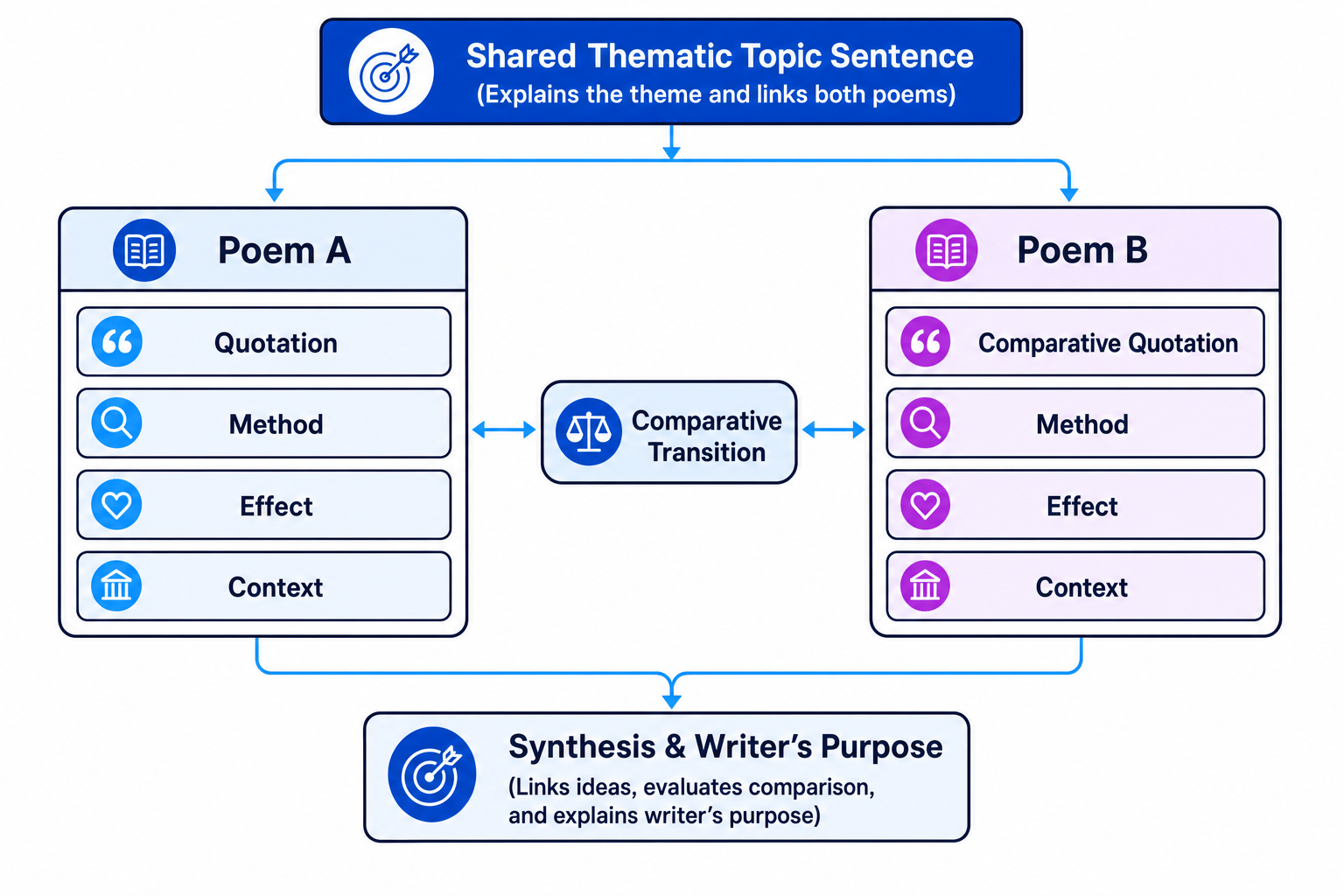
This structure ensures that you are constantly comparing throughout your essay, rather than keeping the poems isolated.
The 'Divide and Conquer' Mistake
Do not divide your essay down the middle. If you write an entire page on Poem A followed by an entire page on Poem B, your essay will feel like two disconnected pieces. Use comparative transition words (such as conversely, similarly, whereas, or in a similar vein) at the start of sentences to force yourself to compare them constantly.
Designing an Integrated Paragraph
An effective comparative paragraph should follow a logical sequence that seamlessly weaves together evidence, analysis, and context for both poems.
1. The Shared Topic Sentence
Begin with a conceptual statement that introduces a shared idea about power or conflict. Do not mention specific literary devices or quotes yet. Focus entirely on the human experience or thematic concept.
- Example: "Both Shelley and Browning demonstrate how absolute power breeds an arrogant, destructive pride that ultimately isolates the ruler."
2. Analysis of Poem A
Introduce your first quotation, identify the writer's method (language, form, or structure), analyze its deep implications, and link it to the historical context (AO3).
- Example: In Ozymandias, the "shattered visage" and "sneer of cold command" utilize harsh, sibilant sounds to emphasize the cold, unforgiving nature of the king's tyranny, reflecting Romantic skepticism toward self-proclaimed monarchs.
3. The Comparative Pivot
Use a transition word to bridge to your second poem, highlighting either a similarity or a sharp difference in how the second poet approaches the same concept.
- Example: "While Ozymandias's power is eroded by time, Browning's Duke in My Last Duchess actively maintains his domestic tyranny through artistic control..."
4. Analysis of Poem B
Introduce your quotation from the second poem, identify the method, analyze its effect, and link it to its respective context.
- Example: The Duke controls who views his late wife's portrait, boasting that "none puts by / The curtain I have drawn for you, but I." The possessive pronoun "I" and the physical control of the curtain symbolize his ongoing, obsessive desire to dominate his environment, mirroring the patriarchal control of Victorian society.
5. Synthesis & Writer's Purpose
Conclude the paragraph by explaining why both writers wanted to convey these ideas. What was their ultimate moral or political warning to their readers?
Worked Example: Comparing Power and Pride
Let's walk through the exact steps to draft a comparative analysis based on a common Power and Conflict prompt.
Exam Prompt: Compare how poets present ideas about the pride of powerful figures in 'Ozymandias' and 'My Last Duchess'.
Comparing human power and pride in Ozymandias and My Last Duchess
-
Construct a balanced, dual-focused comparative thesis statement: Identify how both poets showcase arrogant pride, but distinguish how those powers are limited or preserved. Draft: "Both Shelley in 'Ozymandias' and Browning in 'My Last Duchess' present powerful figures whose supreme arrogance blinds them to their own limitations. However, while Shelley uses the decay of Ozymandias's statue to prove that the power of nature and time will inevitably destroy human pride, Browning presents a chilling portrait of a domestic tyrant whose power remains unchallenged and preserved through artistic objectification."
-
Select and pair precise quotations that target the theme of pride: Choose short, high-yield quotes that have rich linguistic features.
- Ozymandias (Poem A): "sneer of cold command" (Language: metaphor, sibilance) and "Look on my works, ye Mighty, and despair!" (Language: imperative verbs, irony).
- My Last Duchess (Poem B): "I gave commands; / Then all smiles stopped together" (Structure: caesura, euphemism) and "as if she ranked / My gift of a nine-hundred-years-old name / With anybody's gift" (Language: patronizing noun phrase).
-
Incorporate structural and language analysis (AO2) into your parallel comparison: Contrast the structural decay in Shelley's sonnet with the rigid, controlling structure of Browning's dramatic monologue.
- Analysis A: Shelley utilizes a fragmented sonnet form (mixing Petrarchan and Shakespearean structures) to mirror the shattered state of Ozymandias’s ruins. The imperative "Look on my works" is laced with structural irony; the command stands empty because there is nothing left to see but "boundless and bare" sands.
- Analysis B: In contrast, Browning uses a rigid dramatic monologue written in heroic couplets with tight iambic pentameter. This highly controlled form reflects the Duke’s obsession with absolute control. The sudden caesura in "Then all smiles stopped together" functions as a sinister euphemism for her execution, showing his pride is so vast that he can end a human life with absolute indifference.
-
Integrate context (AO3) to explain the writers' underlying motivations: Connect the poets' personal and historical positions to their choices.
- Context A: Shelley, a radical Romantic poet, wrote 'Ozymandias' to criticize the oppressive rule of contemporary monarchs like King George III. His poem serves as a warning that political tyranny is transient and ultimately insignificant compared to the power of nature and time.
- Context B: Browning, writing in the Victorian era, set his poem in the Italian Renaissance to explore and critique the oppressive patriarchal standards of his own time. The Duke's pride in his "nine-hundred-years-old name" exposes a Victorian societal structure where women were treated as mere commodities and possessions.
The Danger of Device-Spotting
Do not write sentences like "Shelley uses a metaphor and Browning uses a caesura." This is called "device-spotting." AQA examiners will penalize this if you do not explain how and why these methods help the poet construct their message. Method and meaning must always be linked.
Crafting Your Introduction and Conclusion
Your introduction and conclusion set the boundaries of your argument. Keep them sharp, conceptual, and direct.
How to Write a 3-Sentence Introduction
- Sentence 1 (The Broad Theme): Define the central theme of the question as it relates to both poems.
- Sentence 2 (Poem A focus): Explain how Poem A illustrates this theme, bringing in its specific historical or literary context.
- Sentence 3 (Poem B contrast): Explain how Poem B compares or contrasts, using a comparative connective to transition.
How to Write a 2-Sentence Conclusion
- Sentence 1 (Synthesizing Thesis): Rephrase your thesis statement, summarizing how both poems approach the prompt differently.
- Sentence 2 (The Ultimate Takeaway): Leave the examiner with a final thought on what both poets want humanity to learn from their works.
Drafting Tip
Do not summarize the plots of the poems in your introduction. Dive straight into analyzing the writers' intentions and ideas. The introduction should be conceptual and set up a clear debate that your essay will resolve.
In the exam
- Spend 5 minutes planning: Do not start writing immediately. Read the prompt, highlight the key thematic word (e.g., 'fear', 'patriotism', 'nature'), brainstorm 3 main points of comparison, and select your comparative poem.
- Deconstruct the printed poem first: Find 2–3 precise quotes on the printed page, noting their language/structural methods and context.
- Retrieve matching quotes from memory: Select quotes from your second poem that either mirror or directly oppose the methods and ideas you found in the printed poem.
- Write integrated paragraphs: Ensure every main body paragraph contains analytical points for both poems, joined together by a comparative pivot.
Check yourself
- Can you explain the difference between the 'block method' and the 'integrated method' of poetry comparison?
- What are three high-yield comparative transition words you can use to bridge your analysis of two poems?
- How does linking a writer's structural choice (like caesura, enjambment, or stanza form) to their contextual background help you secure top marks in AO2 and AO3?
