What you'll learn
- How to make sense of an unseen poem before you start analysing details.
- How to identify the speaker, subject, tone, mood, message, shifts, and ending.
- How to use the title twice: before and after reading the poem.
- How to avoid device-spotting and build a clear first interpretation for AQA GCSE English Literature.
Why the first reading matters
In AQA Paper 2, Section C, you are given poems you have not studied before. The poem is printed in the exam, so you do not need to remember quotations. Your job is to read quickly but thoughtfully, then write a response supported by short references to the poem.
The first reading is not about finding every metaphor. It is about understanding the poem’s basic situation: who is speaking, what is happening, how it feels, and what might be changing.
Unseen poem
An unseen poem is a poem you meet for the first time in the exam. You are assessed on your personal interpretation and your analysis of the writer’s choices, not on memorised context.
First reading goal
Your first reading should give you a working idea of the poem. It does not need to be perfect. You will refine it when you read again.
This route gives you a quick visual map for your first reading. It helps you move from basic understanding to a tentative interpretation.
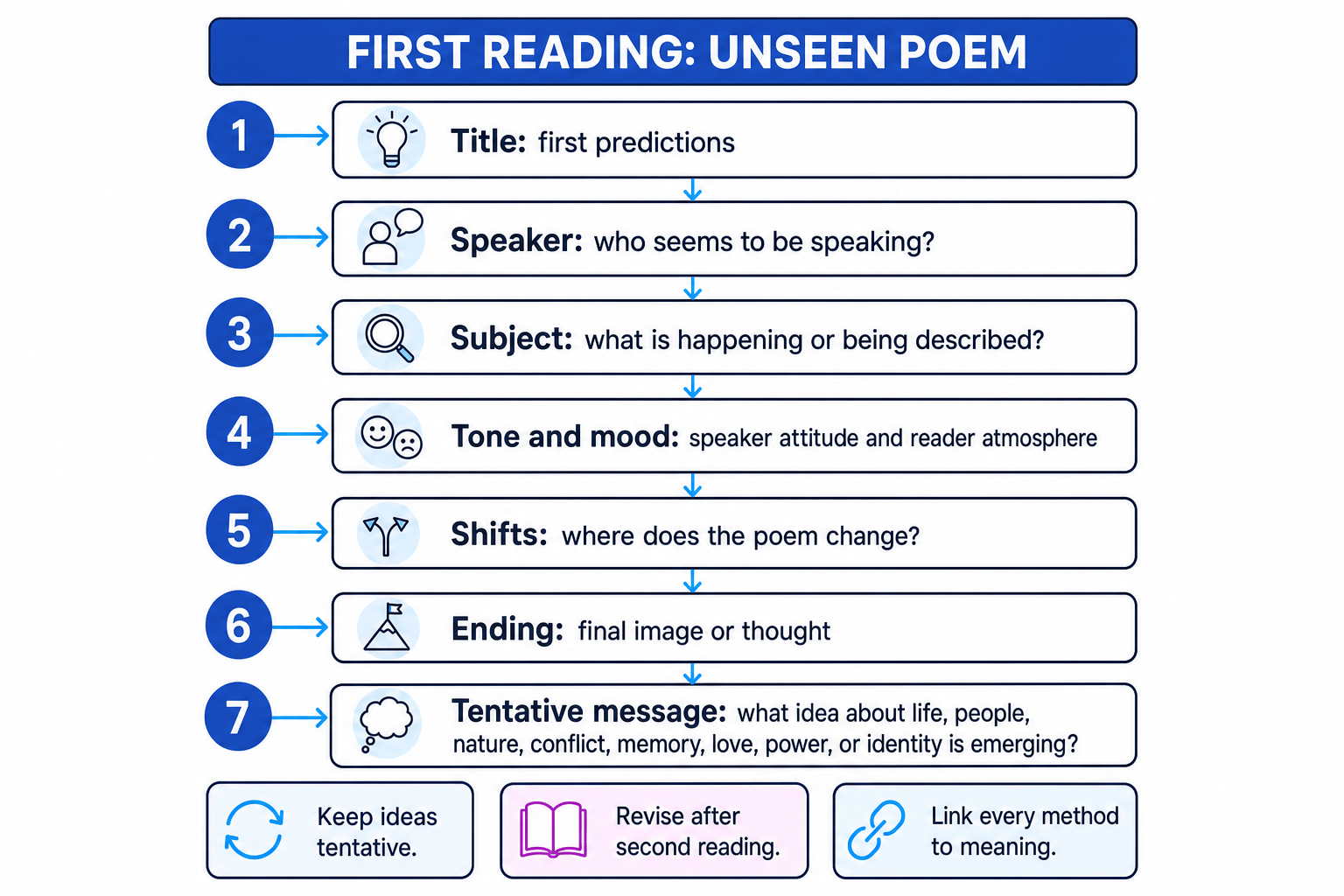
Step 1: Start with the title
Title
The title is the name of the poem. It can suggest the subject, create expectations, introduce a symbol, or become more meaningful after you reach the ending.
Do not over-analyse the title before reading the poem. Instead, make one or two quick predictions. Ask:
- What might the poem be about?
- Does the title sound ordinary, dramatic, mysterious, emotional, or ironic?
- Could the title have more than one meaning?
Then read the poem and return to the title afterwards.
Re-reading a title after the ending
Using Christina Rossetti’s poem “Remember”:
- The title “Remember” first sounds like a command or request, so you might predict that the poem is about memory, grief, or someone wanting not to be forgotten.
- The opening line, “Remember me when I am gone away,” supports that prediction because the speaker directly asks someone to remember her after separation or death.
- The ending complicates the title: “Better by far you should forget and smile / Than that you should remember and be sad.” The poem is not simply demanding remembrance; it suggests that love may involve letting someone move on.
Use the title twice
Glance at the title before reading, but judge it properly after the ending. Many poems make the title change meaning as the poem develops.
Step 2: Identify the speaker
Speaker
The speaker is the voice speaking in the poem. The speaker is not automatically the poet; poets often create a voice, character, or perspective.
To identify the speaker, look for pronouns such as “I”, “we”, “you”, or “they”. A poem may have a clear first-person speaker, or it may sound more distant and observational.
Ask:
- Is the speaker inside the experience or describing it from outside?
- Are they addressing someone directly?
- Do they seem calm, angry, nostalgic, fearful, playful, or uncertain?
If the poem uses direct address, it speaks to a specific “you”, even if that person is not named.
Finding the speaker
In Rossetti’s “Remember”:
- The phrase “Remember me” uses first person, so the speaker is presenting a personal request rather than describing someone else from a distance.
- The repeated address to “you” shows that the speaker is talking to a loved one, not to the general public.
- The phrase “when I am gone away” suggests the speaker imagines death or permanent separation, so the voice feels intimate, serious, and reflective.
Calling the speaker the poet
Avoid writing “Rossetti wants her husband to remember her” unless the poem clearly proves that. Safer phrasing is: “The speaker asks a loved one to remember her.”
Step 3: Work out the subject
Subject
The subject is what the poem is literally about on the surface: the event, person, place, memory, object, or situation being described.
The subject is not the same as the message. The subject is the “what”. The message is the “so what?”
For example:
- Subject: a speaker looking at a ruined building.
- Possible message: human power does not last.
- Subject: a child watching a parent leave.
- Possible message: growing up involves loss and independence.
On your first reading, keep the subject simple. You can make it more subtle later.
Separating subject and message
Imagine a poem where a speaker describes an old photograph of a childhood home.
- The subject is the photograph and the memory of the childhood home, because that is what the poem is directly describing.
- If the speaker notices the photo is “fading” or “creased”, the poem may be exploring time, loss, or the unreliability of memory.
- A tentative message could be: the past remains emotionally powerful, even when memory becomes unclear.
Step 4: Notice tone and mood
Tone
Tone is the speaker’s attitude towards the subject. It might be bitter, affectionate, mocking, regretful, admiring, anxious, or hopeful.
Mood
Mood is the atmosphere or feeling created for the reader. It might feel tense, peaceful, gloomy, eerie, joyful, or nostalgic.
Tone and mood are related, but they are not identical. A speaker’s tone might be calm, while the mood feels threatening. For example, a calm description of a storm could create an unsettling mood.
To identify tone, look at:
- word choices with positive or negative associations
- punctuation, especially questions, exclamations, or pauses
- imagery, such as light, darkness, decay, warmth, coldness
- sentence types, such as commands or rhetorical questions
Distinguishing tone and mood
In “Remember”, Rossetti’s speaker says: “Better by far you should forget and smile / Than that you should remember and be sad.”
- The phrase “forget and smile” creates a gentle and selfless tone because the speaker prioritises the loved one’s happiness over her own wish to be remembered.
- The contrast with “remember and be sad” makes the mood bittersweet: the poem is comforting, but still shaped by death and loss.
- A strong first-reading comment could be: the speaker’s tone shifts from pleading to generous, creating a tender but melancholy mood.
Use precise tone words
Avoid vague words like “sad” every time. Try more exact choices: mournful, nostalgic, resentful, tender, bitter, peaceful, defiant, uneasy.
Step 5: Look for shifts
Shift
A shift is a noticeable change in a poem’s direction. It might be a change in tone, time, setting, speaker, argument, mood, pace, or focus.
A shift is sometimes called a turn. In a sonnet — a 14-line poem often associated with love, thought, or argument — this turn is often called a volta.
You can often spot shifts through words such as:
- but
- yet
- however
- then
- now
- suddenly
- although
You can also spot shifts through structural changes, such as a new stanza, shorter lines, repeated phrases, or a sudden question.
Finding a shift
In “Remember”, the key shift begins with “Yet if you should forget me for a while”.
- The word “Yet” signals contrast, so the poem is moving away from the earlier repeated request to “remember”.
- Before the shift, the speaker seems to ask for memory and loyalty; after the shift, she imagines the loved one forgetting and still being allowed to “smile”.
- The shift changes the poem’s argument: remembrance matters, but the beloved’s happiness matters more.
Shifts create meaning
A poem often means most strongly where it changes. If you can explain what changes and why, you are already moving into analysis.
Step 6: Pay close attention to the ending
Ending
The ending is the final line, final image, or final thought of the poem. It often confirms, challenges, or complicates your first interpretation.
Many GCSE students read the ending too quickly. Slow down at the final lines. Ask:
- Does the ending feel resolved or unresolved?
- Has the speaker changed?
- Is the final image hopeful, bleak, ironic, peaceful, or disturbing?
- Does the ending make the title seem different?
The last line is often a strong place to quote because it usually carries the poem’s final emotional effect.
Ignoring the final line
Do not build your whole answer on the opening only. If the poem changes at the end, your interpretation must include that change.
Step 7: Form a tentative message
Message
The message is the larger idea the poem suggests about its subject. It is not always a simple moral; it may be complex, uncertain, or open to different interpretations.
A good first-reading message often begins with:
- “The poem seems to suggest that…”
- “The speaker presents… as…”
- “At first the poem appears to…, but by the end…”
- “The poem explores the tension between…”
This keeps your interpretation flexible, which is useful because unseen poems often contain contrasts.
Turning first reading into a message
Using “Remember” as a model:
- The subject appears to be a speaker asking a loved one to remember her after death.
- The shift beginning with “Yet” changes the emotional direction, because the speaker allows the loved one to forget if remembering causes sadness.
- A tentative message could be: Rossetti’s poem suggests that true love is not possessive; it may involve releasing someone from grief.
Do not force one fixed meaning
Poems are rarely puzzles with one hidden answer. Your interpretation should be convincing because it is supported by words and methods in the poem, not because it claims to be the only possible meaning.
What to annotate on your first reading
Keep first-reading annotations light. You are not decorating the poem; you are preparing to write.
Useful quick marks:
- Circle the title if it becomes important later.
- Put S near clues about the speaker.
- Underline a few words that reveal tone or mood.
- Mark a shift with an arrow or the word turn.
- Box the final line or final image.
- Write one sentence at the bottom: “This poem seems to be about…”
Method
A method is a writer’s choice in language such as imagery or metaphor, form such as a sonnet or free verse, or structure such as shifts, repetition, and the ending. In your answer, method should always be linked to meaning and effect.
A strong first-reading sentence
After your first reading, aim to produce a sentence like this:
“The poem appears to present [subject] through a [tone] voice, but a shift near the end suggests [message].”
For example:
“The poem appears to present grief through a tender and reflective voice, but the shift near the end suggests that love may mean allowing someone to move on.”
That sentence gives you a direction. Your second reading can then collect evidence for it.
In the exam
- Read the title, then the poem, then return to the title before you start writing.
- On your first reading, focus on speaker, subject, tone, mood, shifts, and ending before hunting for techniques.
- Build your answer around meaning: choose short quotations and explain how the writer’s methods shape your response.
Check yourself
- Can you explain the difference between speaker, subject, and message?
- What clues might show that the tone of a poem has shifted?
- Why is the ending often one of the most important parts of an unseen poem?
