What you'll learn
- How to move from spotting a method to explaining its meaning and effect.
- How to analyse imagery, metaphor, simile, personification, sound, repetition and symbolism.
- How to choose short quotations and “zoom in” on individual words.
- How to build a confident unseen poetry paragraph for AQA Literature Paper 2.
What “language analysis” means
In unseen poetry, you are given a poem you have not studied before. You do not need memorised quotations or background context: the poem is printed in the exam. Your job is to respond thoughtfully to what the poet has written and how they have written it.
Language analysis
Language analysis means exploring how a poet’s word choices, images, comparisons and sounds shape meaning and influence the reader’s response.
For AQA unseen poetry, this mainly rewards your ability to make a clear personal response and support it with evidence, while analysing the poet’s methods. In simple terms: say what the poem suggests, prove it with a quotation, then explore how the language works.
The main move
Do not stop at naming a technique. The real marks come from explaining how the technique develops the poem’s meaning, mood or speaker’s attitude.
Start with the literal meaning
Before analysing language, make sure you understand the poem’s literal meaning: what is happening on the surface.
A speaker is the voice in the poem. The speaker is not always the poet themselves. For example, a poem might be written in the voice of a child, a soldier, a parent, or someone remembering a past event.
Ask yourself:
- Who or what is the poem about?
- What situation, memory or feeling is being described?
- Does the speaker’s attitude seem calm, angry, fearful, regretful, joyful or uncertain?
Why this matters
If you misunderstand the basic situation, your language analysis may go in the wrong direction. A word like “dark” might suggest danger in one poem, but comfort or peace in another.
Moving from literal meaning to interpretation
Imagine an unseen poem includes the line: “The city crouches under rain.”
- First, establish the literal meaning: the poem describes a city in rainy weather.
- Notice the unusual wording: a city cannot literally “crouch”, so the poet is presenting the city as if it has a body.
- Infer the effect: “crouches” suggests fear, weakness or exhaustion, so the rain may feel oppressive rather than refreshing.
Choose short, useful quotations
A quotation is an exact word or phrase from the poem. In unseen poetry, you should usually quote briefly because shorter evidence is easier to analyse closely.
Good quotations are often:
- A striking image: “crouches under rain”
- A powerful verb: “snatches”, “trembles”, “splinters”
- An adjective with strong associations: “hollow”, “golden”, “bitter”
- A repeated word or phrase
Quote small
A tiny quotation can be stronger than a full line. If you quote “crouches”, you can explore its connotations in detail instead of rushing past it.
Zoom in on connotations
A connotation is an associated meaning or feeling connected to a word, beyond its basic dictionary meaning.
For example, the word “home” literally means a place where someone lives. Its connotations might include safety, family, warmth, belonging — or, in a darker poem, confinement and painful memory.
The best unseen poetry answers often zoom in on one word and ask: why this word, not another?
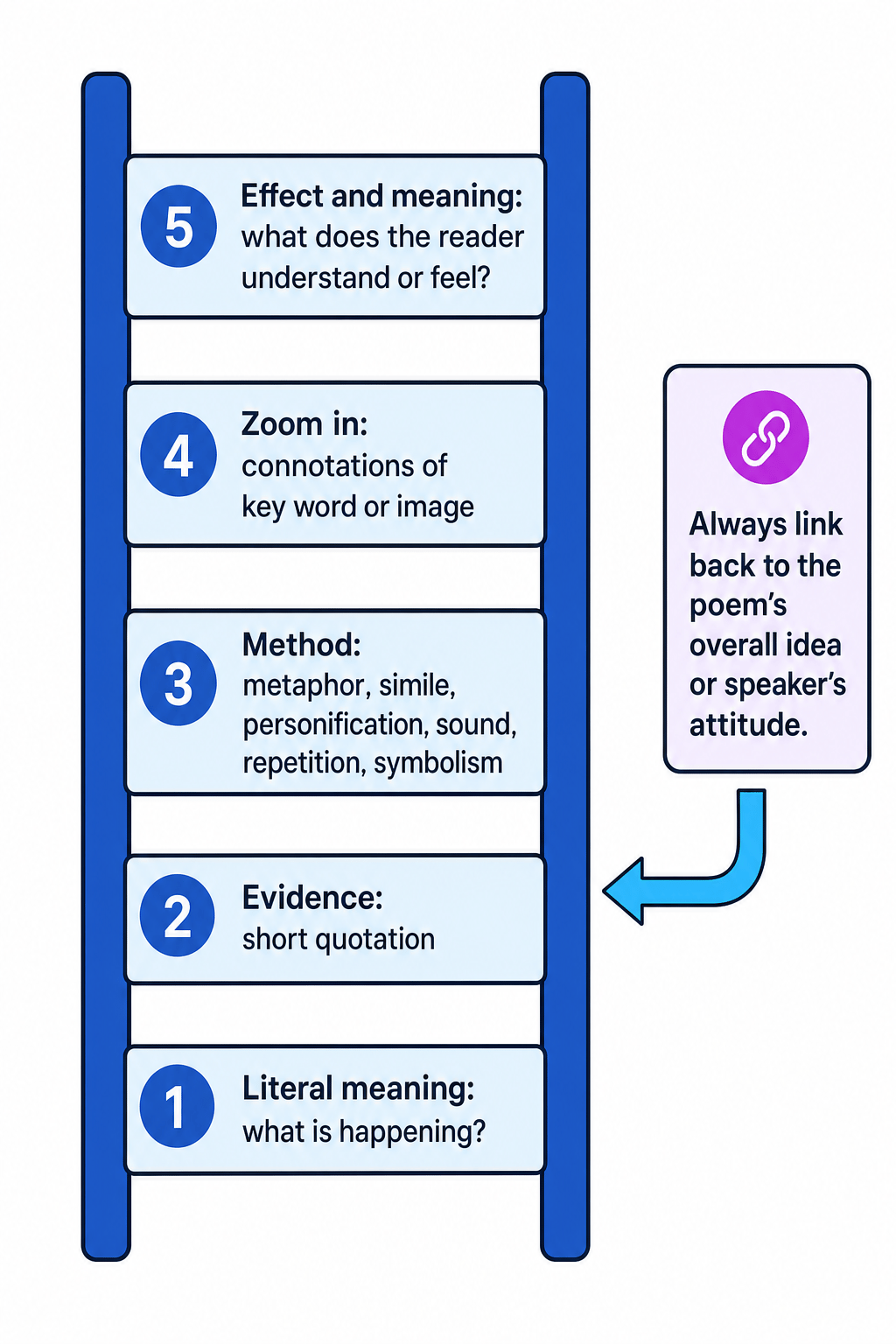
Zooming in on a word
Take the phrase: “a bitter wind”.
- Identify the literal image: the speaker describes unpleasant weather.
- Focus on the adjective “bitter”: it can describe a sharp taste, but also resentment or emotional pain.
- Link the connotations to meaning: the wind may reflect the speaker’s emotional state, making the setting feel hostile and unforgiving.
Feature spotting
Do not write: “The poet uses a metaphor, which is effective.” That names a method but does not analyse it. Always explain what the method suggests and how it shapes the reader’s understanding.
Imagery: creating pictures and sensations
Imagery
Imagery is language that creates a sensory impression, helping the reader imagine what can be seen, heard, touched, tasted or smelt.
Most students think imagery only means visual description, but it can involve any sense:
- Visual imagery: what the reader can picture
- Auditory imagery: what the reader can hear
- Tactile imagery: touch, texture, heat or cold
- Olfactory imagery: smell
- Gustatory imagery: taste
Imagery often reveals emotion indirectly. A poem about grief might not say “I am sad”; instead, it might describe “empty chairs”, “grey light” or “silent rooms”.
Analysing imagery
Consider the phrase: “the room filled with grey silence.”
- Identify the image: the room is presented as colourless and quiet.
- Notice the adjective “grey”: it suggests dullness, lifelessness and emotional heaviness.
- Notice the unusual phrase “filled with silence”: silence is treated almost like a physical substance, suggesting the feeling is overwhelming.
- Link to meaning: the imagery may present loneliness as something that occupies the whole space around the speaker.
Metaphor and simile: making comparisons
Metaphor and simile
A metaphor describes one thing as if it is another thing. A simile compares one thing to another using words such as “like” or “as”.
Both methods help poets explain feelings or ideas in a compressed, vivid way.
For example:
- Metaphor: “Hope is a lantern.”
- Simile: “Hope is like a lantern.”
The difference is grammatical, but the analytical question is the same: what does the comparison suggest?
If hope is compared to a lantern, it may seem small but valuable, fragile but guiding, surrounded by darkness but still useful.
Analysing a comparison
Take the simile: “Her voice was like cracked glass.”
- Identify what is being compared: the voice is compared to damaged glass.
- Explore connotations of “cracked glass”: fragility, sharpness, damage and the possibility of breaking further.
- Apply this to the speaker or situation: the voice may sound emotionally strained, suggesting the person is close to breaking down.
- Link to the reader’s response: the image may create sympathy because the person seems vulnerable and hurt.
Personification: making the non-human seem human
Personification
Personification gives human qualities, actions or emotions to something non-human, such as an object, place, animal, season or abstract idea.
Poets often use personification to make settings feel alive. Weather, buildings or landscapes can seem threatening, comforting, watchful or tired.
For example, if a poem says “the house sighed”, the house is not literally breathing. The personification might suggest age, sadness, relief or memory, depending on the rest of the poem.
Analysing personification
Consider the line: “The sea clawed at the wall.”
- Identify the personification: the sea is given the human or animal-like action “clawed”.
- Zoom in on “clawed”: it suggests aggression, violence and desperation.
- Connect the method to atmosphere: the sea seems threatening and predatory rather than calm or beautiful.
- Link to meaning: the poet may be presenting nature as powerful and destructive, making human structures seem fragile.
Sound: how the poem feels in the mouth and ear
Sound devices are patterns of sound created by the poet’s choice and arrangement of words. They can affect pace, mood and emphasis.
Useful sound terms include:
- Alliteration: repetition of the same starting sound in nearby words, such as “wild winds”.
- Sibilance: repeated “s” or “sh” sounds, which may sound soft, secretive, sinister or soothing.
- Plosives: hard “p”, “b”, “t”, “d”, “k” or “g” sounds, which can create impact, violence or abruptness.
- Onomatopoeia: words that imitate sounds, such as “crash”, “buzz” or “whisper”.
Sound is not automatic
Do not claim that a sound always has the same effect. Sibilance is not always sinister; it could be gentle or peaceful. Use the poem’s meaning to decide.
Analysing sound
Consider the phrase: “black branches beat the broken sky.”
- Identify the repeated sound: the “b” sound is repeated in “black”, “branches”, “beat” and “broken”.
- Name the method if useful: this is alliteration, and the repeated “b” is also plosive.
- Explore the effect of the sound: the hard beats make the line feel forceful and violent.
- Link to the image: because the branches “beat” the sky, the sound reinforces a threatening, stormy atmosphere.
Repetition: noticing what comes back
Repetition
Repetition is when a poet repeats a word, phrase, sound, image or idea.
Repetition can suggest many things, including obsession, fear, routine, emphasis, memory, grief or certainty. The key is to ask why that particular thing returns.
If a poem repeatedly uses the word “still”, it might suggest peace, death, waiting, shock or emotional paralysis. You need the surrounding poem to decide.
Analysing repetition
Imagine a poem repeats the phrase: “I waited”.
- Identify what is repeated: the speaker returns to the phrase “I waited”.
- Consider the effect of the repeated first-person pronoun “I”: it keeps attention on the speaker’s personal experience.
- Consider the verb “waited”: it suggests delay, helplessness or hope.
- Link to the whole poem: the repetition may show that waiting has become central to the speaker’s life, creating frustration or sadness.
Symbolism: when an object means more
Symbolism
Symbolism is when a person, object, place, action or image represents a bigger idea.
A symbol works on two levels. It is literally present in the poem, but it also suggests something wider.
Common poetic symbols include:
- Light: hope, truth, safety, memory, revelation
- Darkness: fear, mystery, ignorance, death, comfort
- Doors: opportunity, separation, secrecy, choice
- Birds: freedom, escape, fragility, song
- Seasons: growth, decline, change, renewal
Be careful: symbols are not fixed. A bird might symbolise freedom in one poem, but vulnerability in another.
Analysing symbolism
Consider the image: “a locked door at the end of the hall.”
- Identify the literal object: the poem describes a door that cannot be opened.
- Explore possible symbolic meanings: a locked door could represent secrecy, exclusion, fear or an unreachable memory.
- Use the setting to refine the interpretation: because it is “at the end of the hall”, it may suggest something the speaker is moving towards but cannot yet face.
- Link to meaning: the symbol could show emotional blockage, as if the speaker is unable to access part of their past.
Bringing methods together in a paragraph
A strong paragraph does not need to analyse every method in the poem. It should develop one clear idea in depth.
A useful structure is:
- Make a clear point about what the poet presents.
- Embed a short quotation.
- Name the method if it helps your analysis.
- Zoom in on one or two key words.
- Explain the effect on the reader.
- Link back to the question or the poem’s overall idea.
Model paragraph
The poet presents the city as vulnerable and exhausted rather than powerful. The personification in “the city crouches under rain” makes the city seem like a living creature trying to protect itself. The verb “crouches” has connotations of fear and weakness, suggesting that the weather is not just background detail but an oppressive force. This could make the reader feel that the speaker sees urban life as worn down and defeated. The image therefore develops a bleak mood and hints that the speaker feels trapped within the environment.
Notice that the paragraph does not just say “personification is used”. It explores the verb, its connotations, and the wider meaning.
A flexible sentence frame
Try: The word “[quotation]” suggests… because it has connotations of… This makes the reader think/feel… and links to the poem’s idea of…
How much terminology should you use?
Terminology is helpful, but it is not the whole answer. If you can accurately name metaphor, simile, personification, alliteration, repetition or symbolism, do so. But if you cannot remember the exact term, still analyse the effect.
For example, “The poet compares the voice to ‘cracked glass’, suggesting it is fragile and damaged” is much stronger than “The poet uses a simile” with no explanation.
Meaning first, method second
Use terminology to support your ideas, not to replace them. A clear explanation of meaning is more valuable than a list of devices.
In the exam
- Read the poem twice: first for the overall meaning, then for interesting words, images and patterns.
- Choose three or four short quotations you can analyse closely, rather than trying to cover everything.
- For each quotation, move from method to connotations to effect, always linking back to the question.
- Avoid vague comments like “this makes the reader want to read on”; be specific about mood, attitude or meaning.
Check yourself
- Can you explain the difference between a metaphor, a simile and personification?
- When you choose a quotation, can you zoom in on one important word and explore its connotations?
- Can you link a language method to the poem’s overall mood, message or speaker’s attitude?
