What you'll learn
- How to tell the difference between form and structure in an unseen poem.
- How to analyse stanzas, line length, rhyme, rhythm, enjambment, caesura and volta.
- How to move beyond feature-spotting into meaningful comments about effect.
- How to write about form and structure confidently in AQA unseen poetry.
Why form and structure matter
In unseen poetry, you do not need to know the poem beforehand. That is the point: AQA wants to see how well you can respond to a new poem using your own ideas.
You are mainly rewarded for an informed interpretation supported by evidence, and for analysing the poet’s methods. Form and structure are part of those methods. They show how the poem is built, not just what it says.
Form and structure
- Form means the overall type, shape or pattern of the poem: for example, whether it is written in regular stanzas, free verse, a sonnet-like shape, or a dramatic monologue.
- Structure means the way the poem is organised and develops: where it begins, how it shifts, where it pauses, and how it ends.
A helpful way to think about this is: language is the poet’s word choice; structure is the poem’s journey; form is the poem’s overall container.
This diagram shows the main features you can notice quickly when you first meet an unseen poem.
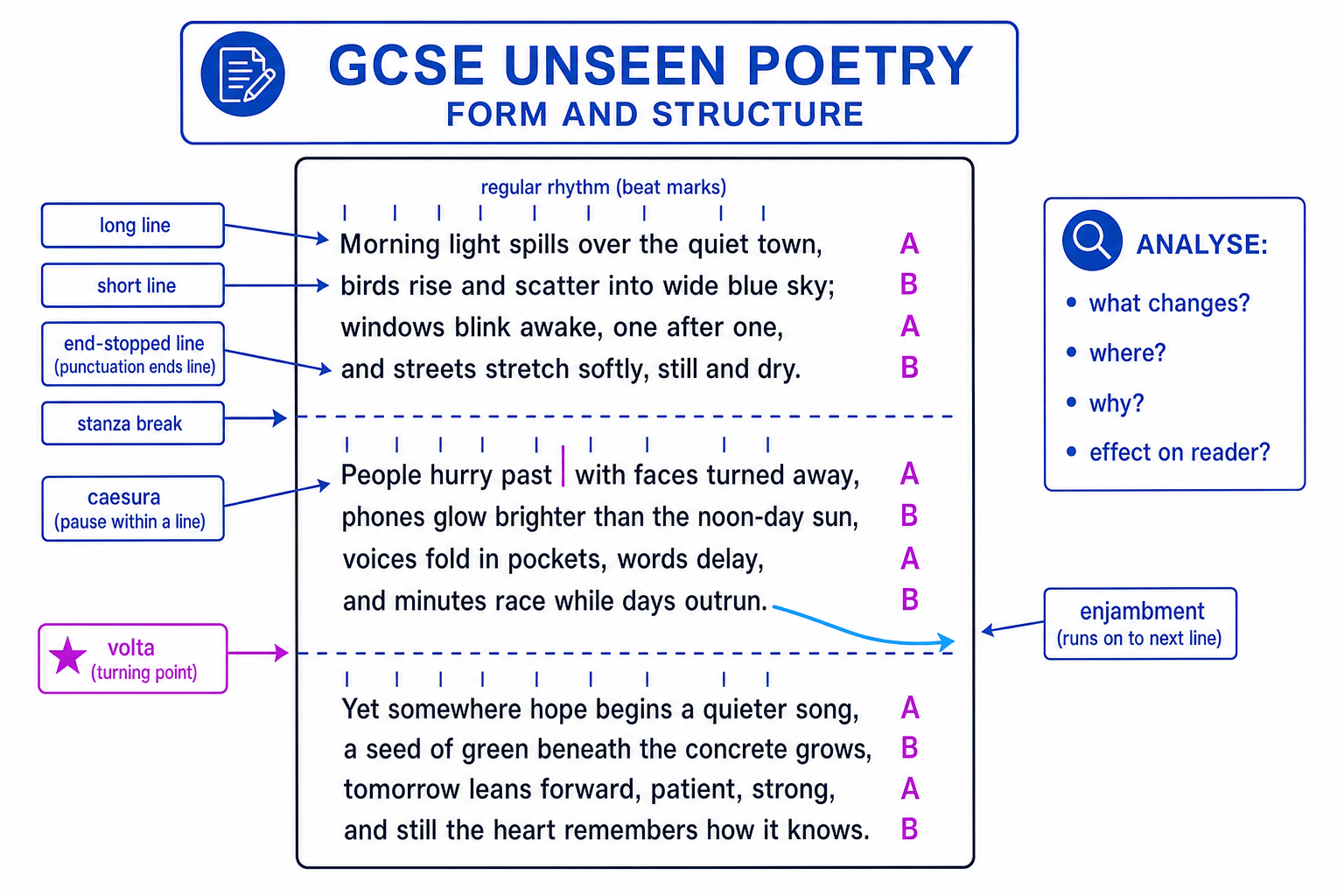
Start with the poem’s journey
Before analysing individual techniques, ask: what changes from the beginning to the end?
The speaker is the voice or persona speaking in the poem. The speaker may be similar to the poet, but you should not automatically assume they are the same person.
The tone is the speaker’s attitude or mood — for example, angry, nostalgic, fearful, calm, bitter or hopeful.
When reading structurally, track changes in:
- mood or tone
- time, place or season
- focus, such as from nature to the self
- certainty or confusion
- hope, fear, anger or acceptance
The structural journey
A strong unseen response often notices a movement: the poem may begin with one feeling or idea, then shift towards a different understanding by the end.
Stanzas
Stanza
A stanza is a group of lines separated from other groups of lines by a space. You can think of it as a paragraph in a poem, though it often works more musically or visually than prose.
Stanzas can divide a poem into stages. A poem with three stanzas might move from memory, to present reflection, to final realisation. A poem with one long stanza might feel breathless, trapped or continuous.
Do not just write, “The poem has four stanzas.” That is description, not analysis. Instead, ask what each stanza does.
Analysing stanza changes
Imagine an unseen poem has three stanzas:
- The first stanza describes a busy city street with “crowds” and “traffic”.
- The second stanza focuses on one person standing “alone at the crossing”.
- The final stanza turns inward as the speaker says, “I hear my own heart.”
A strong analysis might develop like this:
- Compare the focus of each stanza: the poem moves from a wide public setting to one isolated figure, then finally to the speaker’s private emotion.
- Connect structure to meaning: this narrowing focus suggests the poem is not really about the city itself, but about loneliness within a crowd.
- Explain the reader effect: the stanza movement makes the reader experience the speaker’s isolation gradually, rather than being told it directly.
Counting without interpreting
Avoid saying “there are three stanzas” as if that proves something on its own. Always explain how the stanza arrangement shapes meaning.
Line length and line breaks
Line length and line break
Line length means how long or short each line is. A line break is where one line ends and the next begins.
Line length affects pace and emphasis. Short lines can feel abrupt, fragile, tense or important. Long lines can feel flowing, crowded, conversational or overwhelming.
A line can also be end-stopped, meaning the line ends with punctuation such as a full stop, comma, colon or dash. End-stopped lines often create a clear pause or sense of control.
Reading line length for emphasis
Imagine these lines appear in an unseen poem:
The house kept all its windows closed.
No music.
No light.
- Notice the change in length: the first line is longer and descriptive, while the next two lines are very short.
- Ask what the short lines emphasise: “No music” and “No light” are isolated, making the absence feel stark and final.
- Link to meaning: the shortened lines may suggest emotional emptiness, as if the speaker can only manage brief, bleak observations.
Short lines are not always simple
A short line often carries extra weight because it is visually isolated. Ask why the poet wanted that word or phrase to stand alone.
Rhyme
Rhyme
Rhyme is the repetition of similar sounds, usually at the ends of lines. A rhyme scheme is the pattern of rhymes, labelled with letters such as ABAB or AABB.
Rhyme can create order, musicality, comfort or predictability. However, rhyme can also feel restrictive, childish, ironic or unsettling, depending on the poem’s subject.
A half-rhyme is when words sound similar but do not rhyme fully, such as “stone” and “storm”. Half-rhyme can create unease because the pattern nearly fits, but not quite.
Using rhyme scheme to infer control
Imagine the end words of a stanza are:
rain
street
pain
feet
- Label the rhyme scheme: “rain” and “pain” rhyme, so they are A. “street” and “feet” rhyme, so they are B. The pattern is ABAB.
- Consider the effect of regularity: the balanced pattern may suggest control, routine or a carefully ordered reflection.
- Connect to the subject: if the poem is about grief, the regular rhyme could show the speaker trying to impose order on painful feelings.
Do not force rhyme analysis
Not every poem has a neat rhyme scheme. If the poem is written in free verse, meaning it does not use a regular rhyme or rhythm pattern, that may itself suggest freedom, instability or natural speech.
Rhythm
Rhythm
Rhythm is the pattern of beats or stresses in a line. Metre is a regular rhythm pattern across lines.
You do not need to scan a poem perfectly in the exam. Instead, listen for whether the rhythm feels steady, song-like, broken, heavy, rushed or hesitant.
A regular rhythm can suggest control, marching, certainty, ritual or calm. A disrupted rhythm can suggest panic, confusion, anger, grief or natural speech.
Comparing steady and broken rhythm
Compare these invented lines:
We walked, we worked, we wore the road away.
I stopped — then stumbled. Could not speak.
- Compare the movement: the first line uses repeated “We” phrases and feels steady, almost like a chant.
- Notice disruption: the second line is broken by the dash and shorter sentence fragments.
- Interpret the contrast: the rhythm changes from collective endurance to personal breakdown, suggesting the speaker’s confidence has collapsed.
Read it quietly in your head
In the exam, you can “hear” the rhythm by silently reading the line. If it feels smooth or jagged, that is often worth analysing.
Enjambment
Enjambment
Enjambment happens when a sentence or phrase runs over from one line to the next without a strong punctuation pause.
Enjambment can create flow, speed, uncertainty or suspense. It may make the reader continue quickly into the next line, mirroring overflowing emotion or ongoing movement.
For example, if a poem says:
I followed the river until it carried
my name out to sea
the line break after “carried” creates suspense. For a moment, the reader asks: carried what? The next line completes the idea.
Caesura
Caesura
A caesura is a noticeable pause within a line of poetry, often created by punctuation such as a dash, full stop, colon or semicolon.
Caesura can suggest interruption, shock, hesitation, conflict or emotional control. It can also slow the pace and make the reader dwell on a particular moment.
Interpreting pauses and run-on lines
Imagine an unseen poem includes:
I tried to forgive you —
but the words fell
through me.
- Identify the pause: the dash after “you” creates a caesura-like interruption, making the attempt to forgive feel difficult or unfinished.
- Notice the enjambment: “the words fell / through me” runs over the line break, making the feeling continue beyond one line.
- Connect both methods: the pause suggests emotional blockage, while the enjambment suggests the speaker’s pain keeps moving through them despite that blockage.
Technique labels without meaning
Do not write “The poet uses enjambment” and stop there. Add what it makes the reader feel, notice or question.
Volta
Volta
A volta is a turning point in a poem, where the idea, tone or argument shifts. It often appears around words such as “but”, “yet” or “however”, or at a stanza break.
Voltas are common in sonnets, but any poem can have a turn. In unseen poetry, spotting the turn is very useful because it helps you explain the poem’s overall structure.
A volta might shift from:
- despair to hope
- anger to regret
- memory to present reality
- certainty to doubt
- description to personal confession
Finding the turning point
Imagine a poem spends two stanzas describing winter darkness, then begins the final stanza:
Yet under the frost, the first roots stir.
- Identify the shift: the word “Yet” signals a contrast with the previous bleak description.
- Analyse the image after the turn: “roots stir” suggests hidden growth, survival or renewal beneath the surface.
- Link to the poem’s message: the volta may change the poem from a simple description of hardship into a more hopeful reflection on resilience.
The volta often reveals the message
If you can explain what changes at the volta, you are often close to explaining the poem’s central idea.
Turning observations into analysis
The best answers do not list methods. They connect method to meaning.
A useful sentence pattern is:
At first / later / by the end, the poet… This structural shift suggests… because… The reader is left feeling…
You can also use comparative structural language:
- “The poem opens with…”
- “This changes when…”
- “The stanza break marks a shift…”
- “By the final line…”
- “The repeated rhyme creates…”
- “The disrupted rhythm reflects…”
Building a structural paragraph
Imagine a poem begins with long flowing lines about the sea, but ends with the single short line:
Home.
- Make a point about the structural change: the poem moves from expansive, flowing description to a single-word final line.
- Use evidence precisely: the isolated final word “Home” contrasts with the earlier long lines about the sea.
- Analyse the method: the short final line slows the pace and gives the word visual importance on the page.
- Link to meaning: this could suggest that, after emotional wandering, the speaker finally reaches a place of certainty or belonging.
A model paragraph might be:
The poem’s structure moves from openness to certainty. At first, the long flowing lines about the sea create a sense of movement and searching, as if the speaker is emotionally unsettled. However, the final one-word line, “Home”, is visually isolated, which gives it weight and finality. This structural narrowing suggests the speaker has moved from uncertainty towards belonging, leaving the reader with a sense of quiet resolution.
What to avoid
Assuming every feature has one fixed meaning
A caesura does not always mean conflict. Enjambment does not always mean freedom. Rhyme does not always mean happiness. The effect depends on the poem’s ideas and mood.
Use cautious verbs
Try phrases like “may suggest”, “could imply” or “creates a sense of”. These sound thoughtful and analytical, especially when discussing an unseen poem.
In the exam
- Read the poem once for the basic meaning, then again for its journey from beginning to end.
- Mark two or three structural features that genuinely affect meaning: a stanza shift, short final line, rhyme pattern, pause, enjambment or volta.
- Avoid feature-spotting; always explain what the method suggests about the speaker’s feelings or the poem’s message.
- Use short quotations because the exam is closed book and precise evidence is stronger than long copying.
- For the comparison question, compare how both poems develop, shift or end — not just what they are about.
Check yourself
- Can you explain the difference between form and structure without using the same definition for both?
- Can you find a volta in a poem and explain what changes after it?
- Can you analyse enjambment or caesura by linking it to pace, feeling and meaning?
