When analyzing Poem B under time pressure, do not try to understand every single line. Focus entirely on the theme requested in the prompt. If the prompt asks you to compare how the poets present fear, scan Poem B exclusively for how fear is described, what methods are used to show it, and how that compares to Poem A.
Look for Binary Opposites
To find immediate points of comparison, look for simple binary contrasts between the two poems:
- Is one poem positive and the other negative?
- Is one set in a chaotic environment and the other in a peaceful one?
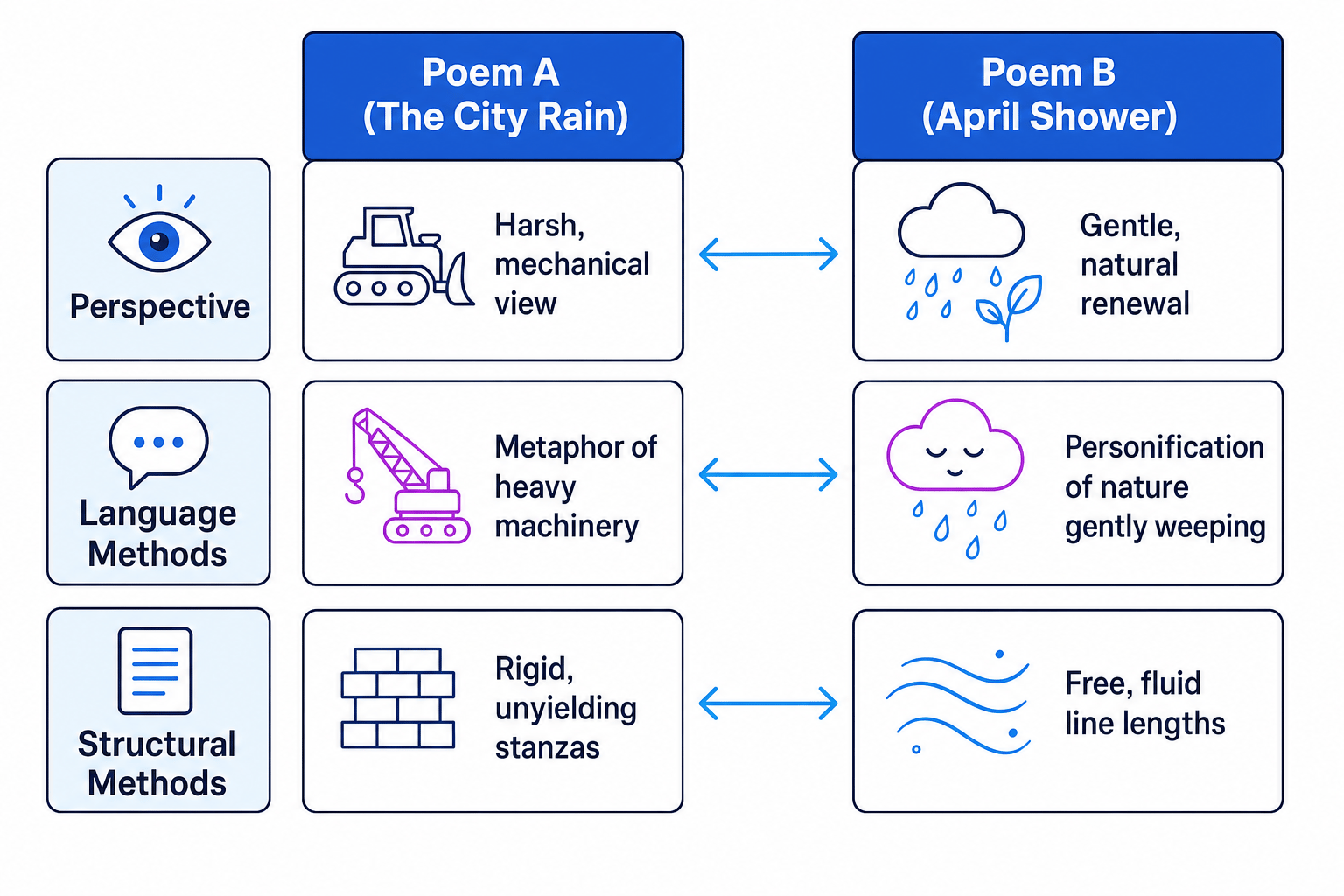
- Does one poet use regular, highly structured rhymes while the other uses loose, unpredictable free verse?
The Step-by-Step Comparative Method
To secure the highest marks, your writing must be balanced and comparative throughout. A common trap is writing a paragraph about Poem A, followed by a paragraph about Poem B, with a single comparative sentence tacked onto the end. This is consecutive, not comparative.
Instead, structure your response as one or two integrated, highly comparative paragraphs.
Feature Hunting without Meaning
Do not simply list techniques (e.g., "Poem A has a simile and Poem B has personification"). Identifying a method without linking it to the writer’s purpose or the effect on the reader will limit you to lower mark bands. Every method you name must help explain why the poet wrote the poem.
Here is how to construct a comparative analysis from scratch.
Comparing presentation of the natural world
Consider these two short extracts:
- Poem A ("The City Rain"):
The grey clouds marched like heavy iron gears,
Grinding the sky, stripping the streets of light. - Poem B ("April Shower"):
The soft sky wept a cool, forgiving tear,
And kissed the thirsty petals back to life.
Question: Compare how the speakers present the effects of rain in "The City Rain" and "April Shower".
-
State the core conceptual difference or similarity in perspective. Begin with a direct comparison of the overall feelings or ideas conveyed by both poets.
Drafting step: In "The City Rain," the speaker presents the rain as a destructive, industrial force that strips the city of vitality. Conversely, the speaker in "April Shower" presents the rain as a nurturing, restorative presence that heals the natural landscape.
-
Integrate a method from Poem A and analyze its specific effect. Introduce a precise quotation from the first poem, name the literary device, and explain how it shapes the reader's understanding.
Drafting step: To convey this harsh perspective, the poet of "The City Rain" uses an industrial simile, describing the clouds as marching "like heavy iron gears." This comparison strips the weather of its natural essence, suggesting a cold, mechanical, and oppressive force that actively "grinds" away the light, creating a feeling of claustrophobia.
-
Use a comparative connective to transition directly to a contrasting method in Poem B. Immediately link your analysis to the second poem, using a quotation and naming a corresponding device to contrast the effects.
Drafting step: In stark contrast, the poet of "April Shower" utilizes gentle personification, portraying the sky as weeping a "cool, forgiving tear." While the simile in Poem A evokes mechanical hostility, the personification in Poem B evokes empathy and tenderness. The verb "kissed" further emphasizes this gentle touch, presenting the rain not as a grinding force, but as a loving savior that brings "thirsty petals back to life."
Structuring Your Writing under Time Pressure
To write your response efficiently in 15 minutes, use a highly focused structure. You only need one or two paragraphs, but they must be packed with analytical comparisons.
Use this simple, robust paragraph template to keep your writing on track:
Comparative Point→Poem A (Quote + Method + Effect)→Comparative Connective→Poem B (Quote + Method + Effect) \text{Comparative Point} \rightarrow \text{Poem A (Quote + Method + Effect)} \rightarrow \text{Comparative Connective} \rightarrow \text{Poem B (Quote + Method + Effect)} Comparative Point→Poem A (Quote + Method + Effect)→Comparative Connective→Poem B (Quote + Method + Effect)Analytical Transition Word Bank
Keep a mental list of comparative transition words to make your sentences flow naturally and signal comparison to the examiner:
- To show contrast: Conversely, on the other hand, in stark contrast, whereas, while, alternatively.
- To show similarity: Similarly, in a matching way, likewise, echoing this, in tandem with.
In the exam
- Target the prompt: Read the comparative question first, highlight the key theme (e.g., grief, nature, anger), and use this focus to guide your reading of Poem B.
- Keep quotes short: You only have 15 minutes. Use single-word or short-phrase quotations (e.g., "heavy iron gears") rather than copying out entire lines.
- Compare methods, not just themes: Make sure you explicitly pair a device from Poem A (e.g., a simile) with a device from Poem B (e.g., personification) and explain how their effects differ.
- Ignore context: Remember that AO3 is not assessed in this 8-mark question. Do not include any historical or biographical facts about the poets.
Check yourself
- Can you explain why writing two separate paragraphs (one on Poem A, one on Poem B) is less effective than writing an integrated comparative paragraph?
- Which Assessment Objective (AO) is completely omitted from the mark scheme for the 8-mark unseen comparison question?
- What are three highly effective comparative connectives you can use to transition from analyzing Poem A to analyzing Poem B?
