What you'll learn
- How the AQA unseen poetry questions work in Paper 2 Section C.
- How to read an unfamiliar poem quickly and still say something thoughtful.
- How to build a clear analytical paragraph using short quotations and methods.
- How to practise the 24-mark single-poem question and the 8-mark comparison.
The shape of the unseen poetry section
In AQA GCSE English Literature, unseen poetry appears in Paper 2 Section C. You are given poems in the exam, so you do not need to memorise quotations for this section.
You usually answer:
- Question 1: one unseen poem, 24 marks.
- Question 2: a short comparison between the first poem and a second unseen poem, 8 marks.
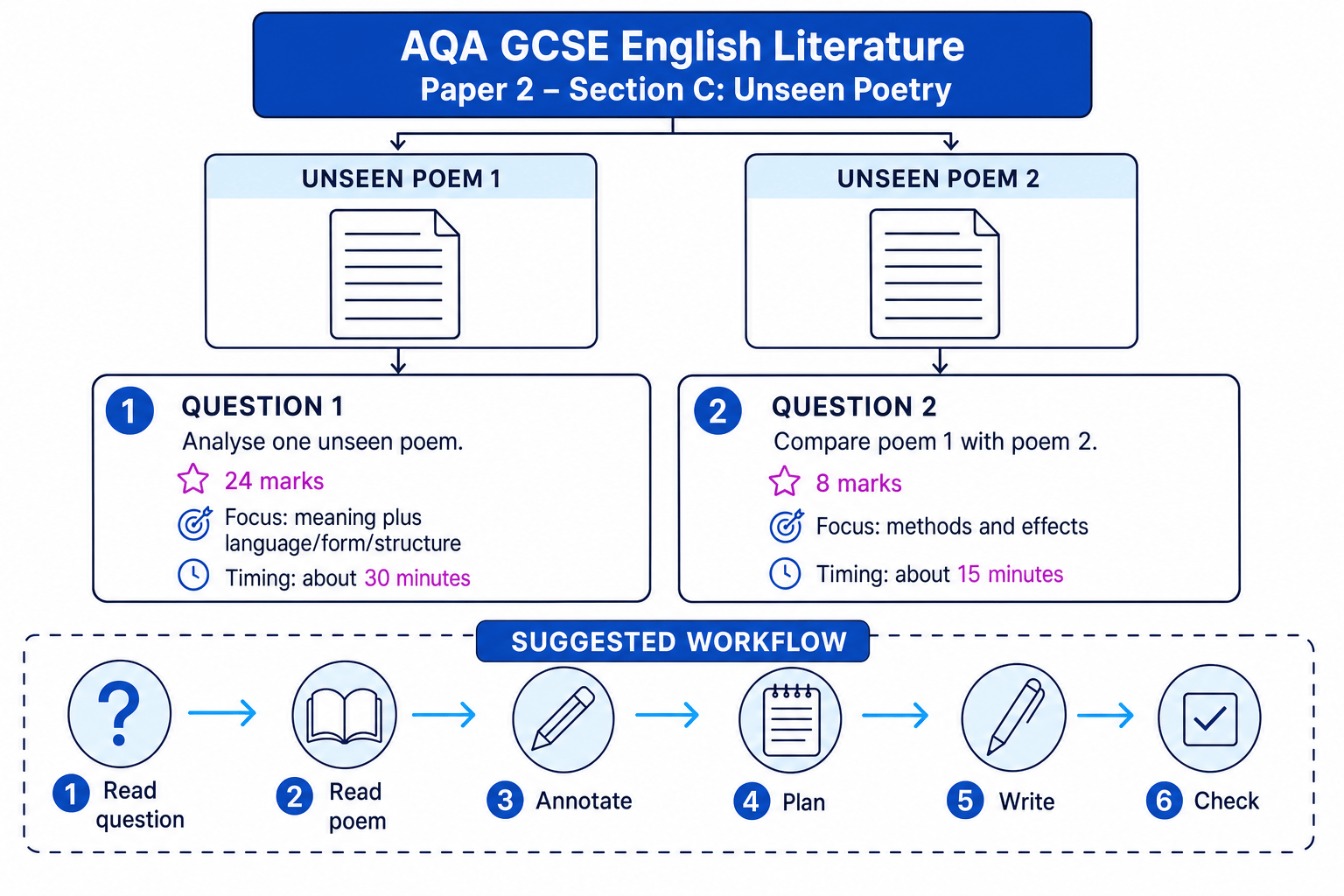
Unseen poem
An unseen poem is a poem you have not studied before. In the exam, your job is to understand it for the first time, then write about how the poet presents ideas, feelings or experiences.
Meaning before methods
Do not start by hunting for techniques. First work out what the poem is about, who is speaking, and how the feelings change. Then choose methods that help prove your interpretation.
What the questions reward
The unseen poetry section mainly rewards two things:
- A clear personal response: your own thoughtful answer to the question, supported by references to the poem.
- Analysis of methods: explaining how the poet uses language, form and structure to create meaning.
Method
A method is a deliberate choice made by the writer. In poetry, this can include language such as word choice and imagery, form such as the type or shape of poem, and structure such as the order of ideas, stanza breaks or changes in tone.
You do not need to write about historical context unless the exam paper gives you a short note. Unseen poetry is about close reading.
Inventing context
Avoid guesses like “the poet probably lived during a war” unless the paper tells you. Made-up context does not earn marks and can distract from the poem itself.
First reading: understand the voice and feeling
Before annotating, read the question. It tells you what to focus on: loneliness, power, memory, childhood, nature, conflict, hope, or another idea.
Then read the poem twice.
Key things to identify
Speaker
The speaker is the voice in the poem. The speaker is not automatically the poet; it may be a character, persona or imagined voice.
Tone
Tone means the attitude or feeling created by the poem, such as angry, nostalgic, anxious, hopeful, bitter or calm.
Ask yourself:
- What situation is being described?
- What does the speaker feel at the start?
- Does the feeling change by the end?
Reading for meaning and change
Imagine a poem begins with the line “The station holds its breath at midnight” and later says “one clean note” rises from a busker’s music.
- The opening suggests stillness and tension because the station is described as if it can “hold its breath”.
- The phrase “at midnight” creates a dark, lonely setting, so the mood at the start feels tired or uneasy.
- The later image of “one clean note” suggests something pure breaking through the darkness, so the poem may shift towards hope.
- A strong interpretation would be: the poem presents tiredness at first, but gradually shows how a small moment of beauty can change the speaker’s mood.
Practice poem A: single-poem question
Use this practice poem as if it were printed in the exam.
Late Shift
1 The station holds its breath at midnight,
2 lights buzzing like trapped bees.
3 My boots drag home the long day,
4 a grey coat soaked in rain.
5 Then, through the tunnel, a busker lifts
6 one clean note into the dark.
7 Coins wake in strangers’ pockets;
8 faces turn, small moons.
9 For a minute, even the rails
10 seem to hum towards morning.
Practice prompt 1
In “Late Shift”, how does the poet present tiredness and hope?
This is the kind of 24-mark question where you should write about the whole poem, not just one line.
Planning a 24-mark answer
A good plan can be very short. You need a clear argument, usually built around the poem’s movement from beginning to end.
Structure
Structure means how the poem is organised. This includes the beginning, middle and end, changes in mood, repeated ideas, stanza breaks, sentence lengths and the order in which images appear.
Volta
A volta is a turn or shift in a poem’s mood, argument or direction. It is often signalled by a word such as “but”, “then” or “yet”.
Planning a response to Late Shift
- The question asks about tiredness and hope, so the answer needs to track both feelings rather than only summarising the setting.
- At the start, tiredness is presented through heavy physical imagery: “boots drag”, “long day”, and “grey coat”.
- The word “Then” in line 5 acts as a structural turning point because the busker’s music interrupts the dull, exhausted mood.
- By the end, hope appears through sound and light imagery: “one clean note”, “small moons”, and “hum towards morning”.
- A possible thesis is: the poem presents tiredness as heavy and lonely, but shows hope arriving quietly through shared human attention and music.
Writing an analytical paragraph
A strong paragraph usually does five things:
- Makes a point that answers the question.
- Embeds a short quotation.
- Names or explains a method.
- Explores the effect on the reader.
- Links back to the poem’s overall meaning.
Imagery
Imagery is descriptive language that creates a picture or sensory impression in the reader’s mind. It often works through methods such as metaphor, simile and personification.
Personification
Personification gives human qualities to something non-human, such as an object, place or idea.
Model paragraph
The poet initially presents tiredness as a heavy, almost physical burden. The phrase “My boots drag home the long day” makes the speaker’s exhaustion feel unavoidable, as the verb “drag” suggests slow, difficult movement. The personification of the “long day” also makes time seem like a weight the speaker has to carry. This tiredness is reinforced by the dull colour image of the “grey coat soaked in rain”, which creates a bleak and uncomfortable mood. However, because this comes before the turning point “Then”, the poet prepares the reader to notice the contrast when music enters the poem and begins to create hope.
Use tiny quotations
Short quotations are often stronger than long ones. A phrase like “boots drag” is easy to analyse closely; copying three whole lines usually leads to summary.
Adding form and structure without forcing it
You do not need to identify a complicated form. If the poem is not obviously a sonnet, ballad or dramatic monologue, do not pretend it is.
Form
Form means the overall type, shape or pattern of a poem. This can include whether it has regular stanzas, rhyme, a fixed form, or a single speaking voice.
For unseen poetry, structure is often easier to discuss than form. Look for:
- A change from negative to positive feeling.
- A movement from outside to inside, past to present, or isolation to connection.
- Repetition of an image or sound.
- A final line that changes the meaning of the poem.
Using structure in Late Shift
- The poem begins in stillness with “The station holds its breath”, so the opening mood feels suspended and lonely.
- The word “Then” marks a volta because the busker’s music interrupts this stillness.
- The final phrase “towards morning” changes the direction of the poem, moving from midnight darkness towards renewal.
- A structural sentence could be: Structurally, the poem moves from the trapped atmosphere of “midnight” to the forward-looking image of “morning”, suggesting that hope grows gradually rather than arriving dramatically.
Technique spotting
Do not write “This is a simile” and stop. Always explain what the method suggests about the speaker’s feelings or the poem’s ideas.
Practice poem B: comparison question
Now compare the first poem with this second practice poem.
Early Train
1 Dawn uncurls above the platform,
2 pale as milk in a glass.
3 My suitcase knocks against my knee;
4 the city keeps its windows closed.
5 A whistle cuts the sleepy air,
6 and everybody steps in line.
7 I watch the fields begin to loosen,
8 green hands opening by the track.
Practice prompt 2
In both “Late Shift” and “Early Train”, the speakers describe journeys. What are the similarities and/or differences between the ways the poets present journeys as changing people’s feelings?
This 8-mark comparison is shorter than the first answer. You only need a focused response, usually one or two developed paragraphs.
Comparison
A comparison explains similarities and differences between texts. In unseen poetry, the best comparisons focus on how poets use methods to present similar or different ideas.
Planning the comparison
For the comparison, do not re-write your whole first answer. Choose one main similarity or difference and support it with brief quotations from both poems.
Planning a comparison of journeys
- Both poems connect journeys with a change in feeling: “Late Shift” moves from exhaustion to hope, while “Early Train” moves from sleepiness to possibility.
- Both poets use personification: “Coins wake” in “Late Shift”, while “Dawn uncurls” and “green hands” appear in “Early Train”.
- The difference is that “Late Shift” changes because of human music, whereas “Early Train” changes because of the natural world opening up.
- A comparison sentence could begin: Both poets present journeys as emotionally renewing, but they create this renewal in different ways.
Model comparison answer
Both poets present journeys as moments where tired or closed-off feelings begin to change. In “Late Shift”, the speaker’s world is initially heavy and lonely, with “boots drag” suggesting exhaustion. However, the busker’s “one clean note” introduces hope, as if music can briefly lift the atmosphere. Similarly, in “Early Train”, the journey begins in a sleepy city where “windows” are “closed”, suggesting emotional distance or silence.
However, the poets create change in different ways. In “Late Shift”, hope comes through human connection, shown when “faces turn” towards the music. By contrast, “Early Train” uses natural imagery as “green hands” open by the track, suggesting the journey leads the speaker out of the shut city and towards freedom. Both poems therefore show journeys as transformative, but one uses shared music while the other uses the awakening landscape.
Quick practice prompts
Try these with the same two poems, or swap in any unseen poem your teacher gives you.
For a 24-mark single-poem response
- How does the poet present loneliness in “Late Shift”?
- How does the poet present the power of music in “Late Shift”?
- How does the poet present anticipation in “Early Train”?
- How does the poet use setting to create mood in “Early Train”?
For an 8-mark comparison
- Compare how the poets present cities in “Late Shift” and “Early Train”.
- Compare how the poets use sound in the two poems.
- Compare how the endings of the poems create hope.
In the exam
- Read the question first and underline the focus word, such as hope, fear, memory or change.
- Spend a few minutes annotating the poem’s movement: beginning, turning point and ending.
- Use short quotations and zoom in on individual words, not whole copied chunks.
- For the comparison, write less but compare more directly using connectives such as similarly, whereas and however.
- Do not invent context; stay with what the poem, title and any printed note actually give you.
Check yourself
- Can you explain the difference between the speaker and the poet?
- Can you identify a turning point in a poem and explain why it matters?
- Can you write one comparison sentence that includes quotations from both poems?
