In your AQA GCSE English Literature Paper 2 exam, you will be asked to write an essay on either a character or a theme in Dennis Kelly's contemporary play, DNA.
To achieve the highest marks, you must understand that the characters in DNA are not just realistic teenagers; they are dramatic constructs designed to explore deeper philosophical questions. Kelly uses their actions, relationships, and language to investigate how humans behave when trapped between individual morality and group survival.
What you'll learn:
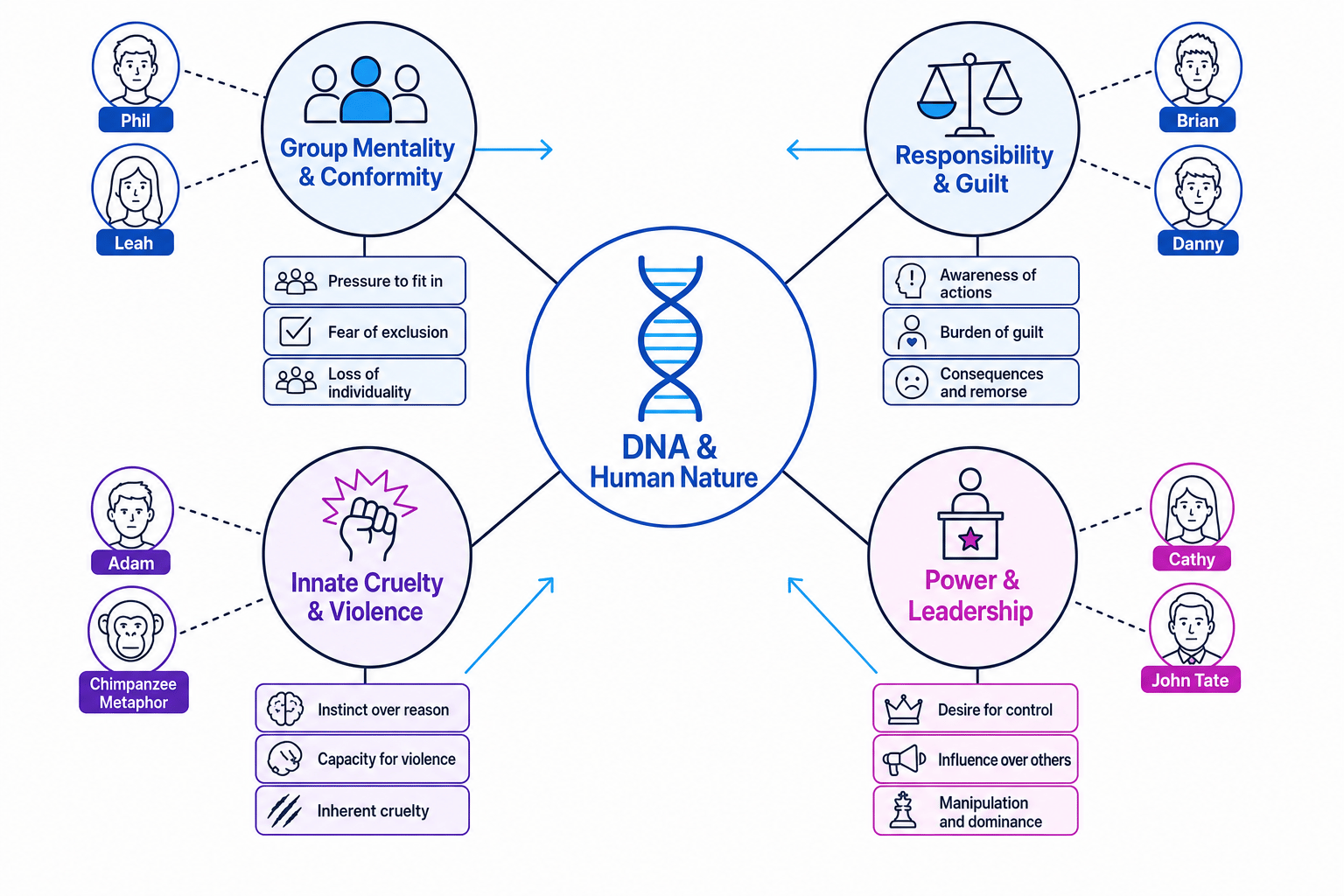
- How Dennis Kelly explores the dangers of group mentality and conformity.
- The way the play examines personal vs. collective responsibility and guilt.
- How the metaphor of the title, DNA, links to themes of innate human cruelty and power.
1. Group Mentality and Conformity
To understand DNA, you must first understand how groups can change individual human behaviour. Kelly is deeply interested in how easily civilized humans can regress into pack-like, animalistic behaviour.
Conformity
Conformity is the act of matching attitudes, beliefs, and behaviours to group norms or politics. In DNA, Kelly demonstrates how the fear of being isolated or excluded forces individuals to conform to horrific decisions.
At the start of the play, the characters are a loose collection of misfits, but the accidental "death" of Adam unites them. Kelly shows that as the group becomes more unified, the individuals within it lose their personal moral compasses.
The Loss of Individuality
Leah is the primary voice of warning against this loss of identity. She notices how the group is swallowing their individual thoughts:
"Suddenly we’re not individuals anymore, we’re a group. We’re an organism."
By comparing the group to an "organism" (a biological term), Kelly suggests that the teenagers have fused into a single living thing that acts instinctively to protect itself. This "organism" does not have a conscience; its only goal is survival.
The Pressure to Fit In
The characters tolerate bullying and cover up crimes because the alternative—being cast out—is too terrifying.
- John Tate uses fear and banishment to keep control: "If anyone says it... I'm gonna bite their face."
- Cathy finds a sense of purpose and social status in the group's criminal actions, quickly rising from a passive follower to a dangerous, active accomplice.
The Price of Belonging
In DNA, belonging to a group comes at a terrible price: the surrender of your own moral agency. To stay in the "organism," you must remain silent and complicit.
2. Innate Cruelty, Power, and Human Nature
The title of the play, DNA, is a direct reference to the genetic code that makes us who we are. Kelly asks a chilling question: Is cruelty written into our very DNA?
The Chimpanzee vs. Bonobo Metaphor
Throughout the play, Leah delivers long monologues to the silent Phil. These are not random ramblings; they are structural devices Kelly uses to introduce the play’s philosophical themes.
In Act 2, Scene 1, Leah discusses our closest evolutionary relatives:
"Chimpanzees are evil. They murder each other... to mark territory... But then there's the bonobos... they're our other cousins... they're peaceful."
The Ape Within Us
Kelly uses Leah’s scientific comparison as an analogy for the teenagers' behaviour.
- The Chimpanzee: Represents the group's violent, territorial, and hierarchical impulses. Their treatment of Adam (throwing stones, laughing as he falls) is chimpanzee-like behaviour.
- The Bonobo: Represents empathy, love, and community. Leah desperately wants the group to be like bonobos, but the play's action suggests that human "DNA" is far more aligned with the violent chimpanzee.
The Transition of Power
Power in the play is fluid and dangerous. It is never held by the most moral person, but by the one most willing to use violence or manipulation.
John Tate (Rule by fear/threats) ──> Phil (Rule by cold, silent calculation) ──> Cathy (Rule by psychopathic enthusiasm)
By the end of the play, Cathy is described by Richard as "cutting first years' hair" and running things with an iron fist. Her ascent to power shows that once violence and cruelty are normalized by a group, the most ruthless individuals will always rise to the top.
3. Responsibility and Guilt
A key thematic conflict in DNA is the struggle between individual responsibility (doing what is morally right as a single person) and collective interest (doing what is best for the group's survival).
Phil's Utilitarianism
Phil is the ultimate pragmatist. He views the situation through a lens of cold, mechanical utility. To Phil, Adam's life is a variable that can be managed. When Adam is found alive in the woods in Act 3, Phil decides he must be killed permanently to protect the group:
"If he comes back... everyone's going to jail... we're joining as a group."
Phil values the structural survival of the group over the life of an individual. He represents a terrifying, amoral logic.
Confusing Phil's Silence for Stupidity
Do not write that Phil is unintelligent because he does not speak much. Phil’s silence is a structural power dynamic. He listens, calculates, and only speaks when he has a plan. His words are functional directives, demonstrating a complete lack of emotional or moral conflict.
The Toll of Guilt
While Phil remains seemingly unaffected by his actions, Kelly uses other characters to show the devastating psychological toll of guilt:
- Brian: He cannot cope with the pressure of the lie. He regresses into childhood, is put on medication, and is seen "eating earth" and playing with plastic cups. His mind has fractured under the weight of his moral compromises.
- Danny: He is obsessed with his career path ("I've got a plan. Dental school.") and views the crime purely as an obstacle to his personal ambition. His guilt is selfish and self-absorbed.
- Leah: Her guilt manifests as an existential crisis. When she realizes she cannot stop Phil or save the group from their own cruelty, she chooses the only moral option left: she walks away and leaves the group entirely.
Worked Example: Writing a Thematic Analysis
Here is how to construct a highly analytical essay paragraph exploring the theme of Responsibility and Guilt in DNA.
Analyzing the Presentation of Guilt and Responsibility
Analyze how Kelly presents the psychological impact of guilt and responsibility through the character of Brian.
-
Formulate a clear thesis statement (AO1/AO3): Begin by stating how Kelly uses the character as a construct to convey a wider thematic message about the human conscience.
- Draft: "Kelly presents the theme of guilt as a destructive force that utterly deconstructs the human psyche. Through the character of Brian, Kelly suggests that ignoring one's personal moral responsibility to conform to a group's lies leads to psychological fragmentation."
-
Integrate precise, memorized evidence (AO1): Introduce a short, powerful quote that illustrates this destruction, contextualizing where it occurs in the play.
- Draft: "This is most vividly demonstrated in Act 3, when the guilt of his complicity reduces Brian to a regressed state of childhood vulnerability, where he is seen 'eating earth' and giggling hysterically, claiming, 'I think I'm finding it quite exciting.'"
-
Analyze the writer's methods and their effects (AO2): Zoom in on specific words, dramatic devices, or symbols, explaining how they construct meaning.
- Draft: "The bizarre, visceral stage direction 'eating earth' serves as a physical manifestation of Brian's mental decay. By consuming dirt, Brian literalizes his moral degradation; he is grounded, dirtied, and broken by the group’s crime. His regression to a child-like state of 'giggling' and finding it 'exciting' is a psychological defense mechanism; his mind has fractured because it cannot reconcile his innate sense of morality with the horrific reality of the cover-up. Kelly uses this regression to show how the pressure of collective guilt physically and mentally hollows out the individual."
-
Link to the play's wider context or message (AO3): Explain why Kelly wanted the audience to see this. What is the social or philosophical warning?
- Draft: "Through Brian's collapse, Kelly warns his contemporary audience of the high cost of moral cowardice. Written in a modern climate where group dynamics often overshadow individual accountability, Brian acts as a tragic warning: when we surrender our individual responsibility to protect a collective lie, we risk destroying our own humanity."
In the exam
- Focus on the "Why": AQA examiners do not want a summary of what the characters do. They want to know why Dennis Kelly wrote the play this way. Always link themes to the writer's intent (e.g., "Kelly uses the theme of peer pressure to warn modern audiences about...").
- Treat characters as constructs: Never talk about Phil, Leah, or Cathy as if they are real people. Use phrases like "Kelly constructs the character of Leah to represent..." or "Through the character of Phil, Kelly symbolizes..."
- Analyze the Stage Directions: DNA is a script, not a novel. Kelly’s stage directions (like Phil’s silent eating, or Brian’s physical regression) are powerful structural methods. Analyzing them counts as AO2 method analysis, just like analyzing spoken dialogue!
Check yourself
- Why is Leah’s monologue about bonobos and chimpanzees highly significant to the theme of human nature?
- How does the change in leadership from John Tate to Phil, and finally to Cathy, reflect Kelly’s ideas about power and violence?
- What happens to Brian and Danny, and how do their reactions to the crime illustrate different ways of dealing with guilt?
