To excel in your GCSE English Literature exam, you must understand more than just "what happens" in The Tempest. You need to understand how Shakespeare structures the events to explore profound ideas about power, revenge, forgiveness, and freedom.
This guide breaks down the plot scene-by-scene, showing how the dramatic structure mirrors the psychological journeys of the characters.
What you'll learn
- The unique structural shape of The Tempest, including Shakespeare's rare adherence to the Classical Unities.
- A clear, act-by-act breakdown of the play's rising action, climax, and resolution.
- How to link key plot developments to the characters' development and central themes.
The Structural Blueprint of the Play
Before examining the plot scene by scene, you must understand the rules Shakespeare used to build this play. Unlike most of his other plays, which jump across different countries and span years, The Tempest is incredibly compressed.
The Classical Unities
A set of rules for drama derived from Aristotle's Poetics. They require a play to have three things:
- Unity of Action: One main plot with minimal, closely related subplots.
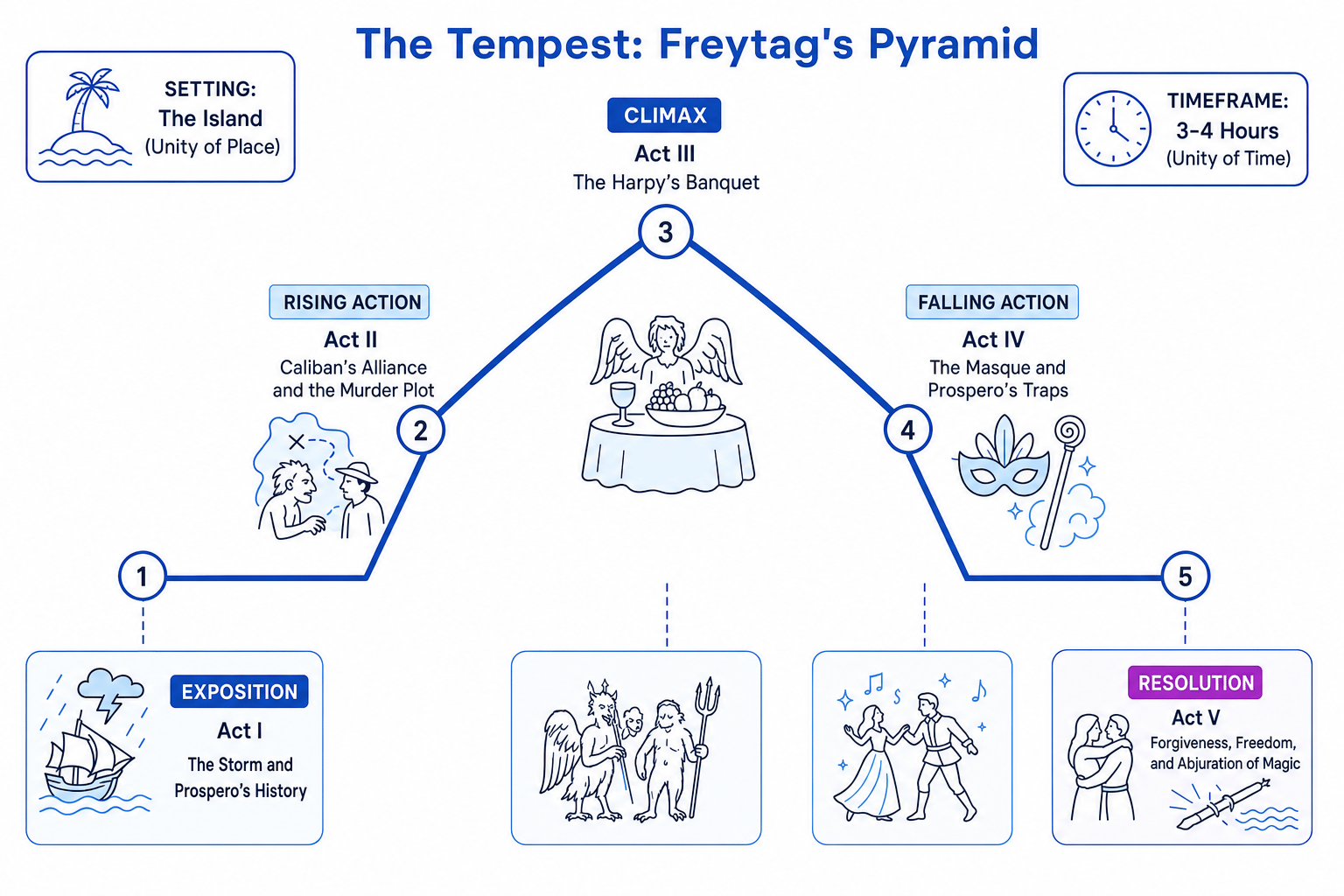
- Unity of Place: A single physical location (the island).
- Unity of Time: The events of the play should take place over no more than 24 hours.
Real-Time Drama
In The Tempest, the events on the island unfold in "real time." The play starts around 2:00 PM and ends at 6:00 PM—precisely matching the actual duration of an afternoon performance in a Jacobean theatre. This intensifies the magical, claustrophobic atmosphere of the island and mirrors Prospero's total, omnipotent control over his "subjects."
To visualize how these unities shape the narrative arc, look at the five-act structure of the play below. It follows Freytag's Pyramid, a framework used to map out dramatic tension.
Act-by-Act Plot Breakdown
Act I: The Storm and the Survivors (Exposition)
- Act I, Scene 1 (The Tempest): The play opens mid-action on a ship caught in a violent, magical storm. We see a breakdown of social hierarchy: the Boatswain orders the royal passengers below deck, shouting, "What cares these roarers for the name of king?" This immediately establishes the theme of power and the subversion of natural order.
- Act I, Scene 2 (The Backstory & Entrapment): We move to the island. Miranda, Prospero’s daughter, is deeply distressed by the shipwreck. Prospero reassures her that no one was harmed and reveals their past through a massive dump of exposition (backstory).
Usurpation
The illegal act of seizing a throne, office, or power by force. Twelve years prior to the play, Prospero was the Duke of Milan before his brother, Antonio, usurped him with the help of Alonso, the King of Naples.
Prospero explains how they were cast adrift and saved by the noble Gonzalo, landing on this enchanted island. We are then introduced to Prospero's two contrastingly captive servants:
- Ariel: A swift, magical spirit imprisoned by the deceased witch Sycorax and rescued by Prospero. Ariel wants his freedom, but Prospero demands absolute obedience first.
- Caliban: The indigenous inhabitant of the island, Sycorax's son, whom Prospero has enslaved after Caliban attempted to rape Miranda. Caliban is resentful and curses Prospero, asserting his rightful ownership of the island: "This island's mine, by Sycorax my mother."
The scene ends with Ariel using magic music to lure Ferdinand (the King's son) to Miranda. They fall in love at first sight—exactly as Prospero planned—though Prospero pretends to be hostile to test Ferdinand’s loyalty.
Act II: Conspiracies and Comedy (Rising Action)
- Act II, Scene 1 (The Courtly Plot): On another part of the island, the noble survivors wash ashore. Alonso, the King of Naples, grieves for his supposedly drowned son, Ferdinand. The kind lord Gonzalo tries to comfort him with a famous utopian speech describing a perfect society without rulers or poverty. Meanwhile, Antonio (Prospero's treacherous brother) and Sebastian (Alonso's brother) mock Gonzalo. While the others sleep under Ariel's spell, Antonio convinces Sebastian to murder Alonso and seize the crown of Naples. Ariel wakes Gonzalo just in time to prevent the murder.
- Act II, Scene 2 (The Comic Plot): We meet the play’s comic relief: Stephano (a drunken butler) and Trinculo (a jester). They stumble upon Caliban hiding under a cloak. After some physical comedy, they share alcohol with Caliban. Mistaking Stephano for a "god" because of the "celestial liquor," Caliban kneels before him, swearing to be his subject and chanting "Ban, 'Ban, Cacaliban, has a new master!"
The Parallels of Power
Notice how Shakespeare uses parallel plots to reinforce his themes. The serious, tragic plot of Antonio and Sebastian trying to assassinate Alonso is mirrored by the low-status, comedic plot of Caliban, Stephano, and Trinculo plotting to murder Prospero. Both plots show how easily human beings are corrupted by the desire for power and control.
Act III: Love and Judgment (The Climax)
- Act III, Scene 1 (The Lovers): Ferdinand is forced by Prospero to perform hard manual labor—carrying heavy logs. Miranda tries to help him, and they declare their mutual love. Prospero watches from hiding, deeply pleased that his plan is succeeding.
- Act III, Scene 2 (The Murder Plot): Caliban, Stephano, and Trinculo grow drunker. Caliban convinces Stephano to murder Prospero in his sleep, take Miranda as his queen, and rule the island. Caliban delivers a beautiful, unexpected speech describing the island’s magic: "Be not afeard, the isle is full of noises, / Sounds, and sweet airs, that give delight and hurt not." This humanizes Caliban and highlights his deep connection to the island.
- Act III, Scene 3 (The Harpy Banquet): The courtly party is exhausted and starving. Prospero uses his magic to present them with a grand banquet, but as they prepare to eat, Ariel descends "like a harpy" (a mythical monster of vengeance) amid thunder and lightning. Ariel denounces Alonso, Sebastian, and Antonio as "three men of sin" and declares that the loss of Ferdinand is their divine punishment for usurping Prospero. The men are driven mad with guilt and terror.
Confusing the Climax
Many students assume the climax of The Tempest is Act V, when Prospero forgives his enemies. Structurally, the climax is Act III, Scene 3 (the Harpy scene). This is the absolute turning point where Prospero's enemies are completely at his mercy, and his ultimate victory is assured. Act V is the resolution, where he chooses how to use that victory.
Act IV: Celebration and Retribution (Falling Action)
-
Act IV, Scene 1 (The Masque and the Trap): Prospero relents and gives Ferdinand his blessing to marry Miranda. To celebrate, he summons a masque—a courtly play featuring spirits playing Roman goddesses (Iris, Ceres, and Juno) who bless the couple with fertility and prosperity. Suddenly, Prospero remembers Caliban’s murder plot. He abruptly dismisses the spirits, delivering his famous, melancholic speech about the transience of life:
"Our revels now are ended. These our actors, / As I foretold you, were all spirits, and / Are melted into air, into thin air... We are such stuff / As dreams are made on; and our little life / Is rounded with a sleep."
Prospero and Ariel then set a trap for the conspirators. They hang glittering clothes on a line; Stephano and Trinculo are distracted by the cheap garments, ignoring Caliban's desperate pleas to focus on the murder. Prospero and Ariel unleash spirits in the shape of hunting hounds to chase them away.
Act V: Forgiveness and Freedom (Resolution)
- Act V, Scene 1 (The Resolution): Ariel reports that the court party are locked up, weeping, and driven mad. Ariel remarks that if he were human, his "affections would become tender" at the sight. Moved by a spirit's capacity for sympathy, Prospero decides to show mercy, declaring: "The rarer action is / In virtue than in vengeance." He decides to forgive his enemies.
Abjuring Magic
Before confronting his enemies, Prospero performs a ritual to give up his supernatural power: "this rough magic I here abjure." He promises to break his magic staff and "drown my book" deep in the sea. This signifies his return to the ordinary, mortal human world.
Prospero reveals himself to the court party in his Duke's robes. Alonso immediately repents and restores Prospero's dukedom. Prospero "reveals" Ferdinand and Miranda playing chess, proving Ferdinand is alive. Alonso is overjoyed.
Prospero acknowledges Caliban, stating, "this thing of darkness I / Acknowledge mine." Caliban repents his foolishness in worshiping Stephano and vows to "seek for grace."
Finally, Prospero grants Ariel his long-awaited freedom: "My Ariel, chick, / That is thy charge. Then to the elements / Be free, and fare thou well!"
- Epilogue: Prospero stands alone on the empty stage. In a direct address to the audience, he explains that his magic is gone, and he is now trapped on the stage unless the audience "frees" him with their applause.
Worked Example: Analyzing a Turning Point
Analyzing the climax of the banquet scene
If you are asked to analyze how Shakespeare presents the theme of justice or retribution in the play, you can walk through these steps to craft a strong, high-scoring paragraph:
- Identify the dramatic function of the scene within the play’s structure. Act III, Scene 3 is the climax where Prospero uses Ariel to confront his enemies. State that the sudden transition from a peaceful "banquet" to a terrifying "Harpy" disrupts the expectations of the courtly characters, marking the peak of Prospero's power.
- Examine Shakespeare's theatrical methods (the stage directions and Ariel's speech). Look at the physical action on stage. Ariel enters "like a harpy" with "thunder and lightning" and "claps his wings upon the table." Explain that the Harpy is a classical symbol of divine vengeance. This makes the confrontation feel like a cosmic judgement rather than just a personal grudge.
- Analyze the linguistic choices within the core quotation. Focus on Ariel's declaration: "You are three men of sin." The direct pronoun "You" singles out Alonso, Sebastian, and Antonio. The noun "sin" frames their political usurpation of Milan as a spiritual transgression. This appeals to a Jacobean audience's belief in the Divine Right of Kings (the idea that deposing a rightful ruler was a sin against God).
- Evaluate the distinct reactions of the characters to determine how the plot resolves. Notice how the plot branches based on character reactions. Alonso feels immediate guilt, crying that the "billows" spoke his transgression, which sets up his redemption in Act V. In contrast, Sebastian and Antonio draw their swords in defiance, showing they remain unrepentant. This contrast highlights that true justice requires active repentance.
The Silent Antonio
In Act V, when Prospero forgives his brother Antonio, Antonio does not speak a single word of apology or acceptance. For a top-grade AO1 response, note that this silence leaves the ending ambiguous. It suggests that while Prospero has achieved moral growth by choosing forgiveness, the political corruption of the real world cannot be magically cured.
In the exam
- Never write a purely chronological summary. The examiner knows the story. Every time you mention a plot point, immediately explain why Shakespeare structured it that way and what theme or character trait it reveals.
- Use correct structural terminology. Refer to "exposition," "rising action," "climax," "parallel subplots," and "the classical unities" rather than just "the beginning" or "the middle."
- Link structure to context (AO3). Explain how the tight time constraint (Unity of Time) mirrors the growing anxiety of King James I's court regarding political conspiracies and the preservation of order.
Check yourself
- How does the comic subplot involving Stephano, Trinculo, and Caliban mirror the serious courtly plot?
- Why is it significant that The Tempest takes place over exactly four hours?
- What is the structural climax of the play, and why does it occur in Act III?
