Understanding the plot of Dennis Kelly’s DNA is about much more than just memorising "what happens." Because DNA is a modern drama piece, its plot is inseparable from its structure. Kelly structures the play like a mathematical equation or a cycle, repeating specific settings and character pairings to show how the characters' morality slowly decays.
By mastering the plot summary, you will be able to trace how a single, panicked lie spirals into cold-blooded murder, and how the group’s power dynamics shift along the way.
What you'll learn:
- How Dennis Kelly uses a four-part structure to mirror the escalating moral crisis of the group.
- The role of repeating settings ("A Street", "A Field", "A Wood") in structuring the play's tension.
- Key narrative turning points, from the initial cover-up to the chilling final resolution.
The Core Structure: A Four-Part Cycle
To understand the plot of DNA, you must first understand its structural framework. The play does not use traditional acts. Instead, it is divided into four distinct sections, each following a repeating, cyclic pattern of three distinct settings.
Cyclic Structure
A cyclic structure is a literary device where elements, settings, or events are repeated in a specific pattern, often returning to where they began. In DNA, this structure emphasizes that despite trying to move forward, the characters are trapped in an inescapable loop of their own making.
Every one of the first three sections of the play moves through the same three locations in the exact same order. Section 4 breaks this pattern slightly to show the permanent damage done to the characters.
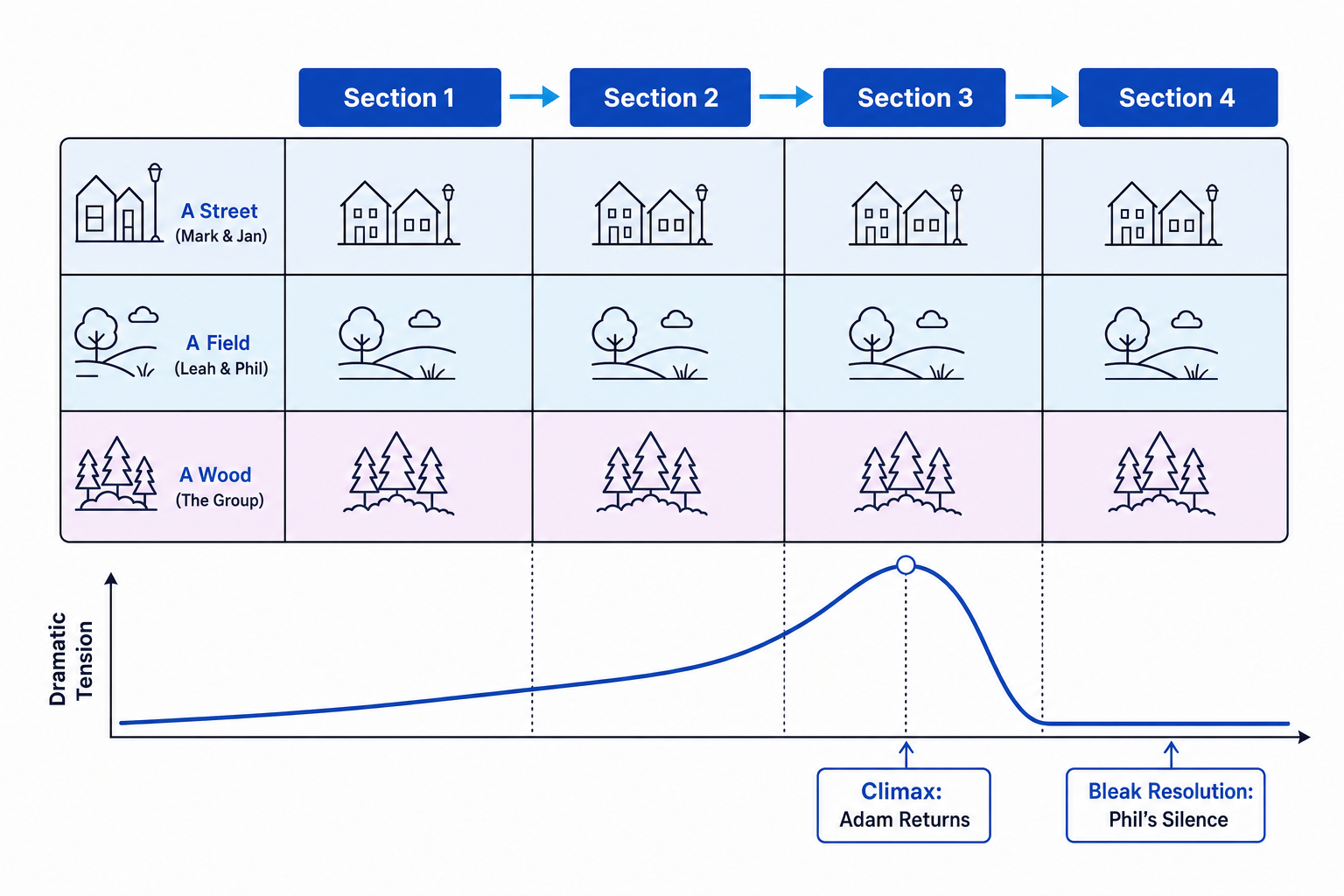
The Three Repeating Locations
- A Street: Every section opens with a short, rapid-fire conversation between Jan and Mark. They act as a modern Greek chorus, delivering essential plot updates (exposition) to the audience.
- A Field: We then transition to a quiet field, where Leah delivers frantic, existential monologues to a completely silent Phil. This location provides a psychological window into the moral weight of their actions.
- A Wood: This is where the wider group meets. It is dark, secretive, and dangerous. The wood is where the group's critical decisions are made, where their crimes are planned, and where their violence escalates.
Plot Breakdown by Section
Let's walk through the plot chronologically, looking at how the tension builds across these repeating locations.
Section 1: The Inciting Incident and the Plan
The play opens with Jan and Mark on A Street, panicking that "someone's dead." This is the play's inciting incident—the event that disrupts the status quo and sets the plot in motion.
We move to A Field, where Leah talks about chimp behaviour, empathy, and nature, while Phil silently eats an ice cream.
In A Wood, the full group gathers. We learn the backstory of what happened to Adam. In a desperate bid to fit into the group, Adam was subjected to horrific bullying—being made to eat leaves, drink warm Coke, and walk across a deep, open grille over a vertical shaft. He fell in, and the group believes he is dead.
The Birth of Phil's Leadership
When the group collapses into panic and self-pity, John Tate (the nominal leader) loses control. Phil suddenly steps forward, breaks his silence, and delivers a cold, precise, step-by-step plan to frame a non-existent, middle-aged postman to cover up their crime. This moment establishes Phil's chilling pragmatism.
Section 2: The Cover-Up and the Frame-Up
The pattern repeats. On A Street, Jan and Mark reveal that the cover-up is working, but a real man matching Phil's fake description has actually been arrested.
In A Field, Leah questions her own worth to Phil, comparing her love for him to a dog's devotion. Phil remains silent, eating a waffle.
In A Wood, the group meets in a state of high anxiety. The police have found "DNA evidence" on a direct item of clothing belonging to the framed postman. Rather than back down, Phil commands the group to escalate the lie. He instructs Brian to find the postman's actual genetic material, and forces Cathy to put Adam's DNA onto a sweater and place it on the innocent suspect.
Confusing the Two 'Deaths' of Adam
Many students mistakenly write that Adam dies in Section 1 when he falls down the shaft. He does not. He survives the fall, but is later murdered in Section 3. Make sure you keep these two key plot points separate when writing about structural progression.
Section 3: The Climax (Adam's Return)
On A Street, Jan and Mark deliver a shocking plot twist: "He's alive."
In A Field, Leah monologues about a feral pet chimpanzee that attacked its owner, foreshadowing the group's capacity for raw, animalistic violence.
In A Wood, the group discovers that Adam is indeed alive. He has been living in the woods, badly brain-damaged, dirty, and feral. He does not fully understand who he is or what has happened.
This is the dramatic climax of the play. The group faces a terrible moral choice: do they bring Adam back and admit their lies, or do they silence him forever to protect themselves?
Leah desperately pleads for Adam’s life, but Phil takes charge once more. Recognising that Adam's return would expose their massive web of lies and send them to prison, Phil decides Adam must die. He instructs Cathy to suffocate Adam with a plastic bag. Devastated by Phil's coldness and her own complicity, Leah walks away from Phil forever.
Leah's Departure
Leah does not witness the murder of Adam. She runs away in protest when Phil gives Cathy the instructions to "use the plastic bag." Ensure you note her departure before the act itself takes place.
Section 4: The Aftermath
The final section breaks the established cycle. There is no scene in the Wood, representing the destruction of the group's unity.
On A Street, Jan and Mark express deep unease about the aftermath.
In A Field, Phil sits completely alone and silent. Leah is gone; she has moved to a different school. Richard attempts to talk to Phil, stepping into Leah's old role by delivering a monologue to Phil’s silence. Richard reveals the bleak fates of the other characters:
- John Tate has had a nervous breakdown and found God.
- Danny is at dental school but is deeply unhappy and "hates clinical dentistry."
- Brian is on strong medication and spends his days staring at the wall.
- Cathy has become a tyrannical, violent leader, showing no remorse.
The play ends in total, unresolved silence from Phil, symbolizing the spiritual and moral death of the characters.
Analysing Structural Shifts in Power
To get top marks in your GCSE exam, you must not simply retell the plot. You must show how Kelly uses the plot's structure to communicate his deeper ideas about power, responsibility, and human nature.
Let's look at how to construct a paragraph analyzing a key structural transition.
Analysing a structural turning point
How does Kelly use the transition from Section 2 to Section 3 to explore the corrupting nature of power?
- State the structural context and point: Kelly uses the transition between the rising action of Section 2 and the climax of Section 3 to show how easily moral boundaries collapse when group survival is threatened.
- Provide textual evidence of the shift: In Section 2, the group is unified under Phil's cold logic to frame an innocent man, but by Section 3, the reality of Adam's survival ("He's alive") shatters their illusion of control and demands a far more extreme use of power.
- Analyse the writer's methods: Kelly contrasts the chaotic panic of the group with Phil’s monosyllabic, calculated commands. The sudden shift in setting to the deep woods, coupled with the horrific visual symbol of the "plastic bag," highlights the group's transition from passive bullies to active murderers.
- Link to key themes and writer's intent: By structuring this climax around a choice between confession and murder, Kelly suggests that power, once acquired through deceit, inevitably demands greater acts of violence to sustain itself, exposing the dark animal instincts lurking beneath civilized teenage society.
The Role of Jan and Mark
Think of Jan and Mark as the "gatekeepers" of the plot. Every time they appear on "A Street", they accelerate the pace. Whenever you write about the play's structure, note how Kelly uses these short, fast-paced scenes to create a sense of inevitable momentum, dragging the audience quickly from one moral crisis to the next.
In the exam
- Avoid the "plot-retelling" trap: Never write "First this happens, then that happens." Always frame your points around why Kelly structured the plot this way (e.g., "Kelly structures Section 3's climax to highlight...").
- Utilise structural terms: Use words like exposition, inciting incident, rising action, climax, resolution, and cyclic structure to describe the progression of events.
- Trace the emotional arc: Note how the characters' language changes as the plot advances. In Section 1, they speak in frantic, overlapping fragments; by Section 4, they are either silent (Phil) or deeply damaged (Brian).
- Anchor events to settings: Always mention where a scene takes place. The physical contrast between the open, exposed Field and the dark, hidden Wood is central to how Kelly illustrates the cover-up.
Check yourself
- Can you list the four main characters whose mental states or social situations are ruined by the end of Section 4, and explain what happens to them?
- What are the three repeating locations used in the play, and which specific characters are associated with each location?
- Why is the absence of a "Wood" scene in Section 4 structurally and symbolically significant to the play's ending?
