Welcome to your study guide for Dennis Kelly's gripping modern drama, DNA. First performed in 2007, this play plunges us into a dark, contemporary world where a group of teenagers commits a terrible crime and must deal with the moral and social consequences.
For your GCSE English Literature Paper 2 exam, you need to understand how Kelly uses this tense narrative to explore deeper questions about human nature, group dynamics, and morality.
What you'll learn
- The core premise and four-act structural arc of the play.
- How power operates within the teenage hierarchy.
- How to link the characters' actions to the central theme of human evolutionary behavior.
What is DNA?
At its heart, DNA is a psychological thriller and a modern tragedy. The story begins in the aftermath of a disaster: a group of teenagers has bullied and accidentally "killed" one of their peers, Adam, by throwing stones at him until he fell into a deep grille. Rather than taking responsibility, they band together under the silent, chilling leadership of Phil to execute a complex cover-up.
To understand the play, you must first understand three essential concepts that Kelly weaves into the drama:
Groupthink
A psychological phenomenon where the desire for harmony or conformity within a group results in irrational or dysfunctional decision-making. In DNA, the teenagers abandon their individual morality to align with the group's survival instinct.
Nihilism
The rejection of all religious and moral principles, often characterized by the belief that life is meaningless. Some characters in the play act with a cold, nihilistic detachment, viewing human life as expendable for the sake of the collective.
The Core Conflict
The central tension in the play is not just "will they get caught?", but rather the struggle between individual conscience (represented by Leah) and collective preservation (represented by Phil).
Structure and Settings
Kelly structures the play with a highly deliberate, symmetrical layout across four acts. The action alternates between three distinct locations:
- A Street – A transitory, urban space where two characters (usually Leah and Phil) sit.
- A Wood – A dark, natural environment where the gang meets. This symbolizes a regression to a more primitive, lawless state of human nature.
- A Field – An open, exposed space where characters reflect on what they have done.
This cyclical pattern of locations highlights how the characters are trapped in a loop of their own making. No matter what they plan, they cannot escape the consequences of their actions.
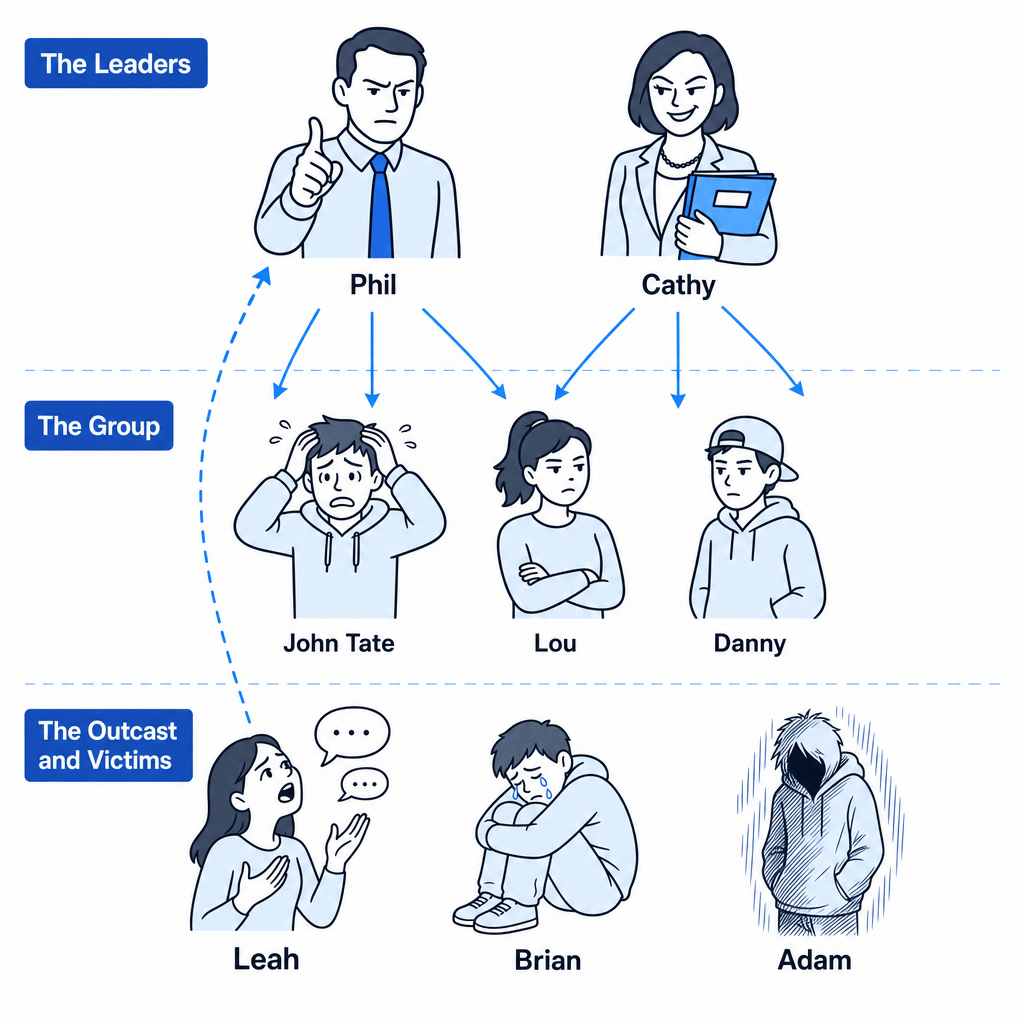
Power Dynamics in the Group
As you can see from the relationship map above, the social structure of the group is volatile. At the start of the play, John Tate is the nominal leader, using fear and threats ("Anyone whispers, anyone even looks like they're going to whisper...") to maintain control.
However, when panic sets in, John Tate's authority crumbles, and Phil steps into the vacuum. Phil rarely speaks, but when he does, his words are precise, transactional, and terrifyingly pragmatic.
Watch the silence!
Phil’s power comes from his silence. While Leah talks incessantly, desperate for reassurance, Phil eats his ice cream, chips, or waffles. His physical consumption of food while others panic shows his cold detachment and absolute control.
On the other hand, we see Cathy progress from a minor follower to a chillingly ruthless lieutenant. She actually enjoys the excitement of the cover-up, showing how quickly ordinary human empathy can disintegrate under the influence of group power.
Ignoring Cathy's evolution
Many students only focus on Phil and Leah. However, Cathy is crucial. She represents the terrifying ease with which individuals can become desensitized to violence. By Act 4, she is described as "running things," showing that she has inherited Phil's cold, pragmatic leadership style.
Analyzing the Play's Themes (Worked Example)
To achieve top marks in your GCSE (particularly for analysis of language and structure), you must link the characters' words to Kelly’s broader thematic messages.
Let's look at one of Leah's famous monologues where she compares humans to our evolutionary ancestors, the chimps and bonobos.
Analyzing a thematic monologue
Read the following quotation from Leah in Act 2, Scene 1:
"It's chimps, Leah, chimps are evil. They murder each other... we’re chimps."
Analyze how Kelly uses this scientific comparison to explore the theme of human nature.
- Identify the method and its immediate meaning: Note that Leah is using a scientific analogy (zoomorphism) to explain the group's violent behavior. By comparing the teenagers to "chimps" rather than "bonobos" (who are peaceful and matriarchal), she suggests that violence is hardwired into their genetic makeup—their "DNA".
- Examine the linguistic choices: Look at the simple, declarative sentence structure: "we’re chimps." The use of the collective pronoun "we" highlights that no one in the group is innocent. The monosyllabic, blunt adjective "evil" strips away any complex psychological excuses; she is confronting the raw, animalistic cruelty of their actions.
- Link to context and writer's intent (AO3): Explain that Dennis Kelly is questioning the concept of civilization. He suggests that beneath our modern social rules, humans retain a primitive, tribal instinct to destroy threats and protect the pack. Leah's monologue acts as a warning: if we do not actively choose empathy (like the bonobos), we will naturally regress to savage brutality.
The Ant Colony
Think of the group in DNA like an ant colony. To an ant, the survival of the nest is the only thing that matters. If an individual ant is injured or threatens the nest's safety, it is discarded without emotion. Phil treats the group exactly like this—human individuals (like Brian or Adam) are sacrificed to preserve the collective "nest".
Context and the Writer's Perspective (AO3)
When writing about DNA, you must consider the context of its creation. It was written in the mid-2000s, a period marked by intense media anxiety about "hoodies," teenage gang culture, and anti-social behavior in the UK.
However, Kelly does not write DNA to condemn teenagers as uniquely evil. Instead, he uses them as a microcosm of wider society.
A Microcosm of Society
A microcosm is a miniature representation of something much larger. Kelly uses this small group of school children to mirror how adult governments and societies justify horrific acts (like wars or cover-ups) under the banner of "the greater good" or national security.
- Moral Relativism: The play shows what happens when a society loses its moral compass. Without strong parental or institutional guidance (notice how adults are entirely absent from the stage, only mentioned as distant, ineffective figures), the teenagers construct their own terrifying moral code based entirely on survival.
Don't just list context!
Do not simply write "this play is about teenage gangs in the 2000s." To get the best marks, always tie context directly to the language. For example: "Kelly's complete omission of adult characters on stage physically represents the isolation of the youth and the breakdown of traditional social structures."
In the exam
- Focus on the "How": Never just retell the plot. The examiner knows what happens. Instead, focus on how Kelly presents ideas. Use verbs like "Kelly constructs," "Kelly symbolizes," or "Kelly juxtaposes."
- Track the character arcs: If you get a question on power or guilt, structure your essay chronologically. Show how a character starts, how they change after the crisis, and where they end up.
- Embed short, sharp quotes: Because this is a closed-book exam, memorize brief, highly versatile quotes. For example, Phil's "Do you want to come back?" is short, but it perfectly reveals his manipulative power and how he uses fear to control the others.
Check yourself
- Why does Dennis Kelly set scenes in "A Wood" when the group is planning their most sinister actions?
- How does the character of Brian change from the beginning of the play to the end, and what does this show about the psychological cost of guilt?
- What is the symbolic significance of Phil constantly eating throughout his scenes?
