What you'll learn
- The basic “shape” of The Tempest: setting, conflict, ending, and dramatic design.
- Why the play is often called a romance rather than a simple comedy.
- How to connect big ideas like power, freedom, forgiveness and illusion to short, memorable quotations.
- How to turn overview knowledge into a clear GCSE Literature response.
The play in one paragraph
The Tempest is a Shakespeare play first performed around 1611. It begins with a violent storm at sea, caused by Prospero, the exiled Duke of Milan, who now lives on a mysterious island with his daughter Miranda. Prospero uses magic to bring his enemies to the island, test them, punish betrayal, arrange Miranda’s marriage to Ferdinand, and finally choose forgiveness over revenge. By the end, he gives up his magic, frees Ariel, forgives his enemies, and prepares to return to Milan.
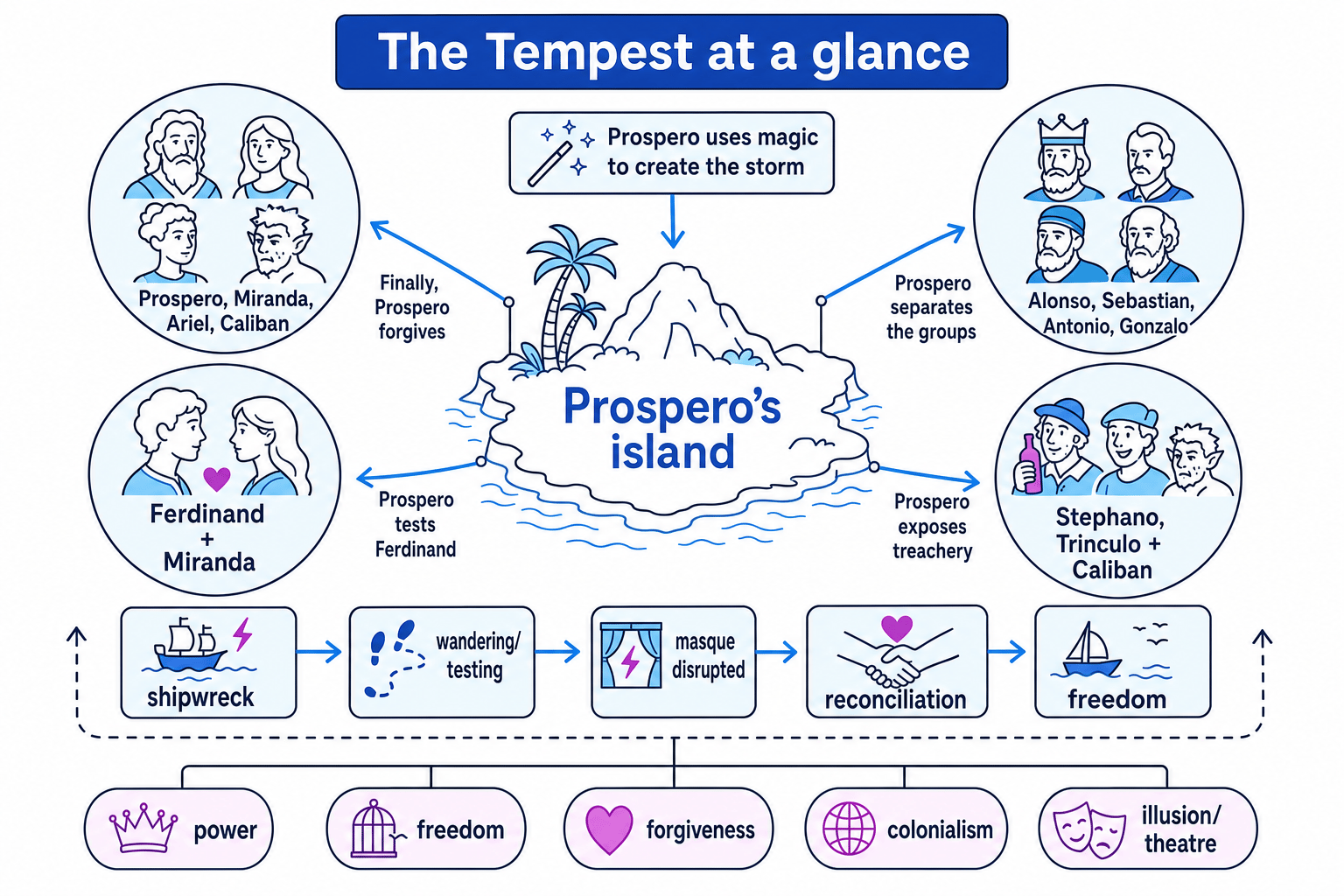
The core journey
At its simplest, The Tempest moves from disorder to restoration: a storm breaks social order apart, but Prospero’s control of events eventually creates political reconciliation, marriage, freedom and return.
The title: why “tempest” matters
A tempest is a violent storm. Shakespeare’s title works on two levels.
First, it refers to the literal storm in Act 1 Scene 1, when Alonso’s ship appears to be wrecked. This throws the characters into panic and confusion.
Second, it suggests emotional and political storms: betrayal, revenge, fear, guilt, love and forgiveness. The storm is not just weather; it is a way of making hidden conflicts visible on stage.
Pathetic fallacy
Pathetic fallacy is when weather or the natural world reflects human emotions or conflict. In The Tempest, the storm reflects the disorder caused by betrayal and Prospero’s desire for control.
Genre: not just a comedy
Shakespeare’s plays are often grouped into tragedies, comedies, histories and romances. The Tempest is usually described as a romance.
Romance
A Shakespearean romance is a late play that mixes danger, loss, magic, family separation, forgiveness and a hopeful ending. It is not “romance” only in the modern sense of love stories.
The play has comic elements: Stephano and Trinculo provide drunken physical comedy, and the ending includes marriage. However, it also contains darker material: attempted murder, enslavement, threats of sexual violence, political usurpation and revenge.
So, when you write about the play, avoid making it sound too simple. Shakespeare creates a world where comedy and cruelty sit very close together.
Calling it a simple comedy
Do not say The Tempest is only a happy comedy. Its ending is restorative, but the play explores serious questions about power, justice, freedom and whether forgiveness is morally stronger than revenge.
Using genre to deepen an interpretation
- Start with the surface ending: Prospero forgives his enemies, Miranda and Ferdinand will marry, and political order is restored.
- Add the romance pattern: the play moves through suffering, separation and magical testing before reaching reconciliation.
- Use Prospero’s line, “The rarer action is / In virtue than in vengeance” from Act 5 Scene 1, to show that the ending is not just happy; it presents forgiveness as a difficult moral choice.
- Link to Shakespeare’s method: the contrast between “virtue” and “vengeance” creates a moral opposition, making Prospero’s decision feel like a test of character rather than a simple plot resolution.
Setting: the island as a stage
Most of the play takes place on an unnamed island. This matters because the island is isolated from normal society. Away from Milan and Naples, characters reveal what they truly want: power, freedom, love, comfort, revenge or forgiveness.
The island can feel magical and beautiful, especially in Caliban’s speech: “The isle is full of noises” in Act 3 Scene 2. But it can also feel like a prison. Ariel wants liberty, Caliban resents Prospero’s rule, and even the shipwrecked nobles are trapped in Prospero’s plan.
Setting
Setting means where and when a text takes place. In drama, setting affects what can happen on stage and what ideas the audience is invited to think about.
The island’s double meaning
The island is both a place of wonder and a place of control. Shakespeare uses it to explore whether power can ever be used fairly.
Structure: how Shakespeare organises the action
Structure
Structure means how a text is organised: the order of events, changes in mood, contrasts between scenes, and how the beginning connects to the ending.
The Tempest has a very controlled structure. Prospero creates the storm at the start, then manages much of what happens afterwards. The play roughly follows this movement:
- Storm and separation: the shipwreck scatters the characters.
- Explanation: Prospero tells Miranda about their past and his betrayal.
- Testing and temptation: Ferdinand is tested; Antonio and Sebastian plot murder; Caliban joins Stephano and Trinculo.
- Masque and interruption: Prospero stages a magical performance, but remembers Caliban’s plot.
- Recognition and reconciliation: Prospero reveals himself, forgives his enemies, frees Ariel and gives up magic.
Masque
A masque was a courtly entertainment involving music, dance, spectacle and symbolic figures. In Act 4 Scene 1, Prospero stages a masque to celebrate Ferdinand and Miranda’s future marriage.
The structure makes Prospero feel like a director inside the play. He arranges scenes, controls timing, and reveals information when he chooses.
Metatheatre
Metatheatre is when a play draws attention to itself as theatre. In The Tempest, Prospero’s magic often resembles stagecraft: he creates illusions, directs events and finally gives up his “art”.
A useful overview sentence
You can describe the play as “a tightly controlled romance in which Prospero stages a journey from chaos to reconciliation.”
Prospero: ruler, father, victim and controller
Prospero is central to almost every part of the play. Before the action begins, he was Duke of Milan, but his brother Antonio took his position. Prospero and Miranda were sent away and eventually reached the island.
This makes Prospero a victim of political betrayal. However, on the island he also becomes a powerful ruler. He controls Ariel through promises of freedom and controls Caliban through threats and punishment.
This is why Prospero is not a simple hero. Shakespeare makes him sympathetic in some ways, but also troubling.
Prospero is morally complicated
Prospero’s journey is not just about getting power back. It is about learning how to use power — and when to give it up.
Short quotations to remember:
- “I must obey” — Ariel, Act 1 Scene 2.
- “This island’s mine” — Caliban, Act 1 Scene 2.
- “I’ll break my staff” — Prospero, Act 5 Scene 1.
- “The rarer action is / In virtue than in vengeance” — Prospero, Act 5 Scene 1.
Big ideas without overloading yourself
For an overview, you do not need to memorise every theme in detail yet. Start with four big ideas.
Power
Power appears in politics, family, magic, language and physical control. Antonio steals Prospero’s dukedom. Prospero controls the island. Caliban argues that the island was taken from him. Ariel serves Prospero but longs to be free.
Freedom
Many characters are trapped in different ways. Ariel wants release from service. Caliban wants freedom from Prospero. Ferdinand is made to carry logs. Prospero himself is trapped by his desire for revenge until he chooses forgiveness.
Forgiveness
The ending depends on Prospero deciding not to take revenge. His line “virtue” rather than “vengeance” presents mercy as stronger and rarer than punishment.
Illusion and theatre
Magic, music, spirits and visions shape the play. Prospero’s famous speech, “We are such stuff / As dreams are made on” in Act 4 Scene 1, connects life, dreams and theatre. Shakespeare invites the audience to think about how fragile human power and ambition are.
Moving from a big idea to analysis
- Choose the big idea: forgiveness. Prospero has the power to punish the people who betrayed him.
- Select precise evidence: “The rarer action is / In virtue than in vengeance.”
- Analyse the language: “rarer” suggests forgiveness is unusual and difficult, while the contrast between “virtue” and “vengeance” presents two moral paths.
- Link to the play’s structure: because this comes near the end, Shakespeare makes Prospero’s choice the turning point from revenge to reconciliation.
- Connect to meaning: the play suggests true authority is shown not through domination, but through self-control and mercy.
Context: what helps, and what does not
Context
Context means the historical, social, cultural and literary circumstances around a text’s creation and reception.
For AQA, context is rewarded when it genuinely helps your interpretation. You do not need to bolt on random facts about Shakespeare.
Useful overview context includes:
- Jacobean monarchy: the play was written during the reign of King James I, when ideas about kingship, authority and order mattered strongly.
- Exploration and colonialism: European voyages influenced ideas about islands, “new worlds” and ownership. Caliban’s treatment raises questions about conquest and control.
- Magic and learning: Prospero’s books give him power. Jacobean audiences could see magic as both fascinating and dangerous.
- Theatre and performance: Prospero’s illusions can be read as a reflection of Shakespeare’s own theatrical art.
Bolted-on context
Avoid sentences like “In Jacobean times people believed in magic” unless you connect it to the play. Better: “Prospero’s magic would have seemed both impressive and morally risky to a Jacobean audience, which makes his decision to give it up more significant.”
How the exam rewards overview knowledge
In AQA Paper 1, you answer on Shakespeare in a closed-book exam. You will be given an extract and then asked to write about the extract and the play as a whole.
Strong answers usually do three things:
- make a clear argument about the question;
- analyse Shakespeare’s methods, not just the events;
- connect the extract to the wider play.
Method
A method is a deliberate choice made by the writer, such as language, imagery, structure, dramatic contrast, symbolism, stagecraft or form.
For The Tempest, useful methods include:
- symbolism: the storm can symbolise disorder and emotional conflict;
- dramatic contrast: noble characters behave dishonourably, while supposedly “less powerful” characters sometimes speak with insight;
- stagecraft: music, spirits, spectacle and entrances/exits create wonder and control;
- blank verse and prose: high-status or serious speech often uses verse, while comic scenes often use prose;
- motifs: repeated ideas such as sleep, dreams, music, service and freedom.
Motif
A motif is a repeated image, idea or pattern that helps develop meaning across a text.
A simple way to remember the whole play
Think of Prospero as someone who begins by controlling the storm outside himself, then has to control the storm inside himself.
At the start, he uses magic to master others. By the end, he must master his own desire for revenge. That is why his renunciation of magic matters: “I’ll break my staff” and “I’ll drown my book” show him giving up the tools that made him powerful.
The overview in one sentence
The Tempest is a romance about a powerful man who uses art and magic to repair a broken political world, but must finally learn that mercy and freedom matter more than control.
In the exam
- Begin with a clear argument about the question, not a plot summary: “Shakespeare presents Prospero’s power as impressive but morally unstable.”
- Use short, accurate quotations you can remember, then zoom in on one or two key words.
- Link the extract to the wider play by mentioning where the idea changes: for example, Prospero moves from control and revenge towards forgiveness and renunciation.
Check yourself
- Why is The Tempest often described as a romance rather than a simple comedy?
- How does the island help Shakespeare explore power and freedom?
- What does Prospero’s decision to give up magic suggest about his character by the end?
