Writing a top-tier essay on Willy Russell’s Blood Brothers requires more than just retelling the tragic story of Mickey and Edward. The examiners want to see a structured, critical argument that treats the play as a deliberate piece of theater.
In this guide, you will learn how to deconstruct exam questions, build high-level analytical paragraphs, and integrate context naturally to unlock the highest marks.
What you'll learn:
- How to satisfy AQA’s Assessment Objectives (AOs) specifically for a modern drama text.
- The "Analytical Loop" method for structuring paragraphs that flow naturally.
- How to analyze Russell's dramatic techniques rather than just analyzing the characters as real people.
- How to weave 1980s social and historical context directly into your literary analysis.
The Prerequisites: Understanding the AQA Assessment Objectives
Before putting pen to paper, you must understand exactly how you are being assessed on Paper 2, Section A (Modern Texts). For Blood Brothers, your marks are divided across three key areas:
- AO1: Clear Argument & Evidence: This is your ability to maintain a focused point that answers the prompt directly, using well-chosen, short, embedded quotations.
- AO2: Writer's Methods: This is where you analyze how Russell uses language, structure, form, and dramatic devices to create meaning.
- AO3: Context: This is your understanding of the relationship between the play and the social, historical, and political landscape of Britain when it was written and set.
Construct
A construct is a character designed by a writer to represent a specific idea, theme, or social group, rather than to exist as a real person. In Blood Brothers, Mickey and Edward are constructs used to show the impact of class inequality.
Characters are Tools
Never write about Mickey, Edward, Mrs. Johnstone, or Mrs. Lyons as if they are real people who make independent choices. Always write about them as tools used by Willy Russell to deliver his message. Use phrases like: "Russell constructs Mickey to represent..." or "Through the character of Mrs. Lyons, Russell exposes..."
The Structural Formula: The Analytical Loop
A common trap for students is writing a "PEE" paragraph (Point, Evidence, Explanation) that feels like a mechanical checklist. To reach Level 5 and 6 (Grade 8/9), your analysis must be fluid. Every detail must connect back to the writer's overarching message.
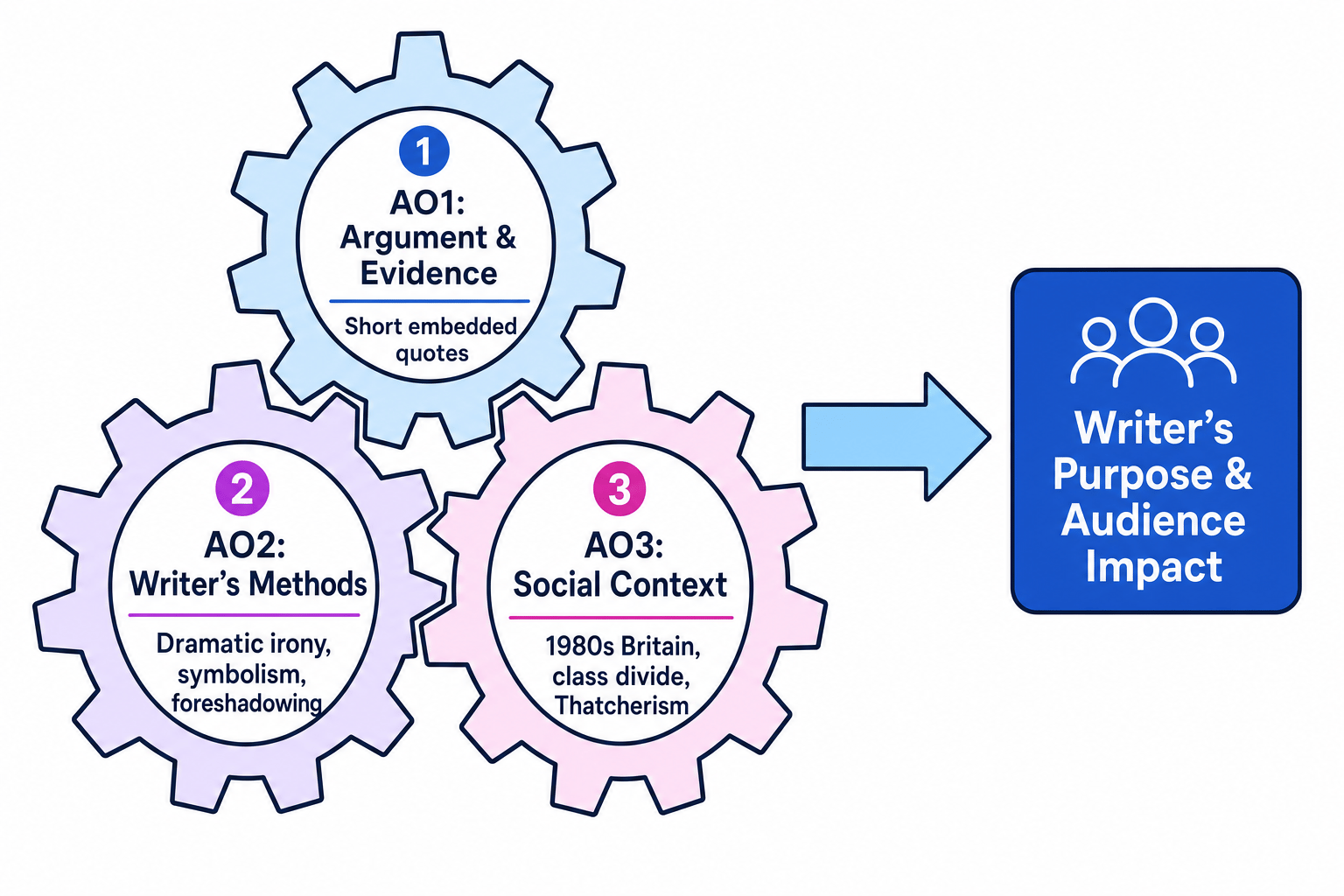
We call this the Analytical Loop. Instead of treating context (AO3) as an afterthought tacked onto the end of a paragraph, it must lock together with your language analysis (AO2) and your main thesis argument (AO1).
Didactic Theatre
Didactic theatre is a form of drama intended to teach the audience a moral, political, or social lesson. Russell uses Blood Brothers as a didactic play to challenge the audience's assumptions about class and opportunity.
To make your analysis seamless, use the following five-part loop within every body paragraph:
- The Conceptual Point (AO1): Make a bold claim about what Russell is doing and why.
- The Integrated Evidence (AO1): Weave a short quotation (1–5 words) directly into your sentence.
- The Method Identified (AO2): Name the specific linguistic or dramatic device Russell employs.
- The Deep Analysis (AO2): Explain the connotations of the words and the dramatic effect on the audience.
- The Contextual Pivot (AO3): Explain how this reflects the realities of 1970s/1980s Britain (e.g., Thatcherism, deindustrialization, or the class divide).
Worked Example: Building a Grade 9 Paragraph
Let’s see how to build a high-scoring paragraph step-by-step.
We will use the exam question: How does Russell present the influence of class on the lives of Mickey and Edward?
Drafting a high-level analytical paragraph
- Formulate a conceptual topic sentence (AO1): Start by asserting Russell's intent. Do not just say what happens in the plot; explain why Russell structured it this way.
- Drafting: "Russell structurally contrasts Mickey and Edward's childhoods to demonstrate how early class divisions inevitably dictate their adult fates."
- Embed a short quotation and identify a dramatic method (AO1 & AO2): Find a moment of contrast. Let's look at the boys' play-fighting as children. We will target the juxtaposition of their linguistic styles and their physical freedom.
- Drafting: "This structural divergence is highlighted when the boys first meet; while Edward speaks with middle-class precision, Mickey's dialogue is littered with dialect and colloquialisms, boasting that his brother's school is 'it' and 'all the teachers are clean as breast'."
- Analyze the linguistic/dramatic effect (AO2): Dive into the connotations and explain what this reveals to the audience.
- Drafting: "The malapropism 'clean as breast' (a mishearing of 'clean-breasted' or 'breast of chicken') instantly signal Mickey's lack of formal education. Yet, Russell juxtaposes this with Edward's immediate, admiring adoption of Mickey's slang. The word 'clean' carries ironic weight: while Mickey's language is deemed 'unclean' by societal standards, his childhood innocence is pure, free from the class-conscious snobbery that later poisons their relationship."
- Pivot directly into historical/social context (AO3): Link this linguistic barrier to the socioeconomic realities of Russell's context.
- Drafting: "Through this linguistic disparity, Russell critiques the UK's tripartite education system of the late-20th century. By denying working-class children like Mickey access to the same linguistic capital and resources as their grammar-school counterparts like Edward, the state systematically funneled working-class youth into low-skilled labor, leaving them vulnerable to the deindustrialization and mass unemployment of Thatcher's Britain."
Feature Spotting
Do not spot devices without explaining their effect. Writing "Russell uses a metaphor when Mickey says X" gets very few marks. You must explain why that specific metaphor is used and how it helps Russell construct his social argument.
Integrating Key Dramatic Devices
Because Blood Brothers is a play, you must analyze its dramatic and structural features, not just its written language. High-scoring essays analyze how Russell uses the medium of theater itself.
1. The Narrator as a Dramatic Device
The Narrator does not just tell the story; he acts as a moral compass, a Greek chorus, and a physical manifestation of fate and guilt.
- Key Quote: "Shoes upon the table, / An' a joker in the pack"
- Method: Motif, Metaphor, and Foreshadowing.
- Analysis: The recurring motifs of superstition (shoes on the table, spilled salt, cracked mirrors) are used by Russell to symbolize the inescapable nature of class destiny. The Narrator uses these superstitious warnings to remind the audience that the boys' tragedy is pre-determined not by magic, but by a rigid social structure.
The Narrator as a Projectionist
Think of the Narrator as a movie projectionist who keeps pausing the film to remind you how it ends. By constantly reminding us of the tragedy to come (foreshadowing), Russell prevents us from getting lost in the comedy of the childhood scenes. He forces us to focus on the social mechanisms driving the characters toward their doom.
2. Dramatic Irony and Juxtaposition
Russell structures the play using a series of parallel scenes. Mickey and Edward experience the same milestones (falling in love with Linda, getting suspended from school, looking for a job) but with completely different outcomes based on their class.
- Method: Juxtaposition and Parallelism.
- Contextual Link: This structural design exposes the myth of meritocracy—the idea that anyone can succeed if they just work hard enough. Russell shows that despite having identical genetics (nature), their environments (nurture) dictate their success.
Quick Quote Retrieval
Keep your quotes short! Memorizing huge chunks of text is difficult and often leads to messy embedding. Instead, memorize two-to-three-word phrases like "clean as breast", "frightened of Yessir", "talking to the walls", or "draw the line". These are easy to weave into your own sentences.
The Danger of the "Thatcher" Trap
AQA examiners frequently complain that students write history essays instead of English essays. They mention "Margaret Thatcher" or "the class divide" in every sentence without actually analyzing Russell's writing.
The Context Trap
Context (AO3) should never be a history paragraph stuck onto your essay. It must always be triggered by a linguistic or dramatic choice (AO2) made by the writer. Only discuss the 1981 recession or high unemployment rates after you have analyzed how Mickey's desperation is shown on stage.
In the exam
- Deconstruct the Prompt: Spend 2 minutes highlighting the key terms in the question (e.g., "the presentation of childhood" or "the character of Mrs. Lyons").
- Draft a 3-point Plan: Before writing, write down three clear thesis statements that will form your body paragraphs. Ensure they show a progression of ideas (e.g., how the theme is presented at the start, middle, and end of the play).
- Treat the Play Chronologically: Structure your paragraphs to track the play's trajectory. This naturally allows you to analyze how Russell builds tension and develops his didactic message.
- Use Active Analytical Verbs: Avoid "shows." Use words like demonstrates, exposes, criticizes, subverts, reinforces, parallelizes, or condemns.
Check yourself
- Can you explain the difference between analyzing a character as a "real person" versus analyzing them as a "social construct"?
- Which specific dramatic device does Russell use to prevent the audience from becoming too emotionally comfortable during the lighthearted scenes of the play?
- How does the "Analytical Loop" method prevent you from separating your language analysis from your contextual analysis?
