Core Analytical Concepts
To reach the highest mark bands, you must move away from simple plot summary. Examiners are looking for a cohesive argument that answers the prompt from the very first sentence.
Thesis Statement
A thesis statement is a clear, concise, and argumentative sentence (usually at the end of your introduction) that outlines your main point of view on the topic. It serves as the "road map" for your entire essay, explaining not just what Shakespeare does, but why he does it.
For example, instead of writing: "In this essay, I will show how Prospero controls Ariel," a strong thesis statement would be: "Through the dynamic between Prospero and Ariel, Shakespeare explores the tension between absolute power and the human desire for liberty, ultimately suggesting that true freedom is only achieved through forgiveness and relinquishing control."
Micro-analysis
Micro-analysis is the practice of selecting a very short, specific linguistic or structural feature (such as a single word, a shift in meter, or a precise literary device) and exploring its layers of meaning, connotations, and psychological effects on the audience.
The 'Golden Thread'
Keep your thesis statement in mind during every paragraph you write. Every point, quote, and analysis step should act as a "thread" connecting back to that main argument. If a paragraph doesn't help prove your thesis, edit or cut it!
Mastering the PEAL Analytical Block
To guarantee you hit all the Assessment Objectives, each main body paragraph should follow a structured, analytical path. We call this the PEAL structure:
- Point (linked directly to your thesis)
- Evidence (a precise, integrated quotation)
- Analysis (micro-analysis of methods and their effects on the audience)
- Link (connecting back to the question and Jacobean context)
Let's look at how to build an analytical block step-by-step.
Analyzing the Prospero-Ariel relationship
Suppose you receive an essay prompt asking: "Explore how Shakespeare presents the relationship between Prospero and Ariel."
Here is how you construct a top-band analytical paragraph from the ground up:
-
Draft a thesis-led topic sentence. Instead of stating a plot fact (e.g., Prospero is Ariel's master), state what Shakespeare is using this dynamic to show about human nature or power.
Drafting: "Shakespeare utilizes the power dynamic between Prospero and Ariel to highlight the fragile nature of absolute authority, presenting Prospero's rule as one sustained by psychological manipulation rather than natural right."
-
Select and embed a precise quotation. Choose a short, highly analytical quote from the text that directly proves your point, weaving it smoothly into your own sentence.
Drafting: When Ariel gently reminds Prospero of his promise to grant him his liberty, Prospero reacts with explosive anger, demanding, 'Dost thou forget / From what a torment I did free thee?'
-
Perform deep micro-analysis on the writer's methods. Identify the literary methods (such as rhetorical devices, vocabulary choices, or structural shifts) and explain their impact on the audience.
Drafting: Here, Shakespeare’s use of the rhetorical question 'Dost thou forget...?' operates as a form of psychological coercion. The noun 'torment' serves to remind Ariel of his physical imprisonment under the witch Sycorax, thus reframing Prospero's current exploitation of Ariel as 'rescue'. By placing this emotional manipulation in a public dialogue, Shakespeare exposes how tyrants exploit the past traumas of the oppressed to enforce obedience.
-
Weave in relevant historical and social context (AO3). Connect the analysis back to the ideas, beliefs, and anxieties of the Jacobean era. Do not just drop in facts; make sure the context explains why the writer wrote this.
Drafting: This dynamic would resonate deeply with a Jacobean audience, who were highly sensitive to issues of divine right, usurpation, and the abuse of power. In a period where King James I wrote extensively on the supreme power of monarchs, Shakespeare subtly warns his audience that a ruler who relies on intimidation and forced servitude, rather than mutual consent, risks losing the spiritual harmony of his realm.
Feature Spotting
Never point out a technique without explaining its effect. Saying "Shakespeare uses a rhetorical question when Prospero asks Ariel 'Dost thou forget?'" is not enough. You must explain why he used it: to weaponize guilt and establish dominance.
Advanced Analysis: Exploring Structure and Form
To score in Band 5 or 6 (Grades 7 to 9), you must look beyond individual words and analyze the structure and form of the play.
- Structure: How does the relationship or theme change from the beginning (Act 1) to the climax (Act 3) to the resolution (Act 5)?
- Form: Is the play a comedy, a tragedy, or a romance? The Tempest is a late romance (or tragicomedy). It contains tragic elements (betrayal, usurpation, murder plots) but moves toward a comic resolution (forgiveness, marriage, restoration of order).
The Elastic Band of Romance
Think of the structure of The Tempest like a rubber band being pulled. Shakespeare stretches the conflict, tension, and threat of tragedy further and further. But in Act 5, instead of snapping into tragedy (like Hamlet or Macbeth), the tension is released, snapping back into a shape of reconciliation and forgiveness.
When writing your essay, always try to track this structural journey. For example, you can contrast Prospero's harsh control of Ariel in Act 1 with his eventual relinquishing of control in Act 5: "My Ariel, chick, / That is thy charge. Then to the elements / Be free, and fare thou well!" The affectionate noun "chick" and the imperative "Be free" illustrate Prospero's internal growth and redemption.
Ignoring the Play's Genre
Do not analyze The Tempest as if it were a straightforward tragedy. Because it is a late romance, the threats of violence (from Caliban, Antonio, or Sebastian) are never fully realized. Shakespeare's ultimate focus is not on destruction, but on the restoration of social and moral order through forgiveness.
In the exam
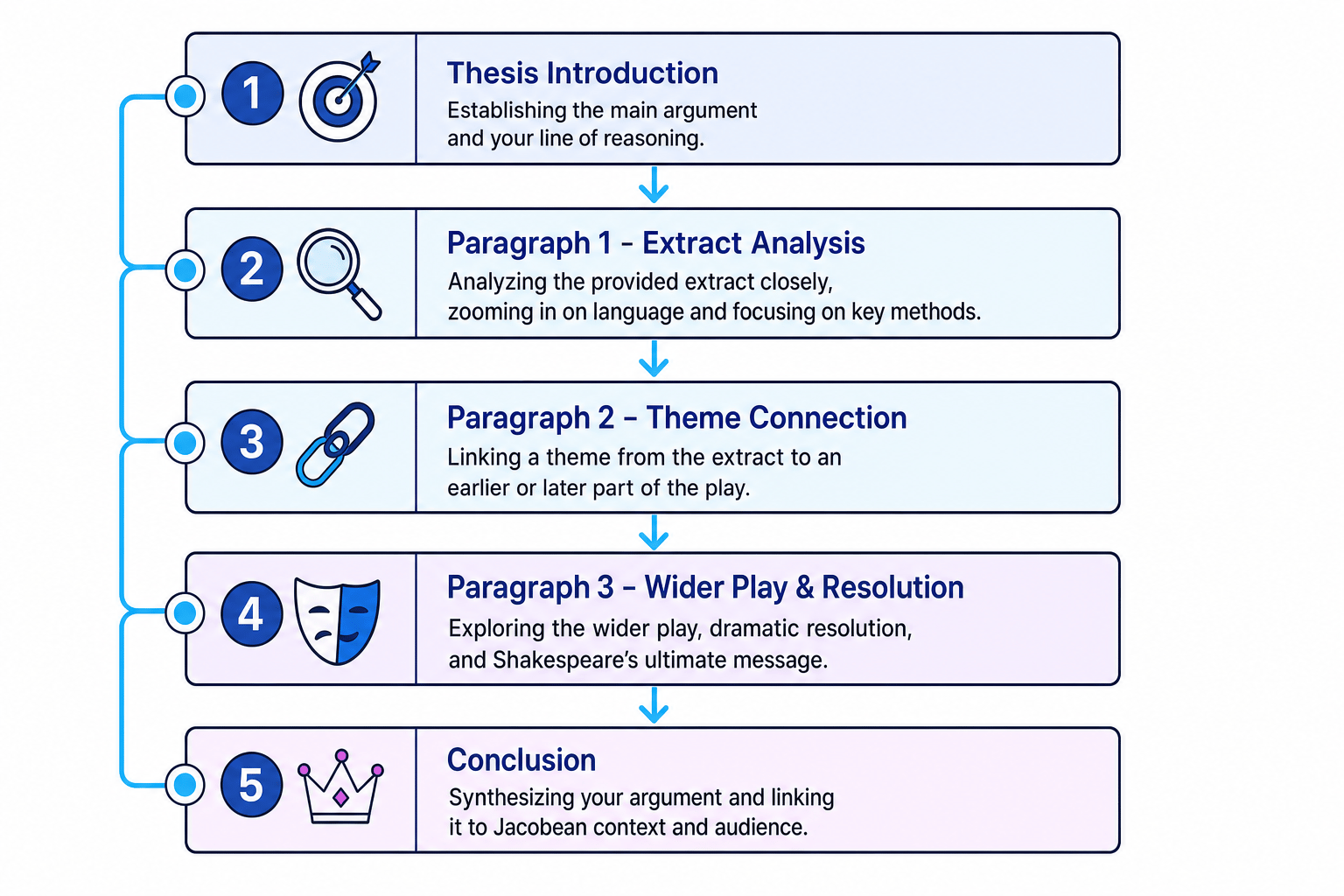
- Spend 5 minutes planning. Underline key words in the prompt, read the extract carefully, highlight 2-3 short quotations, and write a quick 3-point plan mapping out your thesis and paragraphs.
- Start with your thesis. Write an introduction that directly addresses the prompt, giving a sophisticated overview of the character or theme's trajectory across the play.
- Analyze the extract first. Use your first main body paragraph to squeeze every drop of meaning out of the printed passage, using precise terminology (e.g., meter, imperative, semantic field).
- Transition systematically. Use transition words (e.g., Crucially, Conversely, This is mirrored later in the play when...) to bridge the gap between your extract analysis and your wider play analysis.
- Vary your vocabulary. Avoid repeating the word "shows". Use active, analytical verbs such as exemplifies, delineates, subverts, foreshadows, reifies, or interrogates.
Check yourself
- Can you write a thesis statement for an essay about Caliban that goes beyond "Caliban is a monster"?
- Are your quotes short and integrated? (e.g., less than 6-7 words each, woven directly into your own sentences).
- Does your analysis explain the impact of Shakespeare's methods on a Jacobean audience, rather than just a modern reader?
