Welcome to your ultimate guide on drafting top-tier, Grade 9 essays for Dennis Kelly’s DNA. In Paper 2, Section A of your AQA GCSE English Literature exam, you will be asked to write an essay on a modern drama text.
Knowing the plot, characters, and themes of DNA is only half the battle. To score highly, you must be able to assemble this knowledge into a sharp, convincing, and highly structured argument under exam conditions.
This guide will break down the exact formula of a high-scoring essay, demonstrate how to weave your Assessment Objectives (AOs) together, and walk you through building a model paragraph step-by-step.
What you'll learn
- How to decode an exam prompt and formulate a powerful thesis statement
- How to structure your paragraphs to hit AO1, AO2, and AO3 criteria simultaneously
- A step-by-step walkthrough of building a high-scoring paragraph about responsibility
- Key analytical pitfalls to avoid in your writing
Deconstructing the Exam Criteria
Before you put pen to paper, you must understand exactly what the examiner is looking for. In the Modern Texts section of Paper 2, your writing is assessed against four main objectives:
1. AO1: Clear, Structured Argument (Response and References)
Your essay must not be a random list of facts or a simple plot retelling. It must be an argument. You need a clear line of inquiry that directly answers the question, supported by precise, embedded quotations.
2. AO2: Analysis of Writer's Methods
You must analyze how Dennis Kelly uses language, form, and dramatic structure to convey his ideas. Instead of just identifying techniques (like "Kelly uses a metaphor here"), you must explain the effect of these choices on the audience.
3. AO3: Contextual Connections
This involves linking the play’s themes to the broader social, historical, and philosophical ideas Kelly is exploring. In DNA, this means discussing concepts like evolutionary psychology, group mentality, moral responsibility, and modern societal anxieties about youth.
4. AO4: Technical Accuracy (SPaG)
Uniquely, Section A of Paper 2 awards an extra 4 marks for spelling, punctuation, and grammar. This means clear paragraphing, accurate vocabulary, and sophisticated sentence structures are vital.
Thesis Statement
A thesis statement is a 2–3 sentence argument at the very beginning of your essay. It does not just agree or disagree with the prompt; instead, it establishes your central line of argument and explains why the writer (Dennis Kelly) chose to present a character or theme in a particular way.
The Anatomy of an Analytical Paragraph
A high-scoring GCSE essay should consist of a conceptual introduction (including your thesis), three detailed analytical body paragraphs that trace the play's development, and a concise conclusion.
To ensure every body paragraph is balanced and targets all assessment objectives, you can use the Analytical Chain structure. This ensures your writing flows logically from a broad conceptual point down to microscopic linguistic or dramatic analysis, before zooming back out to the writer's social message.
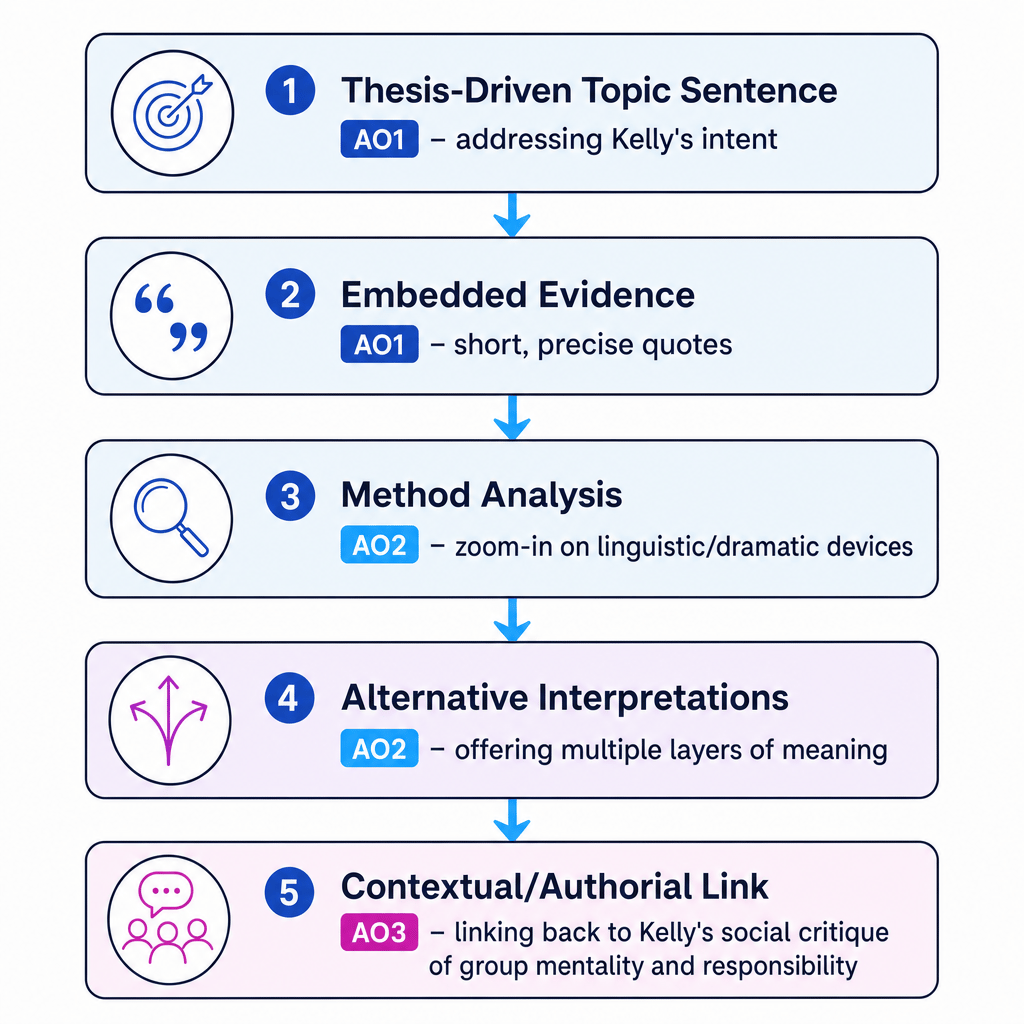
<keyidea title="The "What, How, Why" Approach">
To write a top-tier paragraph, always ask yourself three questions:
- What is Kelly doing? (Your point/idea - AO1)
- How is he doing it? (Your evidence and analysis of methods - AO2)
- Why is he doing it? (His purpose and connection to context/human nature - AO3)
Worked Example: Building a Grade 9 Paragraph
Let's look at how to build a high-scoring paragraph from scratch. We will use a common and vital exam theme.
The Prompt: How does Kelly present the theme of responsibility in DNA?
We will focus on a paragraph that explores Phil's moral detachment and his clinical, pragmatic approach to leadership in Act 2, showing how he strips the group of their individual responsibility.
Constructing an analytical paragraph
Here is how to build this paragraph step-by-step:
-
Formulate a conceptual topic sentence (AO1): Start by asserting a clear, analytical claim that directly addresses the theme of responsibility and hints at Kelly's authorial purpose.
Draft: Kelly presents Phil as a leader who actively dismantles individual moral responsibility within the group, replacing personal conscience with a cold, utilitarian survival instinct.
-
Integrate precise textual evidence (AO1): Introduce a short, highly focused quotation that shows Phil in action. Rather than dropping a long block of text, embed your quotes smoothly into your own sentence.
Draft: This is most chillingly illustrated in Act 2, when Phil steps forward to manage the crisis of Adam's supposed death. Instead of offering comfort, Phil delivers clinical directives, telling the panicking group, "You do this... then you go to the grille."
-
Analyze Kelly's specific dramatic and linguistic methods (AO2): Identify the methods Kelly uses and analyze their psychological effect on both the characters and the audience. Look at sentence types, stage directions, or structural shifts.
Draft: Kelly uses imperative verbs ("do", "go") to highlight Phil's complete, uncontested authority. The monosyllabic, fragmented phrasing strips the plan of any emotional weight, reducing a horrific cover-up to a simple, sequential checklist. This is reinforced by the dramatic contrast between Cathy and Brian's chaotic hysteria and Phil's silent, methodical consumption of chocolates and waffles. His silence functions as a powerful dramatic tool; when he finally speaks, his words carry absolute authority, highlighting how easily individual morality can be silenced by a dominant figure.
-
Connect the analysis to context and authorial intent (AO3): Conclude your paragraph by explaining why Kelly is showing us this. Link Phil's behavior to broader ideas about human nature and society.
Draft: Through Phil's pragmatic leadership, Kelly exposes the terrifying fragility of modern morality when subjected to peer pressure. This mirrors Stanley Milgram’s famous psychological obedience experiments, which demonstrated how readily individuals relinquish their personal moral responsibility when directed by an authority figure. By portraying the group's immediate compliance, Kelly warns his contemporary audience of the dangers of tribalism and the ease with which human beings can abandon ethical responsibility for self-preservation.
Put It All Together: The Finished Model Paragraph
If we combine these four steps, we get a sophisticated, seamless, and highly analytical essay paragraph that meets all the criteria for a Grade 9.
Kelly presents Phil as a leader who actively dismantles individual moral responsibility within the group, replacing personal conscience with a cold, utilitarian survival instinct. This is most chillingly illustrated in Act 2, when Phil steps forward to manage the crisis of Adam's supposed death. Instead of offering comfort, Phil delivers clinical directives, telling the panicking group, "You do this... then you go to the grille." Kelly uses imperative verbs ("do", "go") to highlight Phil's complete, uncontested authority. The monosyllabic, fragmented phrasing strips the plan of any emotional weight, reducing a horrific cover-up to a simple, sequential checklist. This is reinforced by the dramatic contrast between Cathy and Brian's chaotic hysteria and Phil's silent, methodical consumption of chocolates and waffles. His silence functions as a powerful dramatic tool; when he finally speaks, his words carry absolute authority, highlighting how easily individual morality can be silenced by a dominant figure. Through Phil's pragmatic leadership, Kelly exposes the terrifying fragility of modern morality when subjected to peer pressure. This mirrors Stanley Milgram’s famous psychological obedience experiments, which demonstrated how readily individuals relinquish their personal moral responsibility when directed by an authority figure. By portraying the group's immediate compliance, Kelly warns his contemporary audience of the dangers of tribalism and the ease with which human beings can abandon ethical responsibility for self-preservation.
Quotation Integration Trick
Never write "This quote shows..." or "In this quote, Kelly says...". Instead, use active verbs that keep your analysis sharp. Try:
- "Kelly's use of the imperative verb 'do' implies..."
- "Phil’s monosyllabic commands demonstrate..."
- "The clinical tone of the directive suggests..."
<commonmistake title="The "Feature-Spotting" Trap">
Many students spot a technique (like "Richard uses a metaphor") but fail to explain why it is there or how it makes the audience feel. If you identify a technique, you must always explain its psychological effect. For example, why does Kelly use structural pauses? To show the characters' internal panic and their inability to articulate their guilt.
In the exam
When you write your DNA essay in the exam, follow this strategy:
- Spend 5 minutes planning: Do not just start writing. Read the prompt, decide on your overall argument (your thesis), and select three key moments/quotes from across the play that will form your three body paragraphs.
- Keep quotes short and precise: You do not need to memorize entire paragraphs of dialogue. One-word or short-phrase quotes (e.g., "chimpanzees", "dead", "screaming", "prophet") are easier to remember, easier to embed, and allow for much tighter word-level analysis.
- Trace the play's trajectory: Ensure your three paragraphs show a progression. For instance, show how a theme or character starts in Act 1, changes under pressure in Act 2, and concludes in Act 3/4. This shows the examiner you understand the play's overarching dramatic structure.
- Refer to "the audience" and "the writer": Always write about DNA as a construct. Use phrases like "Kelly intends to shock the audience..." or "The play’s structural cyclicality leaves the audience with a sense of...". This keeps your focus firmly on AO2 and AO3.
Check yourself
Before your next practice essay, make sure you can answer these questions:
- Can you explain the difference between a plot summary and a thesis-driven argument?
- Why is it important to analyze stage directions and structural pauses, rather than just spoken dialogue?
- Which real-world psychological concepts can you use to explain the group's behavior in DNA?
