Planning is the single most important step in writing a high-scoring GCSE English Literature essay. Because the AQA exam is closed-book, you cannot afford to figure out your argument as you write. A precise, structured plan acts as a map, keeping your arguments logical, your evidence targeted, and your writing focused on the examiner's mark scheme.
In this guide, you will learn how to build dynamic, top-tier essay plans specifically tailored to Dennis Kelly’s modern drama DNA.
What you'll learn
- How to craft a sharp, conceptual thesis statement that directly addresses the exam question.
- How to structure your essay into a Three-Pillar Plan that charts the dramatic arc of the play.
- How to weave AO1 (argument/evidence), AO2 (dramatic methods), and AO3 (social context) into every paragraph.
The Foundation of a Great Essay Plan
Before you start writing down quotes, you need to know exactly what the examiners are looking for. Your essay should not be a summary of the plot, nor should it be a simple list of character traits. It must be a thematic argument.
To achieve this, you must treat every character and setting in DNA not as a real person or place, but as an authorial construct. Dennis Kelly wrote this play to communicate specific ideas about human nature, group dynamics, and morality. Your essay must explain how and why he does this.
Authorial Construct
A character, setting, or event created by a writer to represent a specific theme, societal issue, or philosophical idea, rather than just to drive a realistic story.
The Golden Rule of DNA Essays
Dennis Kelly is the puppeteer; the characters are his puppets. Never write "Phil does this because he is mean." Instead, write "Kelly constructs Phil as an emotionally detached leader to expose the chilling consequences of pure utilitarianism."
To structure this argument, you must plan a thesis statement and a Three-Pillar Plan.
The Three-Pillar Plan Structure
A high-scoring essay requires a logical progression. Rather than jumping randomly from one scene to another, your plan should follow the chronological or conceptual arc of the play. We call this the Three-Pillar Plan.
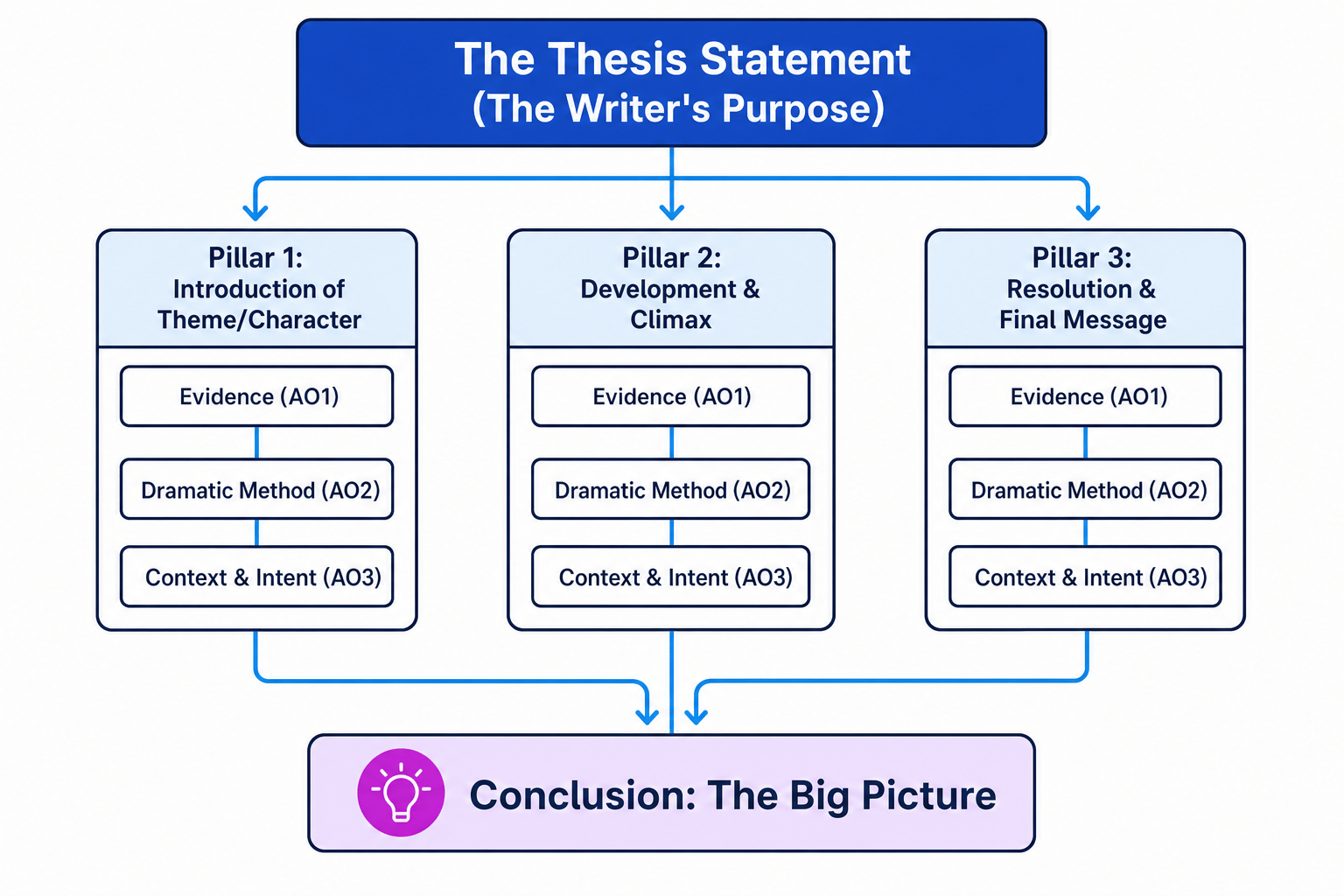
- The Thesis Statement: Your overall answer to the question. It should be one or two sentences that outline Dennis Kelly's core purpose in the play regarding the topic.
- Pillar 1 (The Exposition / Spark): How does Kelly first introduce this character or theme? What social or psychological factors are established at the start of the play?
- Pillar 2 (The Turning Point / Climax): How does the character change, or how does the theme intensify under pressure? Look at the middle of the play, particularly around Adam's "death" or his sudden, shocking return.
- Pillar 3 (The Resolution / Tragic Outcome): What is the final state of the character or group? What warning is Kelly leaving the audience with as the curtain falls?
Worked Example: Planning a Character Essay on Phil
Let's walk through the exact steps of building a top-band essay plan.
Planning an essay on Phil's characterization
Exam Question: Explore how Kelly presents the character of Phil in DNA.
Step-by-step Planning:
-
Formulate a conceptual thesis statement. Avoid simple descriptions like "Phil is a scary leader." Instead, link his behavior directly to Kelly's thematic intent. Ask yourself: What does Phil represent about humanity?
Drafted Thesis: Kelly constructs Phil as a terrifying symbol of cold pragmatism and nihilism. Through Phil’s silent dominance and calculating leadership, Kelly warns the audience of how easily human morality can be sacrificed when individual empathy is surrendered to preserve the safety of the collective group.
-
Map out Pillar 1 (Introduction / The Silent Mastermind). Identify how Phil is introduced and what dramatic methods Kelly uses to establish his character.
Focus: Phil's silence and emotional detachment. Evidence: The stage directions showing him eating ("Phil eats a waffle", "Phil eats a bag of crisps") while Leah speaks frantically, and his sudden, declarative shift to leadership: "No, she's right. Cut through the woods." Methods: Non-verbal performance cues, contrast/foil (with Leah's nervous loquacity), monosyllabic syntax. Context: The breakdown of individual morality within peer groups; tribalism and evolutionary survival instincts.
-
Map out Pillar 2 (The Turning Point / Cold-Blooded Execution). Examine how Phil reacts to crisis to reveal his deeper, darker nature.
Focus: The manipulation of Brian and the decision to frame an innocent man, or later, to eliminate the threat of the living Adam. Evidence: Phil's highly structured, instructional speech to Brian: "You'll land on your back... If you don't shut up we'll throw you in." Also, his physical dominance over Leah when he "places a hand on her shoulder." Methods: Imperative verbs, calm and chillingly logical tone, physical stage business (gestures of control). Context: Machiavellian leadership (the end justifies the means) and the suppression of the weak (Brian/Adam) to protect the herd.
-
Map out Pillar 3 (The Resolution / The Cost of Nihilism). Analyze where Phil ends up and what this says about his philosophy.
Focus: Phil's final isolation on the field after Leah leaves him. Evidence: Richard's description in the final scene: "He doesn't answer. He doesn't look at you. He just stares into space." Methods: Cyclical structure (returning to the field, but silent and alone), structural absence of Leah's voice. Context: Kelly's final warning—a purely utilitarian, emotionless lifestyle leads to absolute psychological isolation and existential emptiness.
The Retelling Trap
Many students write plans that look like a timeline of events: "First Phil eats a waffle, then he tells them what to do with the body, then at the end he is sad." This is plot-retelling and will cap your mark. Ensure your plan focuses on how Kelly uses dramatic techniques and why he presents these shifts.
Integrating Context (AO3) into your Plan
A common mistake is "bolting on" historical facts at the end of a paragraph (e.g., "This play was written in 2007 and teens were feared"). To get the highest marks, your context must be organically linked to your analytical points.
When planning, use the following context prompts specifically relevant to DNA:
- The "Feral Youth" Moral Panic: In the mid-2000s, British media frequently demonized teenagers, presenting them as lawless, anti-social "hoodies." Kelly subverts and explores this panic. Is the cruelty of the group instinctive (DNA) or a product of their environment?
- Nihilism and Moral Relativism: The belief that life is meaningless and traditional morals are useless. Phil acts as a nihilist, viewing human lives as chess pieces to be moved for survival.
- Group Psychology / De-individuation: A psychological state where people lose their personal identity and personal moral compass when they become part of a crowd or group.
Quick Quote-Mapping
Because you are in a closed-book exam, select short, high-impact quotes that can be used across multiple essays. For example, Phil's line "Are we pathetic?" or his instruction to "act natural" can apply to essays on guilt, power, fear, or leadership.
In the exam
- Spend 5 to 7 minutes planning. Do not skip this! A well-planned essay is faster to write and significantly more cohesive.
- Write your Thesis Statement in full on your planning page. This ensures your introduction is instantly powerful and keeps your mind focused on the core argument.
- Use a grid or "Pillar" system to check your AO coverage. Quickly tick off whether each of your three paragraphs has a Quote (AO1), a specific dramatic method like stage directions or stichomythia (AO2), and a link to Kelly's big-picture message or social context (AO3).
- Keep your plan concise. Use bullet points, abbreviations, and single-word method reminders (e.g., SD for stage directions, Mon for monologue).
Check yourself
- Can you write a thesis statement for an essay on the theme of responsibility in DNA in under two sentences?
- Do you have a structural plan for how to discuss Leah's character that follows her transition from desperate talker to silent, self-liberated escapee?
- Are your chosen quotes short enough to remember, and do they contain rich language or structural features that you can write about for multiple sentences?
