To score top marks in your GCSE English Literature exam, you must look beyond what happens in The Tempest and explore how Shakespeare has constructed his final masterpiece.
Analyzing language, form, and structure (AQA Assessment Objective 2) is about investigating how Shakespeare's artistic choices shape our understanding of power, control, forgiveness, and the theatre itself.
What you'll learn
- How to identify and analyze Shakespeare's use of tragicomedy and the three Classical Unities.
- How the symmetrical structure of the play mirrors its themes of usurpation and power struggles.
- How to unpack the dramatic significance of blank verse versus prose, and how Caliban's language subverts class expectations.
1. Dramatic Form: Tragicomedy and Romance
When writing about the "form" of a play, you are looking at the overall genre, structure, and theatrical conventions that Shakespeare uses. The Tempest is one of Shakespeare’s final plays, often categorized as a Romance or a Tragicomedy.
Tragicomedy
A tragicomedy is a play that blends the high-stakes conflict, betrayal, and danger of a tragedy with the humor, magic, and happy resolution of a comedy.
In The Tempest, we see tragic elements: Prospero has been usurped and exiled, and several characters plot murder on the island. However, these dark plots are ultimately neutralized by magic and resolved through forgiveness, repentance, and marriage—the classic comic resolution.
The Classical Unities
Unlike most of his other plays, in The Tempest Shakespeare strictly adheres to the three Classical Unities of drama. Originating from ancient Greek theatrical theory, these rules were designed to make a play feel as realistic and concentrated as possible.
- Unity of Action: The play follows one main plot (Prospero's quest to reclaim his dukedom) with minimal, tightly linked subplots.
- Unity of Place: The entire action of the play takes place in a single physical location (the island).
- Unity of Time: The events of the play unfold in "real-time." Prospero explicitly notes in Act 1, Scene 2 that the time is "At least two glasses"—referring to the two hours it takes to perform a play in the Elizabethan theatre.
By compressing the action into a single afternoon on a remote island, Shakespeare creates a pressure-cooker environment. Prospero behaves like a theatrical director, controlling the precise timing of every encounter to resolve his life's crisis before his magical power runs out.
The Metatheatrical Form
Because Prospero orchestrates the events of the play using "art" (magic) and eventually relinquishes his powers directly to the audience in the Epilogue, critics often view The Tempest as metatheatrical—a play about the nature of theatre itself. Prospero acts as a stand-in for Shakespeare, control-freak playwright and magician rolled into one.
2. Structure: Symmetry and Parallel Plots
The structure of The Tempest is beautifully symmetrical. This mirror-like design allows Shakespeare to compare different groups of characters, highlighting how the desire for power corrupts people at every level of society.
Parallel Usurpation Plots
To demonstrate that political ambition and greed are universal human vices, Shakespeare structures the narrative around three parallel plots of rebellion:
        Prospero's Overthrow (Past)
        [ Antonio usurps Prospero ]
                     |
         __________________________
        |                          |
High-Status Plot             Low-Status Plot
[ Sebastian & Antonio        [ Stephano & Trinculo
  plot against Alonso ]        plot against Prospero ]
- The High-Status Conspiracy: In Act 2, Scene 1, Antonio (Prospero's brother) and Sebastian (Alonso's brother) plot to murder King Alonso while he sleeps. This mirrors the original usurpation of Prospero twelve years prior.
- The Low-Status Conspiracy: In Act 2, Scene 2, Caliban, Stephano, and Trinculo plot to murder Prospero and take over the island.
By running these plots side-by-side, Shakespeare creates a structural mirror. The "civilized" nobles are shown to be just as murderous and chaotic as the drunken servants.
3. Language: Power, Class, and the Verse-Prose Divide
Shakespeare uses the distinction between verse and prose to signpost social status, intelligence, and emotional state. Analyzing this distinction is one of the easiest ways to secure high marks for AO2.
Blank Verse
Blank verse is unrhymed poetry written in iambic pentameter. It has a steady rhythm of ten syllables per line, following a pattern of unstressed then stressed beats (da-DUM da-DUM da-DUM da-DUM da-DUM).
Prose
Prose is conversational, everyday speech without any structured poetic meter or rhyme. In a Shakespearean play script, prose paragraphs look like blocks of standard text, whereas verse has distinct, line-by-line lineation.
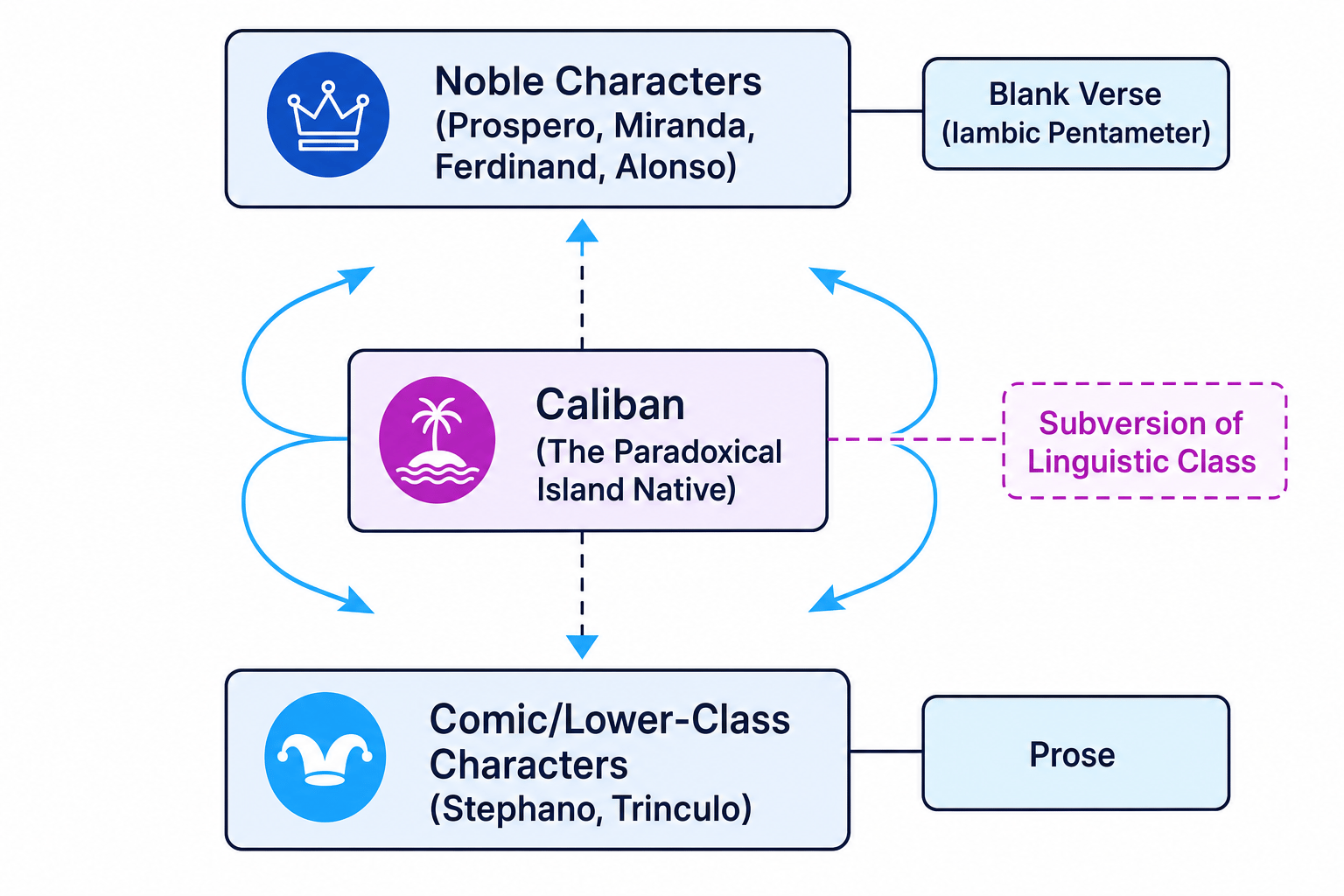
Historically, Shakespeare used blank verse for noble, high-status characters (such as Prospero, Miranda, and Ferdinand) and prose for low-status, comic characters (such as Stephano and Trinculo).
The Caliban Paradox
The most fascinating linguistic choice in the play is how Shakespeare handles the language of Caliban. Despite being branded a "savage" and a "monster" by the European characters, Caliban speaks in some of the most lyrical, beautiful blank verse in the entire play.
When Stephano and Trinculo are terrified by the invisible Ariel's music, Caliban reassures them with his famous speech in Act 3, Scene 2:
"Be not afeard; the isle is full of noises, Sounds and sweet airs, that give delight and hurt not."
By giving Caliban such elevated, poetic language, Shakespeare subverts colonialist assumptions. Caliban is not a mindless beast; he possesses a deep, spiritual, and sensory connection to his homeland that his captors entirely lack.
Ignoring the shift in language status
Do not assume that characters only speak in one style. Prospero speaks in majestic blank verse when exercising authority, but shifts to a humble, direct address in prose or simple rhyming couplets during the Epilogue to signal that he has surrendered his magical power. Always look for changes in a character's speech patterns.
Worked Example: Analyzing Shakespeare's Language
Here is how to construct a high-scoring analytical step-by-step response to a language question.
Analyzing Caliban's relationship with the island
Analyze how Shakespeare uses language to present Caliban's connection to the island in Act 3, Scene 2:
"Be not afeard; the isle is full of noises, Sounds and sweet airs, that give delight and hurt not. Sometimes a thousand twangling instruments Will hum about mine ears, and sometime voices..."
-
Identify the linguistic method and its immediate impact: Shakespeare uses rich, sensory imagery and soft sibilant sounds ("sounds and sweet airs") within a regular blank verse structure. This immediately creates a gentle, soothing tone that contrasts sharply with the harsh, colonial insults ("foul brute") used against Caliban elsewhere.
-
Examine specific word choices and auditory devices: The onomatopoeic verbs "twangling" and "hum" mimic the gentle, omnipresent sounds of the island. By framing these noises as comforting rather than terrifying, Shakespeare reveals Caliban’s intimate sensory alignment with his environment. The noun "delight" emphasizes that the island's magic is a source of joy for him, subverting Prospero's view of the island as a place of containment and punishment.
-
Link to the play's wider context and themes: By granting Caliban—the subjugated native—the most poetic and rhythmic blank verse in the scene, Shakespeare structuralizes a moral hierarchy. While the European "civilized" colonizers (Stephano and Trinculo) speak in coarse, disjointed prose, Caliban speaks with natural dignity, highlighting the tragedy of his enslavement and questioning the validity of colonial hierarchy.
The Power of Ariel's Lyrical Language
When writing about language, don't forget Ariel's songs! Unlike other characters, Ariel often speaks in trochaic tetrameter (four beats of stressed-unstressed) and highly lyrical rhyming songs (e.g., "Full fathom five thy father lies"). This stylized, non-human rhythm reinforces Ariel's status as a supernatural spirit of the air, distinct from both the mortals and the earth-bound Caliban.
In the exam
- Never feature-spot: Do not simply state "Shakespeare uses iambic pentameter here." You must always explain why he uses it. Does it show emotional control? Does it signal high social status?
- Track the transitions: Look for moments where characters transition between verse and prose. A sudden shift to prose often signals a loss of control, mental instability, or a deliberate lowering of social standing.
- Connect structure to theme: When discussing structural techniques (like the parallel plots or the Classical Unities), connect them directly to Shakespeare's exploration of power. The tight structure reflects Prospero’s tight control over his captives.
- Consider the performance: Remember that this is a script. Comment on how structural choices—such as a sudden tempest, a vanishing banquet, or Ariel descending as a Harpy—affect the pacing and visual experience of the audience.
Check yourself
- Why did Shakespeare choose to limit the events of The Tempest to a single afternoon on one island? How does this structural choice relate to Prospero's character?
- Compare the language of Stephano and Trinculo with the language Caliban uses in Act 3, Scene 2. What does this contrast tell us about Shakespeare's view of "civilized" vs "savage" characters?
- What is a "Romance" or "Tragicomedy", and what features of this form can you identify in the resolution of the play's conflicts?
