In your AQA GCSE English Literature Paper 2 exam, you will be expected to write about Dennis Kelly’s modern drama DNA without a copy of the text in front of you. Because this is a closed-book exam, memorizing long, winding passages is not a good strategy. Instead, you need to master a small, flexible toolkit of short, highly analytical quotations.
What you'll learn
- How to select "explosive" quotations that work across multiple characters and themes.
- How to analyze the unique dramatic and linguistic techniques Kelly uses, including stichomythia, non-fluency features, and subtext.
- How to link quotes directly to structural developments and context to secure high marks in AO1, AO2, and AO3.
The Basics: What Makes a Quote "Explosive"?
Before memorizing anything, you must understand what makes a quotation useful for an exam. A great quotation is not just a plot pointer; it is a microcosm of the play's themes, characters, and contexts.
Explosive Quotation
An explosive quotation is a short, memorable word or phrase (typically 2 to 7 words) that contains rich literary devices, connects to at least two major themes, and can be used to analyze multiple characters.
To analyze these quotations successfully, you must use precise subject terminology. Dennis Kelly’s writing style is highly distinctive. He does not write in poetic verse like Shakespeare; instead, he uses naturalistic, fragmented speech to expose the psychological states of his characters.
Key Literary and Dramatic Terms to Know:
- Stichomythia: Rapid, alternating single lines of dialogue between characters. This technique creates a sense of tension, urgency, or panic.
- Non-fluency features: Interruptions, stammers, pauses, and self-corrections (such as "like", "you know", and "um"). Kelly uses these to show a character's anxiety, guilt, or lack of power.
- Subtext: The underlying, unspoken meaning of a line of dialogue. What is not said is often more important than what is said.
- Nihilism: The philosophical belief that life is meaningless and that traditional moral principles are useless. Some characters in DNA exhibit nihilistic behavior as they abandon their moral codes to protect the group.
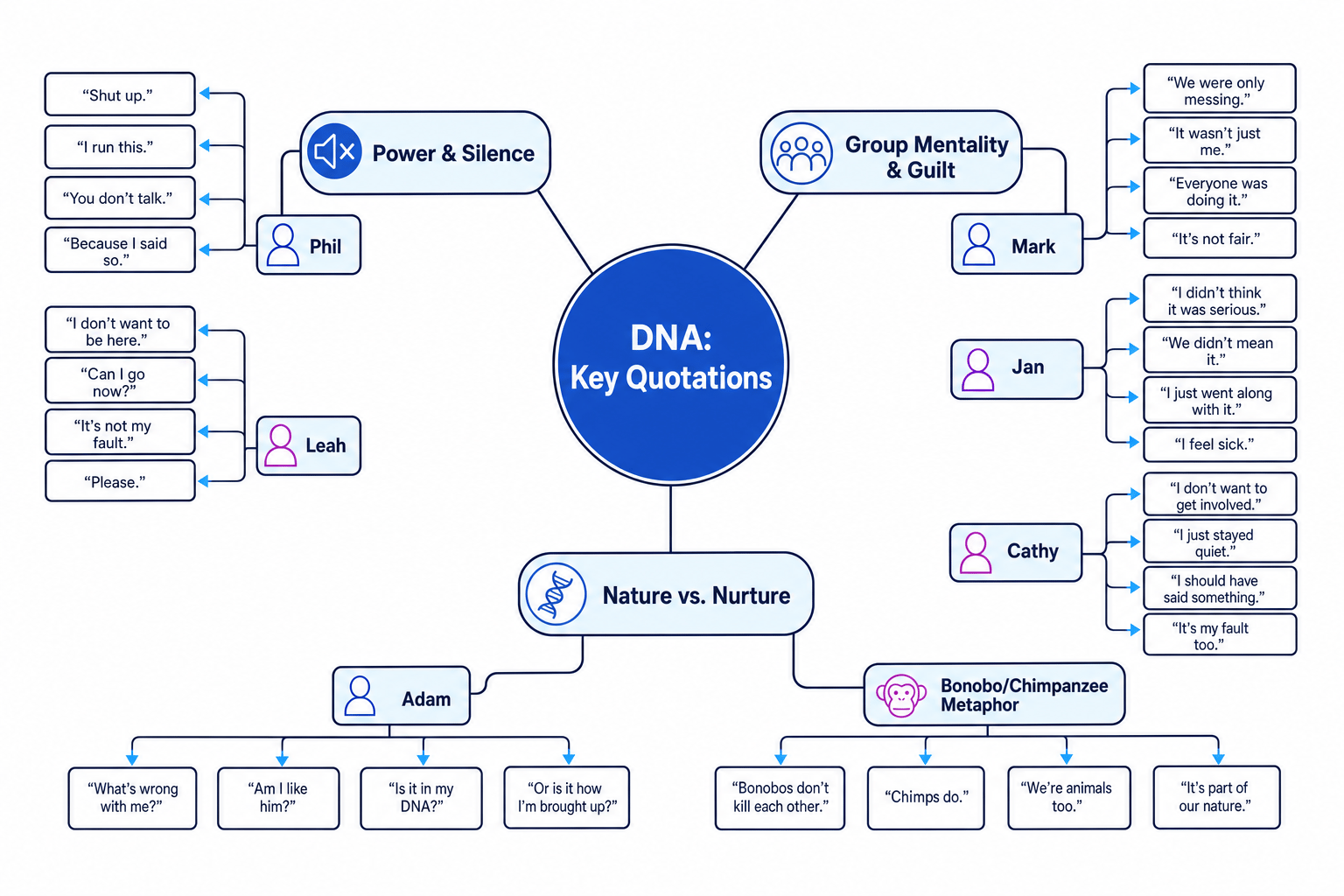
Theme 1: Group Mentality, Panic, and Evasion of Guilt
The play opens with Jan and Mark, who act as a "chorus" (a dramatic device used to narrate off-stage events to the audience). Their rapid dialogue immediately establishes the panic of the group.
Jan and Mark: "Dead? / Yeah. / What, dead? / Yeah."
- The Method: Stichomythia and repetition.
- The Analysis: This rapid-fire exchange reflects the characters' shock and disbelief. The repetition of the word "dead" highlights their inability to process the gravity of their actions. By breaking the news in tiny, fragmented bursts, Kelly shows how they try to distance themselves from the reality of Adam's apparent death.
- The Context (AO3): Kelly explores the bystander effect and corporate responsibility. The characters share the guilt, which psychologically dilutes each individual's personal responsibility.
The Chorus Effect
Jan and Mark do not speak like individuals; they speak as a collective unit. Their stichomythic dialogue shows how group mentality strips away individual moral decision-making, leaving only panic and self-preservation.
Theme 2: Power, Silence, and Manipulation
The dynamic between Phil and Leah is central to the play. Leah talks incessantly, while Phil remains completely silent, eating chocolates, until he suddenly delivers cold, calculated plans.
Leah: "It's chimpanzees, Phil. ... We're in a pit."
- The Method: Metaphor and zoomorphism.
- The Analysis: Leah uses a scientific comparison to explain the group's cruel behavior. She contrasts chimpanzees (who are violent, territorial, and attack outsiders) with bonobos (who are peaceful and resolve conflict through love). By stating "We're in a pit," Leah creates a claustrophobic metaphor for their moral degradation. They have descended into animalistic, pack-like behavior, abandoning their human empathy.
- The Context (AO3): Written in 2007, DNA reflects contemporary anxieties about youth gang culture and the "feral" representation of teenagers in the media. Kelly uses Leah's monologues to ask whether humans are naturally violent (nature) or if society makes us that way (nurture).
Phil: "We're a group. We're a pack. If you don't help us, we'll kill you."
- The Method: Declarative sentences, inclusive pronouns, and violent imagery.
- The Analysis: Phil's transition from silence to speech is terrifying. The words "group" and "pack" show that he values collective survival over individual life. The sudden transition to the direct threat "we'll kill you" shows his cold, utilitarian ruthlessness. His language is completely devoid of emotion; he treats murder as a logical necessity to keep the "pack" safe.
Misunderstanding Phil's Silence
Do not assume Phil is weak or passive because he is silent in the early scenes. His silence is a demonstration of power. He does not need to speak to control Leah; his physical actions (eating systematically) show his complete disregard for her emotional distress. His silence is active, not passive.
Theme 3: Morality, Cruelty, and the Loss of Innocence
As the play progresses, we see how the cover-up deforms the characters' moral compasses. Cathy and Adam represent the extreme ends of this transformation.
Cathy: "It's exciting."
- The Method: Simple sentence and incongruous adjective.
- The Analysis: Cathy’s reaction to the crime is chilling. While others panic, she finds the situation "exciting." The adjective "exciting" is entirely inappropriate for a suspected murder, highlighting her lack of moral boundaries and her desire for social status within the group. As the play develops, Cathy becomes the group's enforcer, demonstrating how easily social hierarchies can empower sociopathic behavior.
Adam: "I'm not... I'm not here?"
- The Method: Ellipsis, repetition, and interrogative syntax.
- The Analysis: When Adam returns in Act 3, his speech is broken and tentative. The repeated "I'm not" and the questioning tone show that his sense of self has been completely shattered by his isolation and trauma. He has lost his identity, existing only as a ghost-like figure. His fragmented speech contrasts sharply with Phil's highly structured, commanding lists.
Structure is a Method!
When analyzing quotes, don't just look for adjectives and metaphors. Look at sentence structure and punctuation. Kelly’s use of ellipses (...) and question marks shows a character's loss of control, while short, declarative sentences show power and certainty.
Worked Example: Analyzing a Key Quotation
Let's walk through how to construct a high-scoring analytical paragraph using a quote from Leah.
Analyzing Leah's monologue
Analyze how Kelly presents the theme of power in the quotation: "Do you think I'm crazy, Phil? ... Because I'm not. I'm just analytical."
-
Step 1: Formulate your thesis statement (AO1)
Begin by directly answering the question, identifying what the quote reveals about the character and theme.
Drafting: Kelly uses Leah's frantic questioning to expose the profound imbalance of power between her and Phil, showing how her desperate need for his validation causes her to question her own sanity. -
Step 2: Embed the quotation and identify the writer's methods (AO2)
Introduce the quote smoothly within a sentence and point out its linguistic features (such as interrogative syntax, direct address, and juxtaposition).
Drafting: Leah's insecure direct address, "Do you think I'm crazy, Phil?", immediately highlights her subordination. Her use of interrogative syntax contrasts sharply with her subsequent defensive assertion, "Because I'm not. I'm just analytical." -
Step 3: Analyze the deeper meanings and connotations (AO2)
Explore individual words or structural patterns to show how they develop the theme.
Drafting: The adjective "analytical" is crucial; Leah attempts to rebrand her deep anxiety and moral panic as cold intellectualism. She desperately wants to match Phil’s logical, unemotional mindset, yet her fragmented speech and constant self-correction betray her deep distress. Kelly uses this to demonstrate that in this group, emotional sensitivity is viewed as 'crazy', whereas cold detachment is prized as power. -
Step 4: Connect to context and the play's wider ideas (AO3)
Explain how this dynamic reflects real-world sociological or philosophical themes.
Drafting: This reflects the wider theme of how totalitarian structures silence dissent. Leah represents the moral conscience of the group, yet she is systematically ignored and disempowered by Phil's silence, illustrating how easily rational individuals can be manipulated into complicity when faced with dominant, unyielding authority.
In the exam
- Keep quotes short: Memorize snippets of 2–5 words (e.g., "We're a pack", "It's exciting", "in a pit"). This makes them easier to integrate smoothly into your sentences.
- Track character changes: Make sure you have quotes from the start, middle, and end of the play. For example, compare Leah's chatty monologues in Act 1 with her absolute silence and eventual departure in Act 4.
- Anchor analysis in structure: When writing about dialogue, mention who speaks, how they speak (stichomythia vs. monologue), and when they remain silent. Silence is a major dramatic device in DNA.
- Link to context (AO3): Always connect the language to Kelly's underlying warning about group psychology, teenage alienation, and the fragility of morality.
Check yourself
- Which character says "It's exciting", and what does this reveal about their moral development throughout the play?
- How does the structure of Jan and Mark's stichomythic dialogue at the start of the play match their feelings of guilt?
- What animal metaphor does Leah use to describe the group's behavior, and what is the difference between the two species she mentions?
