Because the GCSE English Literature exam is closed-book, you do not need to memorise long blocks of text. Instead, the secret to success lies in mastering a small selection of highly versatile, short, and punchy quotations.
In this guide, you will learn:
- How to select and use "micro-quotations" to build seamless arguments.
- How to analyse Shakespeare's language, form, and structure using precise literary terminology.
- Five "golden" quotations from The Tempest that can be adapted to answer almost any essay question.
The Art of the Micro-Quote
When writing your essay, dropping in massive, multi-line quotations ruins the flow of your writing. It also makes it harder to meet the Assessment Objectives (AOs) because you end up "quote dumping"—inserting text without actually analysing it.
To score highly, you must master the micro-quotation.
Micro-quotation
A micro-quotation is a highly condensed phrase of one to five words seamlessly embedded directly into your own sentence. For example, instead of writing out a three-line speech, you might refer to Caliban's view of the island as "full of noises" or his description of the clouds "ready to drop riches".
By using micro-quotes, you keep your writing sophisticated, fluid, and analytical. It also makes memorisation for the closed-book exam much more manageable.
Quote Dumping
Do not start a sentence with a quotation (e.g., "We are such stuff as dreams are made on." This shows that...). This breaks your academic voice. Instead, wrap the quotation inside your own point: Shakespeare highlights the transience of human life by describing humanity as "such stuff" as fleeting "dreams".
Analysing a Quote Step-by-Step
To get top marks for your analysis of language and structure, you must avoid simply "spotting devices." Pointing out a metaphor without explaining why the writer used it will limit your mark. Every piece of analysis should trace a clear line from the quote's literal meaning to its deeper thematic and contextual significance.
The Analysis Golden Rule
Every time you analyse a quotation, you must answer three questions:
- What method is the writer using?
- How does that method make the reader/audience feel or think?
- Why did the writer choose this specific image or structure in relation to the wider themes or historical context?
Let us look at how to put this into practice using a step-by-step analytical method.
Analysing Caliban's resistance to language
Observe how we build a high-level analytical paragraph around Caliban's famous confrontation with Miranda in Act 1, Scene 2: "You taught me language, and my profit on’t / Is, I know how to curse."
- Formulate your thesis statement (AO1): Begin with a clear, conceptual point that answers the essay question. For an essay on power or colonisation, you might write: Shakespeare uses Caliban to expose the destructive, subjugating nature of colonial education.
- Embed your micro-quotations seamlessly (AO1): Introduce your evidence naturally into the flow of your argument. Although Prospero and Miranda believe they civilised Caliban by teaching him "language", Caliban rejects this paternalistic gift, claiming his only "profit on't" is that he now knows "how to curse".
- Identify and analyse the literary methods (AO2): Use precise literary terms to dissect the quote's mechanics. The noun "profit" is loaded with bitter irony; while the colonisers measure "profit" in gold and power, Caliban's only acquisition is the tool of rebellion. His "curse" becomes a linguistic weapon, a verbal rebellion against his physical enslavement.
- Link the analysis to the wider themes and context (AO3): Connect your language analysis to the context of the early modern era. This reflects early Jacobean anxieties surrounding the colonisation of the "New World". Rather than presenting the indigenous figure as a passive recipient of European culture, Shakespeare presents language as a site of conflict, prefiguring modern post-colonial readings of the play where education is recognized as a tool of cultural erasure.
The "Golden Five" Quotations
The following five quotations are highly versatile. No matter what essay question you face—whether on power, magic, nature vs. nurture, or reconciliation—you can adapt these quotes to build a top-tier response.
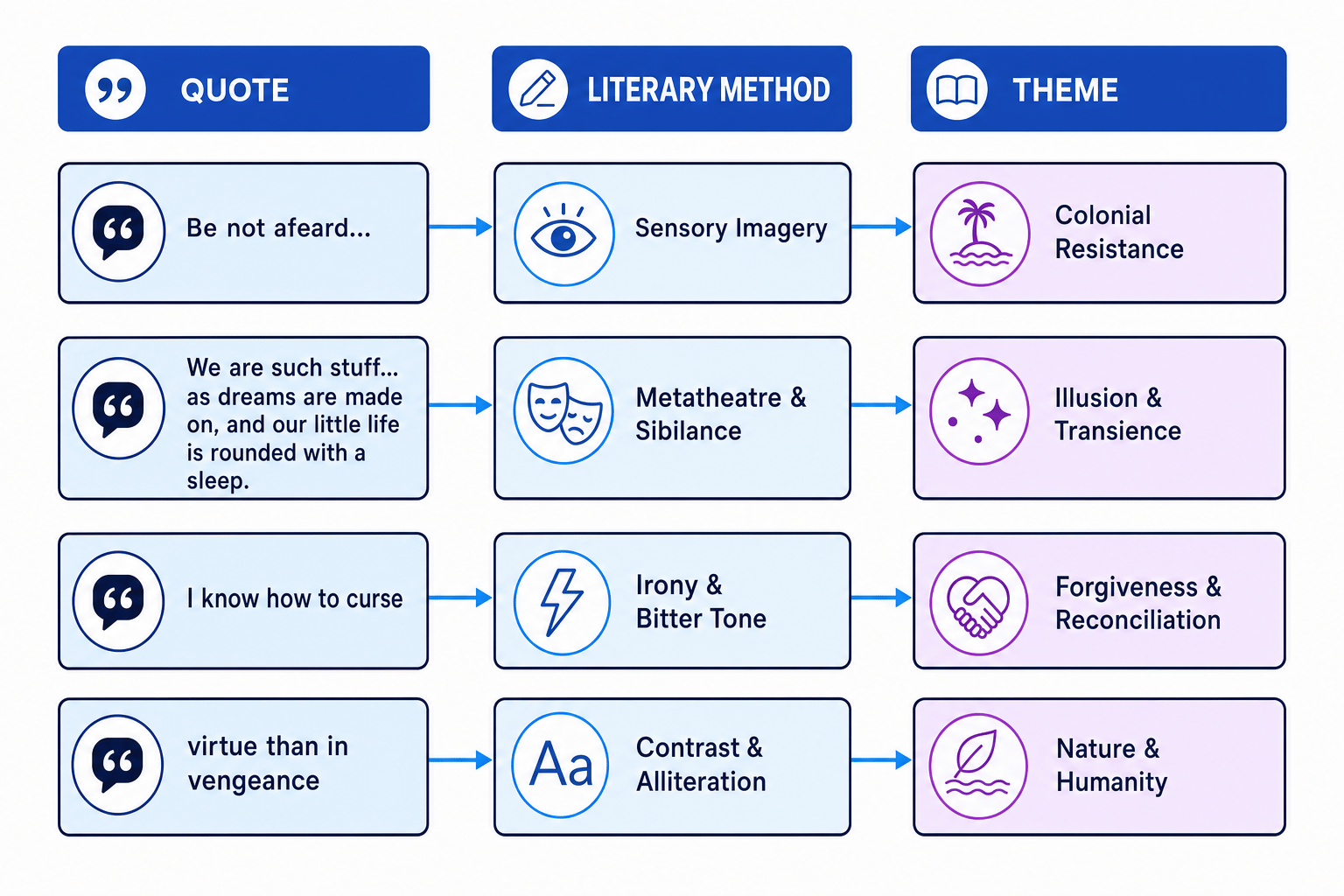
1. Caliban: "You taught me language, and my profit on't / Is, I know how to curse." (Act 1, Scene 2)
- Themes: Power, Colonisation, Nature vs. Nurture, Education.
- Literary Methods: Irony (Caliban uses the tool of "civilisation" to attack his captors); plosive consonant sounds in "profit" and "curse" which convey his deep-seated bitterness.
- Contextual Link: Reflects early 17th-century European exploration. Explorers often justified the subjugation of indigenous peoples by claiming they were "civilising" them through language and religion.
2. Caliban: "Be not afeard; the isle is full of noises, / Sounds and sweet airs, that give delight and hurt not." (Act 3, Scene 2)
- Themes: Humanity, The Natural World, Magic, Illusion.
- Literary Methods: Sensory imagery ("sweet airs", "noises"); sibilance ("sounds and sweet") which mimics the gentle, whispering sounds of the island; change in poetic form (Caliban, usually speaking in prose, here speaks in elegant, blank verse, demonstrating his deep spiritual connection to the island).
- Contextual Link: This challenges the Jacobean concept of the Great Chain of Being, which placed "monsters" like Caliban at the very bottom, below humans. By giving Caliban the most beautiful poetry in the play, Shakespeare humanises him and critiques the cold rationalism of his European captors.
3. Prospero: "We are such stuff / As dreams are made on, and our little life / Is rounded with a sleep." (Act 4, Scene 1)
- Themes: Magic, Illusion vs. Reality, Mortality, Power.
- Literary Methods: Metaphor (comparing human existence to a fleeting dream or a theatrical performance); sibilance ("such stuff", "sleep") creating a quiet, melancholic, and reflective tone.
- Contextual Link: This is a key example of metatheatre (theatre that refers to itself as theatre). Written near the end of Shakespeare's career, this speech is widely interpreted as the playwright's own farewell to the stage, suggesting that all of human history and theatrical artifice will eventually fade into nothingness.
Metatheatre
Metatheatre is a device where a play draws attention to its own nature as a dramatic performance. In The Tempest, Prospero acts as a director, using his magic to stage "spectacles" (like the tempest itself or the wedding masque), drawing a parallel between magic, playwriting, and God's creation.
4. Prospero: "Yet with my nobler reason 'gainst my fury / Do I take part. The rarer action is / In virtue than in vengeance." (Act 5, Scene 1)
- Themes: Forgiveness, Reconciliation, Power, Divine Right.
- Literary Methods: Contrast (juxtaposing "virtue" and "vengeance"); alliteration of the "v" sound draws attention to this moral choice; the comparative adjective "rarer" emphasizes how difficult and noble it is to choose mercy over revenge.
- Contextual Link: This aligns with Christian humanist philosophies of the Renaissance, which valued rational self-control over raw emotion. It also flattered King James I, who wrote about the importance of a monarch showing Christian mercy rather than tyrannical vengeance.
5. Miranda: "O, wonder! / How many goodly creatures are there here! / How beauteous mankind is! O brave new world, / That has such people in't!" (Act 5, Scene 1)
- Themes: Innocence, Illusion vs. Reality, Humanity.
- Literary Methods: Exclamatory sentences ("O, wonder!", "how beauteous!"); repetition of the vocative "O" capturing her overwhelming sense of awe; dramatic irony (the audience knows the "goodly creatures" she is admiring are actually corrupt, murderous conspirators like Antonio and Sebastian).
- Contextual Link: Miranda's naive enthusiasm represents the idealistic hope of a "new world," untouched by the corruption and power struggles of the Old World (Milan/Naples).
Vocabulary for top marks (AO4)
To secure the highest marks for your spelling, punctuation, and grammar (AO4), incorporate high-level vocabulary to describe these quotes. Instead of saying Prospero "forgives people", say he "relinquishes his vengeance in favour of Christian reconciliation". Instead of saying Caliban is "angry", describe his speech as "articulating colonial resentment and subjugation".
In the exam
- Choose three "Golden" quotes before you even step into the exam room that fit the broad themes of power, nature, and magic.
- Weave, don't drop: Ensure your selected quotation fits grammatically into your sentence. Read your sentence back in your head—if it sounds clunky, shorten the quotation.
- Deconstruct the word: Don't just analyze the quote as a whole. Pick one specific word (like the noun "profit" or the adjective "rarer") and write two sentences exploring the specific connotations of that single word.
- Link to the play's ending: Try to include a quotation from Act 5 (like Prospero's turn to "virtue") to show the examiner you understand the dramatic arc and resolution of the play, rather than just the beginning.
Check yourself
- Which character says "Be not afeard; the isle is full of noises," and what does the transition to blank verse reveal about their character?
- What is the dramatic irony embedded in Miranda's famous exclamation, "O brave new world"?
- Why is the noun "profit" ironic in Caliban's quote about learning language?
