Characters in The Tempest are not just realistic individuals; they represent competing ideas about power, nature, society, and forgiveness. Written around 1611, the play is often read as Shakespeare’s farewell to the stage, making the characters’ relationships to art, magic, and control especially significant.
What you'll learn:
- How Shakespeare uses character foils to highlight contrasting ideas about power and humanity.
- The complex, master-servant relationships between Prospero, Ariel, and Caliban.
- How to analyse characters through the lens of Jacobean context, including the Great Chain of Being and early colonisation.
The Hierarchy of the Island
Before diving into individual characters, we must understand the social framework that governs them. Shakespeare structures his characters using a rigid hierarchy. This system is heavily influenced by contemporary Jacobean beliefs and is constantly challenged, disrupted, and restored throughout the play.
The Great Chain of Being
A strict religious and social hierarchy believed in Jacobean England, which decreed that everything in the universe had a specific, God-given place. God was at the top, followed by angels, monarchs, nobles, commoners, animals, and finally, inanimate matter. To disrupt this order was considered a sin against God and nature.
On the island, Prospero disrupts this natural order by using his magical art to force spirits, beasts, and even nobles to bend to his will.
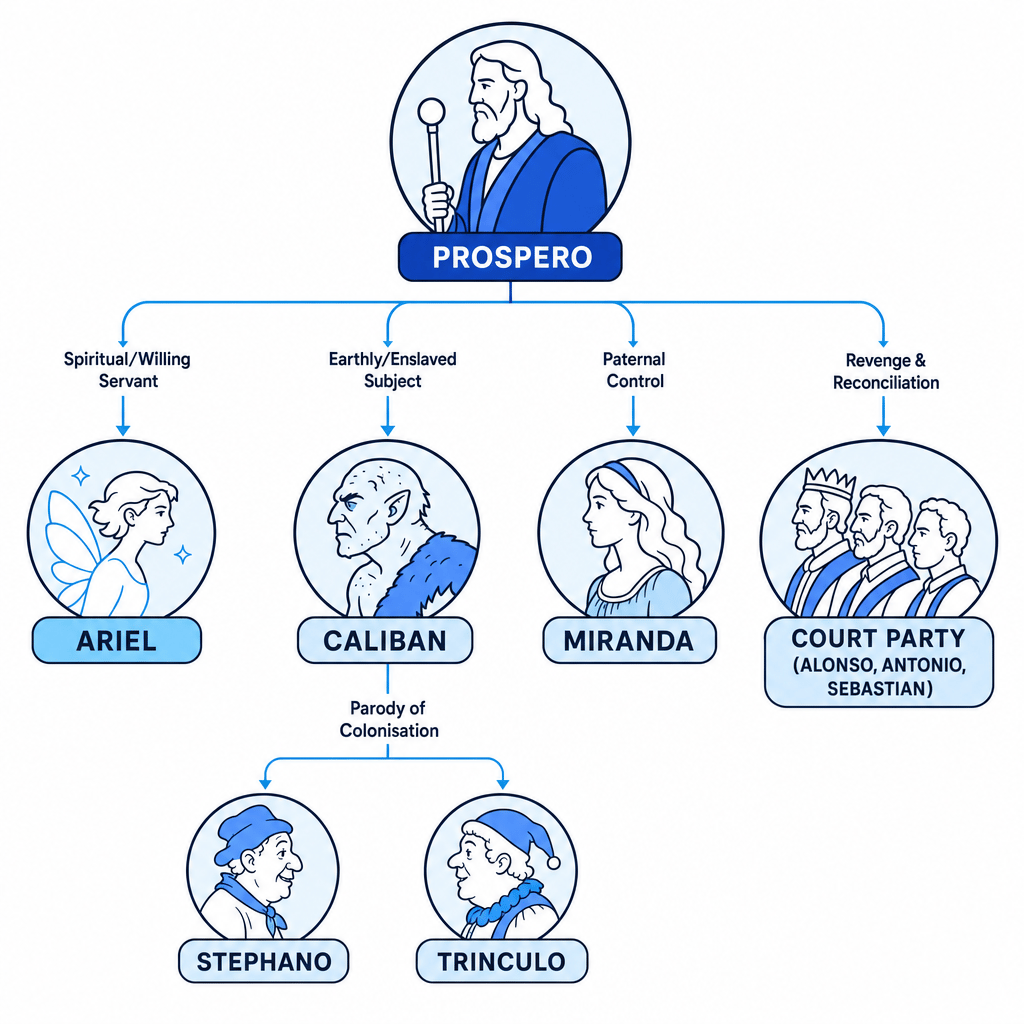
Prospero: The Orchestrator of the Play
Prospero is the deposed Duke of Milan who has spent twelve years on a remote island perfecting his "art" (magic). He is a deeply complex protagonist: he is both a victim of a political coup and a harsh ruler who dominates the island's inhabitants.
The Duality of Prospero
- The Compassionate Father and Scholar: Prospero is deeply protective of Miranda, ensuring her safety and arranging her marriage to Ferdinand to secure her future. His magic is fueled by his studies, representing the Renaissance ideal of intellectual self-improvement.
- The Tyrannical Coloniser: Prospero uses physical threats, emotional manipulation, and magical torment to keep Ariel and Caliban subjugated. He calls Caliban a "poisonous slave" and threatens Ariel with imprisonment in an oak tree.
Prospero's Arc: From Vengeance to Mercy
Prospero’s journey is defined by his transition from a thirst for revenge to an acceptance of forgiveness. In Act 5, prompted by the spirit Ariel, Prospero decides to forgive his enemies, declaring:
"The rarer action is in virtue than in vengeance." (Act 5, Scene 1)
This shift is symbolised by his decision to abjure (solemnly renounce) his magic, break his staff, and drown his book.
Prospero as Shakespeare's Stand-In
Many critics view Prospero's theatrical control over the characters—orchestrating storms, spectacles, and marriages—as an allegory for the playwright himself. When Prospero breaks his staff and asks the audience for forgiveness in the Epilogue, it is often interpreted as Shakespeare bidding farewell to his theatrical career.
Caliban: The Complex "Monster"
Caliban is the son of the deceased witch Sycorax and the original inhabitant of the island. He is one of Shakespeare’s most complex creations, challenging the easy division between "civilised" and "savage."
Foil
A character who contrasts sharply with another character in order to highlight particular qualities of the other. For example, Caliban and Ariel act as contrasting foils to one another in their reactions to Prospero’s rule.
The Contrast in Caliban
To the European characters, Caliban is a "born devil, on whose nature / Nurture can never stick" (Act 4, Scene 1). He is treated as physically deformed and morally corrupt.
However, Shakespeare gives Caliban some of the most beautiful, poetic blank verse in the entire play. His famous "isle is full of noises" speech reveals a deep, spiritual connection to the natural world:
"Be not afeard; the isle is full of noises, Sounds and sweet airs, that give delight and hurt not." (Act 3, Scene 2)
Viewing Caliban as purely comedic or evil
Do not dismiss Caliban as a simple villain or comic buffoon. While he does plot to murder Prospero with Stephano and Trinculo, Shakespeare uses his character to raise profound questions about the justice of colonisation. Caliban's claim—"This island's mine, by Sycorax my mother, / Which thou takest from me"—would have resonated deeply during an era of expanding British global exploration.
Ariel: The Airy Spirit
Ariel is a powerful, shape-shifting spirit whom Prospero rescued from imprisonment inside a pine tree by the witch Sycorax. Ariel serves Prospero out of a mixture of gratitude and fear, but his ultimate goal is always freedom.
Ariel’s Character Qualities
- Intangible and Artful: Ariel performs the magical labour that Prospero cannot physically do himself. He becomes the tempest, creates illusions, and plays enchanting music to lead characters astray or send them to sleep.
- The Agent of Empathy: Despite being non-human, Ariel exhibits more empathy than Prospero. It is Ariel who feels pity for the shipwrecked nobles and prompts Prospero’s change of heart:
Ariel: "If you now beheld them, your affections / Would become tender." Prospero: "Dost thou think so, spirit?" Ariel: "Mine would, sir, were I human." (Act 5, Scene 1)
Miranda: The Innocent Observer
Miranda is Prospero’s fifteen-year-old daughter. Having lived on the island since she was three, she has never seen any humans other than her father and Caliban.
Miranda’s Role and Agency
- Empathy as a Core Virtue: Miranda's opening lines establish her profound empathy. Watching the shipwreck, she cries: "O, I have suffered / With those that I saw suffer!" (Act 1, Scene 2).
- A Pawn in Dynastic Politics: Historically and politically, Miranda is used by Prospero to secure an alliance with Naples through her marriage to Ferdinand.
- Moments of Independence: Despite her father’s controlling nature, Miranda shows agency. She disobeys Prospero's orders by telling Ferdinand her name, and she even proposes marriage to Ferdinand herself: "I am your wife, if you will marry me" (Act 3, Scene 1).
The Irony of Miranda's Final Lines
When Miranda sees the assembled nobles in Act 5, she exclaims: "O, wonder! / How many goodly creatures are there here! / How beauteous mankind is! O brave new world, / That has such people in't!" Shakespeare uses dramatic irony here. The audience knows that this "brave new world" includes corrupt conspirators like Antonio and Sebastian. This tempers Miranda's naive idealism with a sense of realistic caution.
Analysing Character Interactions
In your exam, you will need to write about how these characters interact and how Shakespeare uses these relationships to convey key themes. Let's look at how to build an analytical paragraph focusing on Caliban's complex characterization.
Analysing Caliban's dual nature
Task: Write an analytical paragraph showing how Shakespeare presents the conflict between Caliban’s "savage" reputation and his poetic nature.
- Point: Begin with a clear, conceptual focus that addresses the prompt and links the character to a wider theme.
- Drafting your point: Shakespeare presents Caliban not as a simple, uncultivated savage, but as a complex figure whose innate poetic sensitivity contrasts sharply with the harsh, colonial abuse he suffers under Prospero.
- Evidence: Embed a short, precise quote that directly supports your point.
- Drafting your evidence: This sensitivity is most vivid when Caliban describes the natural magic of the island, reassuring the comic characters that "the isle is full of noises, / Sounds and sweet airs, that give delight and hurt not."
- Method Analysis: Identify the specific language or structural devices Shakespeare uses in the quote, and explain how they function.
- Drafting your analysis: By writing Caliban’s speech in rich, lyrical blank verse (iambic pentameter), Shakespeare elevates his status. The sensory imagery of "sweet airs" and the soft sibilance of "sounds" convey a deep, harmonious connection to the natural world. This linguistic elegance directly challenges the colonial view held by Prospero and the courtly characters, who dismiss Caliban as an unrefined, subhuman beast incapable of higher thought.
- Contextual Link: Connect your analysis to a relevant Jacobean context or the writer’s overall purpose.
- Drafting your contextual link: Through this complex characterisation, Shakespeare engages with contemporary Renaissance debates about the "noble savage" and early colonial exploration. Rather than validating the absolute moral superiority of European "civilisation," the playwright forces the audience to question whether the real "savagery" lies in the brutal usurpation and control exercised by Prospero.
In the exam
- Avoid character-assassination: Do not treat characters like real people. Always write about them as constructs designed by Shakespeare to convey specific ideas. Use phrases like "Shakespeare constructs Caliban to represent..." rather than "Caliban is..."
- Contrast is key: Make sure you discuss character relationships. If you get a question on Prospero, talk about how his character is defined through his foils (Ariel's desire for liberty vs. Caliban's bitter rebellion).
- Use precise terminology: When discussing character speech, notice who speaks in blank verse (noble, high-status, or poetic characters) and who speaks in prose (comic characters like Stephano and Trinculo). This structural method directly reflects their social status and inner nature.
- Keep quotes short: Memorise highly adaptable, short quotes (e.g., "poisonous slave", "brave new world", "rarer action") so you can seamlessly embed them into your sentences.
Check yourself
- Why does Shakespeare have Caliban speak in beautiful blank verse rather than crude prose?
- In what ways does Ariel act as a moral foil to Prospero in Act 5?
- How does Miranda's reaction to the shipwreck in Act 1, Scene 2 contrast with Prospero's attitude toward the survivors?
