In Dennis Kelly’s contemporary play DNA, the characters are not just teenagers hanging out in a wood; they are a microcosm of wider society. Kelly uses them to explore dark, challenging themes: group mentality, peer pressure, the corrupting nature of power, and what happens to human morality when survival is threatened.
Understanding how these characters function individually and in relation to one another is your key to unlocking top-tier marks in your GCSE English Literature exam.
What you'll learn
- How Kelly uses the contrasting pairing of Phil and Leah to explore the tension between intellect, silence, and morality.
- How the shifting leadership dynamics between John Tate, Phil, and Cathy expose the fragile nature of authority.
- How minor characters like Brian, Adam, Mark, and Jan highlight the psychological cost of conformity and the bystander effect.
Understanding Kelly’s Dramatic Methods
Before diving into individual character profiles, it is important to understand how Kelly constructs his characters. In a play, characters are defined not just by what they say, but by their actions, their silences, and how other characters react to them.
Foil
A foil is a character who contrasts sharply with another character (usually the protagonist) in order to highlight and emphasize particular qualities of that other character.
Greek Chorus
A Greek chorus is a group of actors in classical drama who comment on the main action of the play with a collective voice, offering exposition and reflecting the moral stance of society.
In DNA, Kelly utilizes these classical dramatic techniques in a highly modern setting. By looking at the relationships between the characters, we can map out how power, manipulation, and victimhood operate within the gang.
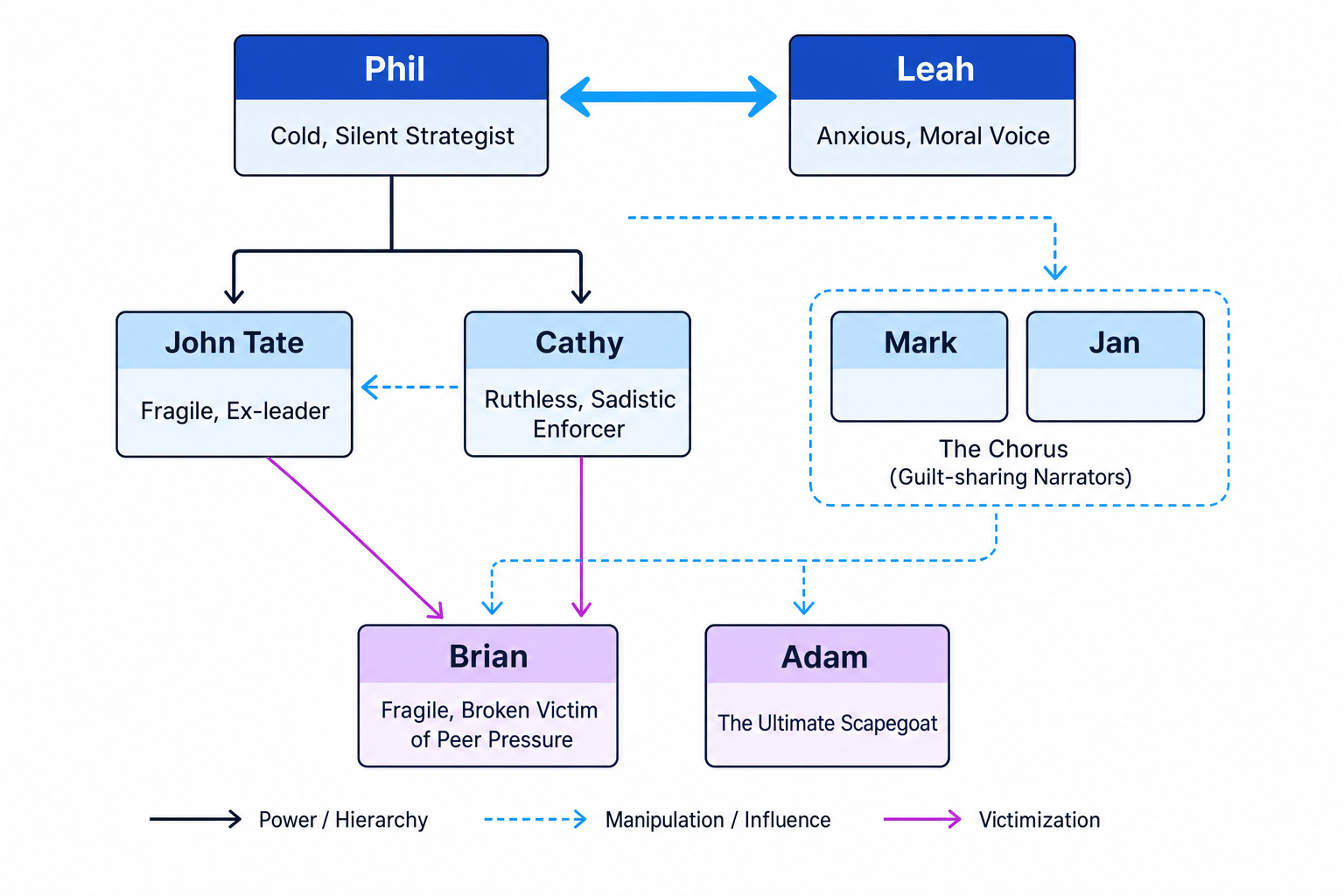
The Central Axis: Phil and Leah
Phil and Leah are the intellectual and emotional core of the play. They appear together in almost every scene set in "A Field", which acts as a quiet, reflective contrast to the chaotic scenes set in "A Wood" or "A Street".
Phil: The Silent Strategist
Phil is a chillingly detached, logical figure. For much of the play, he is entirely silent while Leah talks at him. However, his silence is not a sign of weakness; it is a display of supreme power and psychological control.
- Non-verbal communication: Phil’s actions are dominated by eating—ice cream, chips, waffles, coke. This sensory gratification contrasts with the moral panic around him. It suggests he is a consumer, driven by basic instincts, entirely unbothered by empathy.
- Cold pragmatism: When Phil finally speaks, he speaks in short, imperative, declarative sentences. He does not panic; he plans. His instructions to frame the innocent postman are terrifyingly clinical: "If everyone associates inside the boundary... we’ll be fine."
- Sociopathic tendencies: Phil represents a terrifyingly nihilistic worldview. He is willing to sacrifice anyone—first the postman, then Adam—to protect the integrity and safety of the group.
Leah: The Moral Voice
Leah is the exact opposite of Phil, making her his perfect dramatic foil. She is hyper-verbal, speaking in long, rambling monologues that are filled with anxiety, scientific trivia, and philosophical questions.
- Desperate for connection: Leah is desperately insecure and craves Phil’s attention. She uses extreme behaviors—such as spitting, choking herself, and threatening to kill her pet chimpanzee—just to get him to look at her.
- The voice of conscience: Leah is the only character who consistently questions the morality of their actions. She recognizes the horror of what they have done to Adam: "It’s an ornament. We’ve made an ornament."
- Evolutionary metaphors: Leah frequently talks about chimps and bonobos, using evolutionary biology to try and understand the group's capacity for violence.
The Tragedy of Leah's Departure
Leah’s ultimate decision to leave the group at the end of the play is a tragic moral victory. While she successfully preserves her own integrity by escaping, her departure removes the group's only moral compass, leaving Phil isolated and the rest of the gang completely lawless.
Analyzing Character through Dialogue and Metaphor
To gain high marks for AO2 (analyzing language, form, and structure), you must be able to dissect how a character's speech reveals their psychological state. Let’s look at how we can analyze one of Leah's key monologues.
Analyzing Leah's evolutionary metaphors
Analyze how Dennis Kelly uses Leah's monologue about chimpanzees in Act 2 to convey her fears about human nature.
- Contextualize the quotation: Identify the key quote where Leah compares the group to primates. Leah states: "Chimps are evil. They frame each other, they kill each other... we're chimps."
- Analyze the linguistic methods: Focus on the noun "chimps" and the adjective "evil". By using evolutionary science, Leah is suggesting that the cruelty the gang inflicted on Adam is not an aberration, but an inescapable, hardwired biological instinct. The triplet of active verbs ("frame... kill... we're" ) transitions from primate behavior to human behavior, showing how easily the gap between animal and human is bridged.
- Link to character and theme: Connect this to Leah's wider role in the play. This monologue reveals her deep anxiety and her desperate search for a rational explanation for the group's sadistic behavior. She is trying to absolve them of individual guilt by blaming human nature, yet the raw terror in her voice alerts the audience to the moral vacuum they have entered.
Confusing Leah's rambling for nonsense
Do not write off Leah’s monologues as meaningless babble. Students often mistake her talk of "bonobos" or "de-cluttering" as comic relief. In reality, these are deeply significant, highly intellectual metaphor systems that Kelly uses to critique human society, capitalism, and evolutionary cruelty.
The Shifting Hierarchy: John Tate and Cathy
The power dynamics within the group are highly volatile. As the pressure of their crime mounts, the leadership structure fractures and reconstitutes.
John Tate: The Fragile Leader
At the start of the play, John Tate is the nominal leader of the group. However, Kelly presents his leadership as incredibly fragile, relying entirely on physical intimidation and fear.
- Insecurity and control: Tate tries to ban the word "dead" because he cannot cope with the reality of what they have done. He rules through threats: "If anyone says it, I’m going to have to, you know, bite their face."
- Psychological collapse: Under the stress of the cover-up, Tate quickly breaks down. He cannot handle the moral weight of leadership and retreats into religion, eventually disappearing from the play entirely. He is a weak figure who uses aggression to mask his profound vulnerability.
Cathy: The Sadistic Opportunist
Cathy undergoes the most disturbing transformation in the play. She begins as a minor, quiet follower and ends up as a cruel, sadistic leader.
- Thriving in chaos: Unlike the others, who are paralyzed by guilt, Cathy actively enjoys the drama. She finds the police investigation and the media attention "exciting."
- Lack of empathy: Cathy shows no remorse. She is the one who cuts a first-year's finger to frame him, and she takes a leading role in the final decision to murder Adam. As Richard notes at the end of the play, "Cathy's crazy... she's runnin' things now."
- Machiavellian ambition: Cathy represents how anarchy allows the most ruthless, unfeeling individuals to rise to the top of a social hierarchy.
Contrast Tate and Cathy
A great essay technique is to contrast John Tate’s leadership with Cathy’s. Tate’s leadership is based on a desperate, fearful struggle to maintain order, whereas Cathy’s power is built on embracing and escalating the chaos.
The Victims: Brian and Adam
Kelly uses the characters of Brian and Adam to expose the devastating, real-world consequences of peer pressure and collective cruelty.
Brian: The Broken Conformist
Brian is the weakest and most vulnerable member of the group. He is selected by Phil to lie to the police because his weak-willed nature makes him easy to manipulate.
- Mental fragmentation: The pressure of keeping the secret completely destroys Brian’s mental health. He regresses into a childlike state, playing with mud and eating paper.
- Medicinal suppression: By the end of the play, Richard notes that Brian is on "stronger" medication and is "giggling." Kelly uses Brian to critique how society medicates and silences those who are psychologically damaged by systemic abuse and bullying.
Adam: The Ultimate Scapegoat
Although Adam only appears in one scene (Act 3, Scene 3), he is the catalyst for the entire plot. He is a boy who desperately wanted to fit in, and who was tortured and left for dead as a result of a "prank" gone wrong.
- Physical and mental degradation: When Adam returns, he is living wild in a hedge, dirty, brain-damaged, and unable to remember his own name. He is a shell of a human being.
- The sacrifice: Adam's return presents a moral crossroad. Instead of saving him, the group—led by Phil and Cathy—decide that his "resurrection" is too dangerous for their own safety. He is murdered offstage to protect the collective.
Adam as the Scapegoat
Think of Adam as a literal "scapegoat"—a biblical concept where a community heaps all of their sins, guilt, and shame onto an innocent animal and casts it out into the wilderness to die, thereby cleansing the community of its crimes.
The Modern Greek Chorus: Jan and Mark
Jan and Mark open each of the play’s four acts. They speak in rapid, overlapping, stichomythic dialogue (short, alternating lines of verse or prose).
- The framing device: They provide vital exposition, keeping the audience informed about what has happened offstage.
- Deflection of guilt: Jan and Mark's opening conversations are always characterized by panic and a desperate attempt to minimize their personal involvement: "We were having a laugh... physically having a laugh."
- The voice of the bystander: By acting together, Jan and Mark represent the "bystander effect." They show how responsibility is diluted when shared across a group. Because they both agreed to the actions, neither feels individually responsible for the tragic outcome.
Do not treat Jan and Mark as identical
While Jan and Mark often speak in unison or echo each other's thoughts, pay close attention to who initiates the conversations. Jan is often the one asking the probing questions ("Are we hurt? Is he hurt?"), while Mark is often the one attempting to justify their actions first.
In the exam
When writing about characters in DNA, make sure to follow these strategic steps:
- Avoid the "character-as-real-person" trap: Always remember that characters are constructs designed by Dennis Kelly to convey specific political and social ideas (AO3). Instead of writing "Phil is a mean person," write "Kelly constructs Phil as an embodiment of cold, utilitarian pragmatism to warn the audience about..."
- Analyze methods, not just dialogue: Look at the stage directions. Phil’s silence and his constant eating are deliberate structural choices by Kelly. Contrast his non-verbal dominance with Leah's frantic, unchecked speech (AO2).
- Trace character development structurally: Note how characters change across the play’s four-part structure. Do not just look at a character in isolation; examine how their power increases or decreases from the exposition (Act 1) to the grim resolution (Act 4).
Check yourself
- Why does Kelly choose to keep Phil silent for almost all of Leah's monologues, and what does this reveal about their power dynamic?
- How does Cathy's character arc illustrate the theme of "survival of the fittest"?
- What is the dramatic significance of Jan and Mark opening every single act of the play?
