In Arthur Conan Doyle’s 1890 novella The Sign of Four, the thrilling detective plot is a vehicle for exploring deep anxieties and debates that gripped Victorian society.
What you'll learn:
- How the British Empire and Victorian fears of the "foreign" shape the novel's setting and characters.
- How Doyle uses the Agra Treasure to explore greed, corruption, and the differences between legal and moral justice.
- How the characters of Sherlock Holmes and Dr John Watson embody the Victorian tension between cold scientific rationality and human emotion.
Thematic Map
To write a high-level essay for GCSE English Literature, you need to understand how the novel's central symbol—the Agra Treasure—links directly to its core themes. The map below illustrates these key thematic pathways.
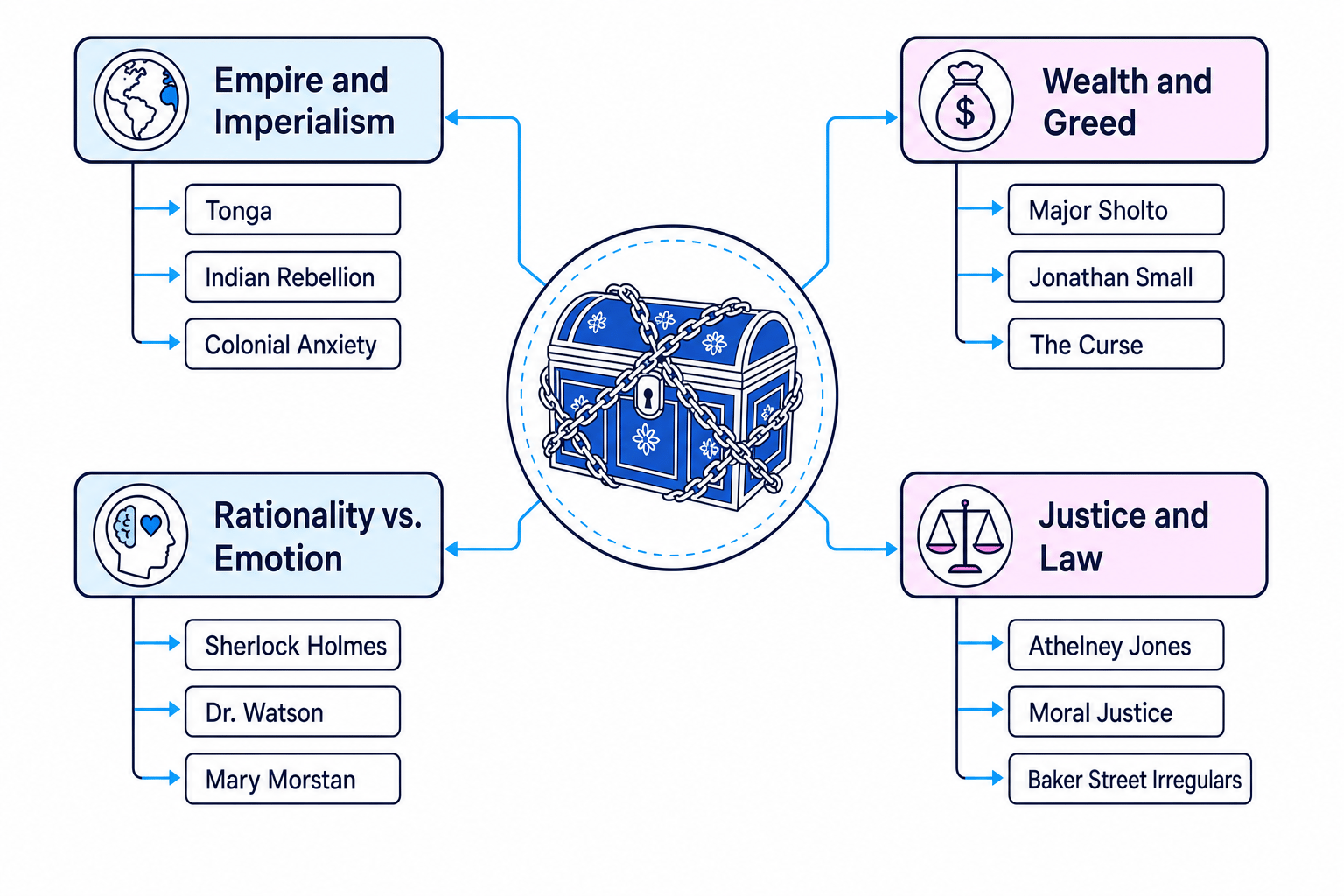
Empire, Imperialism, and Victorian Anxiety
To understand The Sign of Four, you must understand its historical context. At the end of the nineteenth century, Great Britain was the head of a massive global empire. However, beneath the pride of imperial expansion lay a deep-seated anxiety: the fear that the "foreign" world would "infect" or invade the domestic safety of London.
Imperialism
Imperialism is a policy or ideology of extending a nation's rule over foreign nations, often by military force or by gaining political and economic control.
In the novel, Doyle constantly contrasts the safety of Victorian England with the perceived wildness of the colonies (specifically India and the Andaman Islands).
The Gothic Double: London as a Wild Frontier
Doyle uses pathetic fallacy and dark, gothic imagery to make London itself feel like an untamed, foreign jungle.
When Watson and Mary Morstan travel to meet Thaddeus Sholto, London is described as a place of "mud-coloured clouds" and a "dense drizzly fog". The streets are filled with a "subdued hum" and "steamy vapor".
By describing London in this way, Doyle suggests that the dark, corrupting influence of the Empire has traveled back to the heart of Great Britain. The fog is not just weather; it is a metaphor for the moral obscurity and confusion brought about by colonial greed.
Tonga as the Manifestation of Imperial Fear
The character of Tonga is the ultimate symbol of Victorian imperial prejudice and anxiety. He represents the "other"—the unfamiliar, non-white colonial subject whom Victorians viewed with a mixture of fascination and terror.
- Doyle describes Tonga using dehumanising, animalistic language (zoomorphism). He is called a "savage, distorted creature" with "bestial" features and "preternatural ugliness".
- To a Victorian reader, who likely believed in physiognomy (the pseudoscientific theory that a person's character could be judged by their facial features), Tonga’s appearance was a direct indicator of evil.
- Tonga's weapon—the poison dart blowpipe—represents a stealthy, "un-British" way of fighting, contrasting with the Victorian ideal of fair play and open combat.
The Imperialist Cycle
Doyle presents a cycle of imperial guilt. The Agra Treasure is stolen from India during the violent upheaval of the Indian Rebellion of 1857. Because the wealth was acquired through violence and betrayal, it acts as a curse, bringing violence and death back to everyone who touches it on British soil.
Wealth, Greed, and Corruption
The Agra Treasure is the driving force behind the plot, but symbolically, it is a moral poison. Almost every character who covets the treasure is destroyed or corrupted by it.
The Victims of Greed
- Major Sholto: His greed leads him to betray Jonathan Small and keep the entire treasure for himself. He spends his life in a state of constant, paranoid fear, guarding his home with armed guards and eventually dying of terror when he sees Jonathan Small's face at his window.
- Bartholomew Sholto: Unlike his more eccentric and slightly guilt-ridden brother Thaddeus, Bartholomew is consumed by the monetary value of the treasure. He is murdered by Tonga while sitting in his room surrounded by his newly discovered riches.
- Jonathan Small: A British soldier whose greed leads him to join the conspiracy to murder the merchant Achmet for the treasure. His pursuit of the gold costs him his freedom, his leg, and his moral compass, leading to a life of imprisonment and exile.
Transcending Greed: Mary and Watson
In stark contrast to the corrupted characters, Mary Morstan and Dr Watson are defined by their complete lack of greed.
When the chest is finally opened and found to be empty, Watson cries, "Thank God!".
Because the treasure is gone, Watson is free to propose to Mary without being accused of being a "fortune-hunter." Mary, too, receives the news of her lost fortune with a "bright, quiet smile". By rejecting the pursuit of wealth, they escape the curse of the Agra Treasure and find true happiness in love.
Confusing Plot with Theme
When writing about the treasure, do not just describe where it came from or how it was lost. Always link it to Doyle's thematic message: unearned wealth is morally corrupting, and true human connection (like Watson and Mary's love) is infinitely more valuable than material riches.
Rationality and Intellect vs. Emotion
At the heart of the Holmes stories is a philosophical debate: is it better to live a life guided by cold, scientific reason, or one enriched by human emotion and romance?
Sherlock Holmes: The Human Calculating Machine
At the beginning of the novel, Watson describes Holmes as "an automaton—a calculating machine". Holmes actively rejects emotion, claiming that "love is an emotional thing, and whatever is emotional is opposed to that true cold reason which I place above all things."
To cope with the lack of intellectual stimulation between cases, Holmes turns to a "seven-per-cent solution" of cocaine. Doyle uses this self-destructive habit to show the dark side of a purely intellectual life. Without a mystery to solve, Holmes's brilliant mind turns inward and begins to destroy him.
Dr John Watson: The Romantic Heart
While Holmes represents pure intellect, Watson represents human emotion, empathy, and morality. He is the bridge between the reader and Holmes's alien genius. Watson is deeply affected by Mary Morstan’s beauty and vulnerability, showing a capacity for love and emotional growth that Holmes completely lacks.
       [ SHERLOCK HOLMES ]                   [ DR JOHN WATSON ]
       * Rationality & Logic                 * Emotion & Romance
       * Cocaine & Boredom                   * Love & Empathy
       * "Calculating machine"               * Human connection
The Novel's Resolution
Notice the symmetrical structure of the novel's ending. At the close of the book, Watson wins Mary's hand in marriage (a triumph of emotion), while Holmes is left alone, reaching for his cocaine bottle (a triumph of intellect, but a lonely one). This leaves the reader to decide who has truly "won."
Justice, Law, and Morality
Doyle uses The Sign of Four to challenge the Victorian assumption that the "law" is always synonymous with "justice."
Legal Justice vs. Moral Justice
- Athelney Jones represents the official police force. He is loud, bumbling, and relies on rigid, bureaucratic methods that often lead him to arrest the wrong people (like Thaddeus Sholto). He represents the failure of the official legal system.
- Sherlock Holmes represents scientific, rational justice. He works outside the official police force, using deduction and observation to uncover the objective truth.
- Jonathan Small represents a complex moral grey area. While he is a criminal and an accessory to murder, he feels justified in his actions because the treasure was stolen from him first. He scatters the treasure in the River Thames rather than let anyone else have it, declaring that "The Sign of Four" has its own law of retribution.
Put it into Practice: Analyzing a Theme
Writing a thematic analysis paragraph
Analyze how Arthur Conan Doyle presents the theme of Empire and Victorian Anxiety in The Sign of Four.
To write a high-scoring analytical paragraph, we must follow a clear structure: Point → Evidence → Method → Effect → Context (AO1, AO2, AO3).
Step-by-Step Walkthrough
-
State your thesis point (AO1): Formulate a clear, analytical claim that directly answers the prompt, linking the theme to Doyle’s broader authorial intent.
Example: "Doyle uses the character of Tonga to externalise Victorian anxieties about the untamed, dangerous nature of the British Empire invading the domestic security of London."
-
Integrate precise evidence (AO1): Select a memorable, short quote that supports your point and weave it smoothly into your sentence.
Example: "This is most apparent when Tonga is introduced during the chase on the Thames, described by Watson as a 'savage, distorted creature' who behaves with 'bestial' fury."
-
Analyze the writer's methods (AO2): Identify the literary techniques used (e.g., zoomorphism, sensory language) and analyze how they create meaning.
Example: "The zoomorphic adjectives 'savage' and 'bestial' strip Tonga of his humanity, reducing him to a wild animal. Doyle uses this harsh imagery to shock the reader, positioning Tonga as the antithesis of Holmes's refined, intellectual Victorian gentleman."
-
Connect to Victorian Context (AO3): Explain why a Victorian writer would write this and how a contemporary audience would react, linking it to the historical background.
Example: "This portrayal reflects the late-Victorian anxiety surrounding colonial 'reverse colonization'—the fear that the violence used to maintain the Empire abroad would eventually return to corrupt Britain itself. Furthermore, it appeals to contemporary prejudices shaped by social Darwinism and physiognomy, which falsely linked physical non-conformity with moral depravity."
In the exam
- Focus on the "Why": Never just list the themes. Always ask yourself why Doyle chose to write about these ideas in 1890. How do they reflect Victorian concerns about science, the Empire, or industrialisation?
- Anchor your ideas to the prompt: If the question is about Holmes, you can still write about the theme of Emotion vs. Intellect. If the question is about Mary Morstan, write about Wealth and Greed. The themes are your secret weapon to elevate a character question into a high-scoring conceptual essay.
- Use precise methods: When quoting, don't just say "Doyle writes...". Instead, say "Doyle utilizes pathetic fallacy in his description of the 'mud-coloured clouds' to establish a gothic tone of moral decay...".
Check yourself
- Why does Watson cry "Thank God!" when he discovers the Agra Treasure is empty? How does this link to the theme of wealth?
- How does the setting of London (specifically the thick fog and dark streets) mirror the moral corruption associated with the Agra Treasure?
- In what ways does Jonathan Small challenge the Victorian concept of "the law"?
