To truly understand Arthur Conan Doyle’s The Sign of Four (first published in 1890), you must look at it through the eyes of a Victorian reader. The Victorian era was a time of immense change, characterised by rapid industrialisation, scientific breakthroughs, and the vast expansion of the British Empire. However, beneath the surface of Victorian confidence lay deep-seated anxieties about crime, foreign influences, and the moral consequences of imperialism.
In your GCSE English Literature exam, your understanding of these historical and social factors is assessed under AO3 (Assessment Objective 3). This guide will show you how to weave contextual knowledge directly into your analysis of the text's language and structure.
What you'll learn
- How Victorian attitudes toward the British Empire and the Indian Rebellion of 1857 shape the plot.
- The clash between Victorian scientific rationalism and Gothic sensationalism.
- How Victorian xenophobia and social class dynamics are reflected in the characters.
- How to write an integrated analytical response that seamlessly links context to Conan Doyle's literary methods.
Context in GCSE English Literature (AO3)
Many students make the mistake of treating context like a history lesson, dropping random facts about Queen Victoria or steam trains into their essays. To gain top marks, context must always be linked directly to the writer's intentions and the choices they make with language, form, and characterisation.
Assessment Objective 3 (AO3)
AO3 is the assessment objective that rewards you for showing how the relationship between the text and the context in which it was written shapes its meaning. You must explain why the writer wrote the text at that time, and how contemporary audiences would have reacted.
Rather than stating a historical fact in isolation, ask yourself: How does this historical reality explain the way a character behaves, or the imagery the writer uses?
1. The British Empire and Imperial Anxiety
During the late 19th century, Great Britain ruled over a global empire, with India frequently referred to as the "Jewel in the Crown." While many Victorians felt immense pride in this global dominance, there was also a pervasive undercurrent of anxiety.
The Indian Rebellion (1857)
A pivotal historical event for the novel is the Indian Rebellion of 1857 (often referred to in Victorian texts as the "Indian Mutiny"). This was a major, violent uprising against British East India Company rule. Although it occurred over thirty years before The Sign of Four was published, the rebellion left a lasting scar on the Victorian psyche.
In the novel, Jonathan Small's backstory in India takes place during this rebellion. Conan Doyle taps into Victorian fears by presenting India as a dangerous, chaotic place where British law and order are fragile, and where violence lurks around every corner.
The Agra Treasure as a Corrupting Curse
The central plot device of the novel—the stolen Agra treasure—serves as a metaphor for the moral cost of empire.
The Imperial Gothic
The Imperial Gothic is a subgenre of late-nineteenth-century literature that projects Victorian anxieties about the decline of the British Empire. It often features foreign curses, ancient treasures, or mysterious diseases invading the safe, domestic space of Victorian London.
The treasure does not bring happiness to anyone who touches it:
- Major Sholto lives in a state of constant, paranoid fear, hiding away in Pondicherry Lodge.
- Bartholomew Sholto is murdered because of his greed for it.
- Mary Morstan is ultimately happier without it, allowing her to marry Watson without a class barrier dividing them.
By showing how the treasure corrupts everyone who seeks it, Conan Doyle suggests that colonial wealth gained through greed, exploitation, and violence carries a spiritual and moral curse that infects British society.
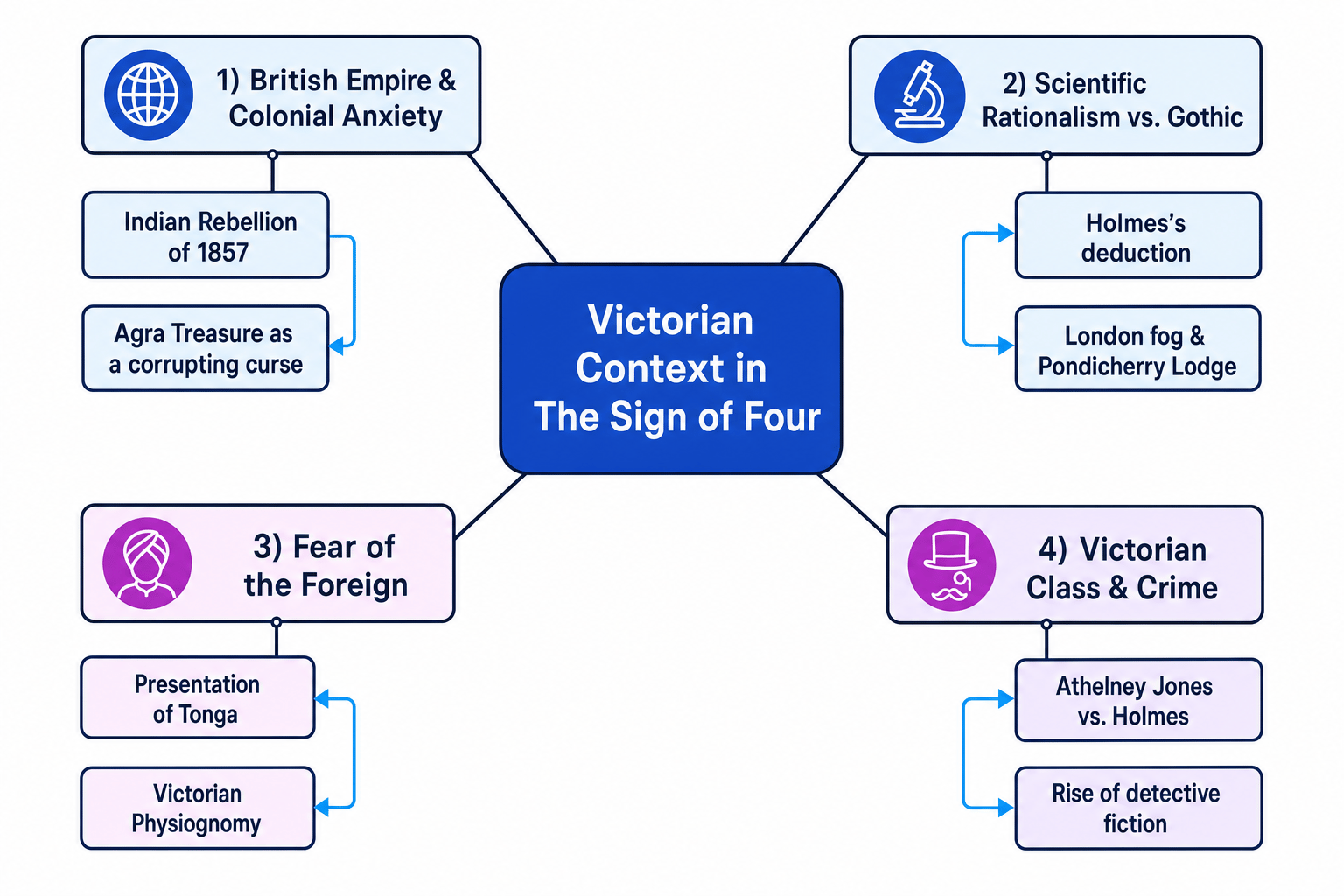
2. Scientific Rationalism vs. the Gothic
The late Victorian era was a battleground between scientific advancement and a lingering fascination with the supernatural, the mysterious, and the dark corners of the human mind.
Forensic Science and Deduction
Sherlock Holmes is the ultimate embodiment of Victorian scientific rationalism. In 1890, forensic science was in its infancy. The official police force (represented by Scotland Yard and the bumbling Athelney Jones) relied on outdated methods, luck, and brute force.
Holmes, however, uses the scientific method: observation, deduction, and chemical analysis. He claims to be a "calculating machine" who values logic above all emotion. To a Victorian reader, Holmes represented the comforting idea that modern science and human intellect could solve any problem, restore order, and defeat chaos.
The Gothic Elements
Despite Holmes’s cold logic, much of the novel is written in the style of Gothic fiction.
Gothic Fiction
A genre of literature characterised by mystery, horror, supernatural elements, decaying settings, and intense emotional states.
Conan Doyle uses the "dense drizzly fog" of London and the isolated, claustrophobic setting of Pondicherry Lodge with its "gravelled gravel paths" and "darkest corner" to create a sense of unease. This contrast between Holmes's bright, scientific mind and the dark, foggy, Gothic streets of London mirror the Victorian struggle to make sense of a rapidly changing, increasingly complicated world.
Holmes as a Victorian Lightbulb
Think of Sherlock Holmes as a brilliant electric lightbulb (a new invention in the late Victorian era). The dark, swirling London fog represents the ancient, mysterious, and chaotic forces of crime and the foreign. Just as the lightbulb cuts through the dark, Holmes's rational mind cuts through the confusion of the Gothic mystery to bring comfort and clarity to the Victorian public.
3. Fear of the Foreign and Victorian Xenophobia
As the British Empire expanded, Victorian society became increasingly xenophobic—displaying a deep-seated fear and distrust of people from other countries.
The Presentation of Tonga
The character of Tonga, Jonathan Small’s companion from the Andaman Islands, is a direct reflection of Victorian colonial prejudice and the pseudo-scientific theories of the time.
Victorians were fascinated by physiognomy (the belief that a person's character or intelligence could be judged by their physical appearance, particularly their facial features) and social Darwinism (the misapplication of evolutionary theory to human societies to justify imperial conquest).
When Watson describes Tonga, he uses highly offensive, animalistic language:
- He calls him a "savage, distorted creature" and "unhallowed."
- He reads from a gazetteer that describes Andaman Islanders as "naturally hideous" and "devils."
By portraying Tonga as a dangerous, animal-like threat who uses poisoned darts (a primitive weapon) to murder Bartholomew Sholto, Conan Doyle justifies the colonial view that non-white indigenous populations were "uncivilised" and needed British control.
Dismissing Tonga's depiction as just 'racism'
While Tonga's portrayal is undeniably racist by modern standards, simply calling it "racist" in your exam is too simplistic. To secure high marks, analyze how and why Conan Doyle used these descriptions. Explain that he was tapping into contemporary Victorian pseudo-sciences like physiognomy and social Darwinism to shock his audience and validate their fears of the "exotic" and "other."
Worked Example: Integrating Context into Quotation Analysis
Let us look at how to construct a high-level analytical paragraph that merges language analysis (AO2) with contextual understanding (AO3).
We will analyse this quotation from Chapter 3, as Watson and Holmes ride in a cab through London:
"A dense drizzly fog lay low upon the great city. Mud-coloured clouds drooped sadly over the muddy streets... It was a humdrum, iron-grey world."
Analyzing Victorian imperial anxiety in a quotation
- Identify the method and state the main point: Conan Doyle uses personification and pathetic fallacy to establish a melancholy, oppressive mood in London, reflecting the internal anxieties of the Victorian metropolis.
- Embed the quotation and analyze the language (AO2): The description of the "dense drizzly fog" and "mud-coloured clouds" that "drooped sadly" suggests a lack of vitality and clarity. The adjective "mud-coloured" and the noun "muddy" strip the capital of the empire of its supposed glamour, reducing it instead to a dirty, "humdrum, iron-grey world." This dull, heavy imagery evokes a sense of decay and stagnation.
- Integrate the context (AO3) to explain the effect on the reader: This bleak depiction of London would have resonated deeply with a late-nineteenth-century audience. While Victorians took pride in their global empire, the polluted, fog-choked streets of London served as a physical reminder of the urban decay and moral pollution of industrialisation. By presenting the heart of the empire as dark, dirty, and vulnerable to foreign threats (like the stolen Agra treasure), Conan Doyle uses the Gothic setting to mirror the psychological unease and imperial anxieties of his contemporary readers.
In the exam
When writing about context in The Sign of Four, keep these three strategic tips in mind:
- Avoid the "History Dump": Never write a paragraph that is solely about historical facts (e.g., explaining the history of the East India Company for five lines). Always link the history back to a specific quote, character choice, or narrative structure.
- Use Context to Explain Motivation: When discussing characters like Major Sholto or Jonathan Small, explain why they act the way they do by referencing Victorian class systems, greed, or imperial experiences.
- Analyze the Ending Through Context: At the end of the novel, the treasure is lost in the River Thames. Note how this restores order to the Victorian characters: Watson can marry Mary because she remains poor (maintaining class boundaries), and the corrupting foreign influence of the treasure is safely buried in British waters.
Check yourself
- Why did the Indian Rebellion of 1857 create such long-lasting anxiety for Victorian readers of The Sign of Four?
- How does the contrasting presentation of Sherlock Holmes and Athelney Jones reflect Victorian attitudes toward science and policing?
- In what ways does the final fate of the Agra treasure resolve the "imperial anxiety" of the novel?
