Writing a top-tier essay for Pride and Prejudice in your AQA GCSE English Literature exam requires more than just knowing what happens to Elizabeth Bennet and Mr Darcy. You must present a cohesive, thesis-driven argument that treats Jane Austen's novel as a deliberate, crafted work of art.
This guide will break down the structural and analytical components of a Grade 9 essay, showing you how to balance language analysis with socio-historical context to satisfy the exam board's assessment criteria.
What you'll learn
- How to construct a "conceptualised" thesis statement that addresses the essay prompt.
- How to weave together language analysis and Regency-era context within every paragraph.
- How to write integrated, high-scoring paragraphs using a systematic step-by-step approach.
The Anatomy of an AQA GCSE Essay
To achieve a top grade, your essay must hit three main assessment objectives:
- AO1: Present a clear, personal response with a structured argument, supported by precise, embedded quotations.
- AO2: Analyse how Austen uses language, structure, and form (such as free indirect discourse or satire) to create meaning.
- AO3: Connect your analysis to the context of Regency England (such as class divisions, gender expectations, and the marriage market).
Free Indirect Discourse
Free indirect discourse is a narrative technique where a third-person narrator presents the internal thoughts, feelings, or speech of a character as if they were the character themselves, blending first-person intimacy with third-person objectivity.
Rather than keeping these elements separate, a high-scoring essay weaves them together seamlessly in every single analytical paragraph.
Step 1: Crafting a Conceptualised Thesis
A thesis statement is the backbone of your essay. It is a 2–3 sentence summary of your overall argument, placed at the very beginning of your response.
To make it conceptual, you must look past the surface-level plot and explain why Austen presents characters or relationships in a certain way. What is her overarching message to her Regency readers?
The Golden Rule of Thesis Writing
Never simply agree or disagree with the prompt. Instead, reframe the prompt to show how Austen uses the characters or themes as tools to critique her contemporary society.
Developing a Thesis
Look at how we can transform a basic statement into a high-scoring, conceptualized thesis.
- Basic statement (Grade 4/5): "In the novel, Darcy is very proud when he first arrives at Meryton, which makes Elizabeth dislike him. However, he changes by the end of the novel and they get married."
- Conceptualized thesis (Grade 8/9): "Austen initially presents Darcy's pride not merely as a personal flaw, but as a symptom of a highly rigid class system that encourages the landed gentry to view those beneath them with condescension. By charting Darcy's moral reformation, Austen suggests that true nobility is defined by humility and self-awareness rather than aristocratic lineage."
Step 2: Designing the Integrated Paragraph
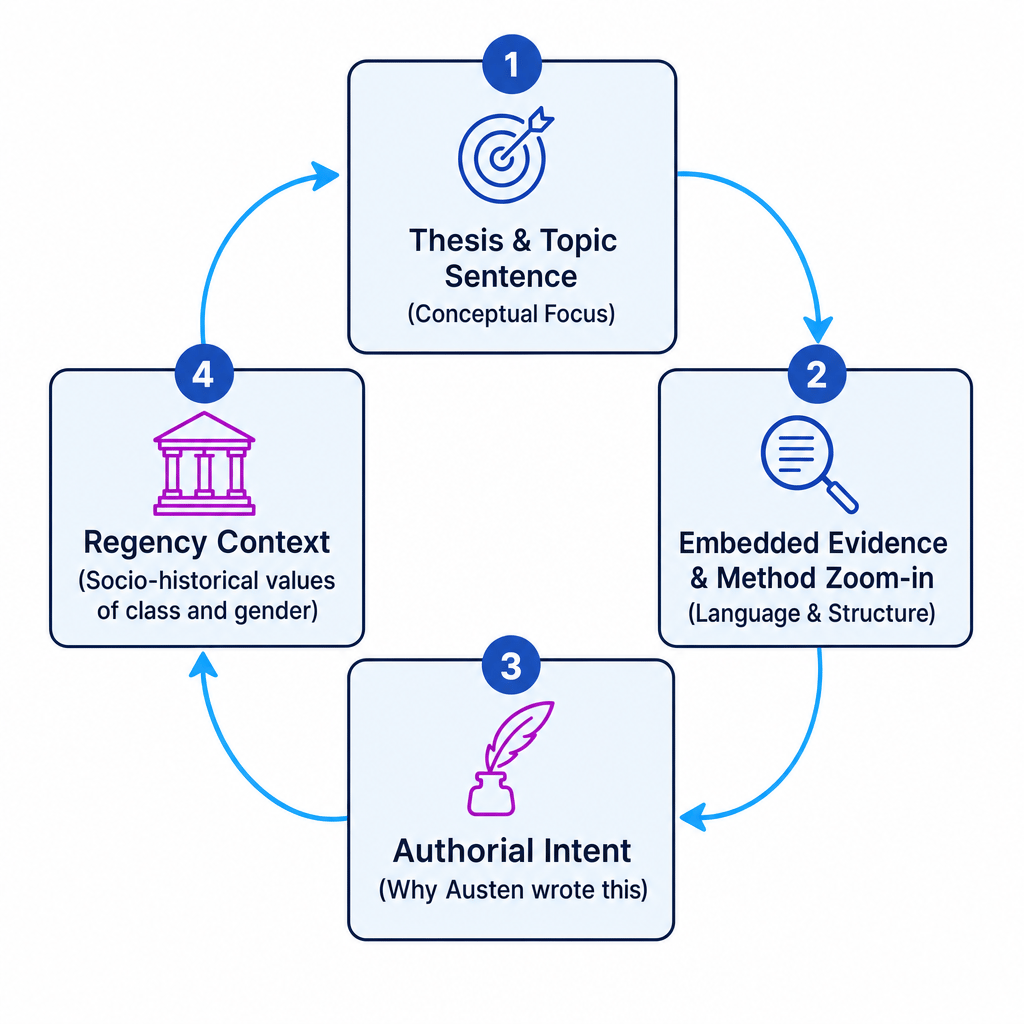
Once you have established your thesis, you must support it with 3–4 detailed body paragraphs. Each paragraph should follow a structured path of analysis:
- The Conceptual Topic Sentence (AO1): Introduce a specific sub-argument that directly supports your thesis. Avoid starting with plot points (e.g., "In Chapter 3, Darcy refuses to dance"). Instead, focus on Austen's authorial intent.
- The Integrated Quote (AO1): Insert a short, precise quotation directly into your own sentence.
- The Method-Led Analysis (AO2): Identify a literary technique or key word choice and analyze its structural or emotional impact on the reader.
- The Contextual Tie-in (AO3): Explain how this literary choice reflects or challenges Regency social codes, such as the laws of entailment, class snobbery, or the commodification of women.
Feature-Spotting
Do not label a technique without explaining its effect. Saying "Austen uses a metaphor here" without detailing why she used it and how it supports your main argument will cap your essay at a Grade 5. Always use the formula: Method →\to→ Effect →\to→ Meaning.
Worked Example: Constructing a High-Scoring Paragraph
Let's walk through the exact intellectual process of drafting an integrated analytical paragraph.
Prompt
Explore how Jane Austen presents Darcy's pride in the early stages of the novel.
Drafting an analytical paragraph on Darcy's pride
-
Formulate a conceptual topic sentence (AO1): We must establish that Darcy's pride is a defense mechanism for his elite social standing, rather than just bad manners.
- Draft: Austen presents Darcy’s initial arrogance not simply as an individual vice, but as a reflection of the hyper-stratified class boundaries of the Regency era, which demand absolute social separation between the landed gentry and the provincial middle class.
-
Embed a highly precise quotation (AO1): We need to bring in Darcy's rejection of Elizabeth at the Meryton Assembly in Chapter 3, blending it naturally into our prose.
- Draft: This snobbery is highlighted during the Meryton Assembly, where Darcy dismisses Elizabeth as merely "tolerable, but not handsome enough to tempt me," refusing to engage with the local community.
-
Analyse literary methods and zoom in on key words (AO2): Now, we unpack the linguistic mechanics. We will analyze the adjective "tolerable" and the verb "tempt" to show Darcy's cold, transactional view of women and social status.
- Draft: Austen’s use of the dismissive adjective "tolerable" strips Elizabeth of her individuality, reducing her to a commodity that fails to meet Darcy's aristocratic standards. Furthermore, the verb "tempt" carries moral and transactional undertones, implying that Darcy views dancing with someone outside his social class as an active threat to his social purity and dignity.
-
Integrate socio-historical context and authorial intent (AO3): We must link this analysis to Regency-era hierarchies and explain why Austen, as a satirist, highlights this behavior.
- Draft: Through this interaction, Austen satirizes the rigid hierarchies of her contemporary society. To a 19th-century audience, Darcy’s refusal to dance was a profound breach of etiquette; by exposing his vanity, Austen critiques how excessive wealth and inherited privilege isolate the aristocracy from genuine human connection, setting up a moral journey where Darcy must unlearn these class prejudices to achieve true happiness.
Blending Your Quotes
Keep your quotations under five words where possible. This makes it easier to weave them into your sentences grammatically, keeping your writing concise, fluent, and highly academic.
Step 3: Mastering the Comparative Conclusion
A common pitfall is treating the conclusion as a simple summary of what you have already written. To stand out to the examiner, your conclusion must elevate your argument to a global scale.
Use your conclusion to answer the "So what?" question: Why does Austen's message still matter to a modern reader?
The Hourglass Essay Structure
Think of your essay as an hourglass.
- It starts wide with a broad, societal thesis in your introduction.
- It gets narrow and precise in the body paragraphs, focusing on microscopic details of language and character interaction.
- It finishes wide in the conclusion, looking at the ultimate moral of the novel and its enduring relevance today.
In the exam
When you open your exam paper, follow this step-by-step strategy:
- Unpack the Prompt (2 minutes): Highlight the key thematic words in the question (e.g., marriage, class, prejudice) and write down 2-3 short, relevant quotes from memory that relate to the wider novel.
- Deconstruct the Extract (5 minutes): Read the provided extract with a pen in hand. Highlight two short quotes that demonstrate Austen's linguistic craft, looking specifically for techniques like irony, free indirect discourse, or hyperbole.
- Draft your Thesis (3 minutes): Write your conceptualized thesis statement at the top of your planning sheet before you write anything else. This will keep your entire essay focused and prevent you from slipping into plot-telling.
- Execute the AQA Paragraph Loop (35 minutes): Aim for 3 substantial body paragraphs. Ensure that every paragraph analyzes the extract AND makes at least one comparative link to another part of the novel to demonstrate your holistic understanding of the text.
Check yourself
Before sitting your mock or final exams, make sure you can answer these questions:
- Can you write a thesis statement on Charlotte Lucas that focuses on the economics of Regency marriage rather than just her "desperation"?
- Are your quotations short enough (under 5 words) to be integrated grammatically into any sentence?
- Can you identify the difference between a plot-based topic sentence and a conceptually-focused topic sentence?
