Writing a high-scoring essay on Sir Arthur Conan Doyle’s The Sign of Four requires more than just retelling the plot or listing quotes. The examiners are looking for a cohesive, conceptualised argument that treats the novel as a deliberate artistic construct.
This guide will deconstruct the anatomy of a top-grade essay, showing you how to balance language analysis, structural choices, and Victorian context to meet the Assessment Objectives (AOs) of your GCSE.
What you'll learn:
- How to formulate a powerful, thesis-driven essay plan.
- How to balance your analysis between the printed extract and the novel as a whole.
- How to write a integrated "analytical synthesis" paragraph using the PEEL+Context formula.
- How to avoid common essay-writing pitfalls that limit students to lower grade boundaries.
Anatomy of a GCSE Essay
To secure the highest marks, your essay must be structured as a unified argument. This means every paragraph must directly help to answer the question, building upon your opening thesis.
Thesis Statement
A thesis statement is a concise, 1–2 sentence summary of your main argument, placed at the end of your introduction. It should not merely state your opinion, but offer a conceptual interpretation of Doyle's underlying authorial intent.
Rather than saying:
"In this essay, I will show how Sherlock Holmes is presented as a very clever detective who uses drugs."
A high-level thesis statement offers an interpretive perspective:
"Doyle presents Sherlock Holmes as a complex embodiment of Victorian dualism: a hyper-rational, scientific machine who simultaneously relies on artificial stimuli to escape the mundane limitations of late-nineteenth-century reality."
The Balance: Extract vs. Whole Text
The AQA paper gives you an extract from the novel and asks a question that relates to both the extract and the novel as a whole. Your essay must address both.
A successful strategy is to divide your essay into three or four conceptual points:
- Point 1: Deep analysis of the extract itself (exploring language, structure, and immediate context).
- Point 2: An exploration of how this theme/character develops elsewhere in the novel, contrasting or mirroring the extract.
- Point 3: A broader look at the resolution of the theme/character across the entire arc of the text, linking directly to Doyle's Victorian context and message.
The "Analytical Synthesis" Paragraph
In the exam, you do not have time to write isolated paragraphs of pure language analysis followed by isolated paragraphs of history. Instead, you must practice analytical synthesis—the art of weaving your argument, your textual evidence, your linguistic analysis, and your historical context into a single, fluid paragraph.
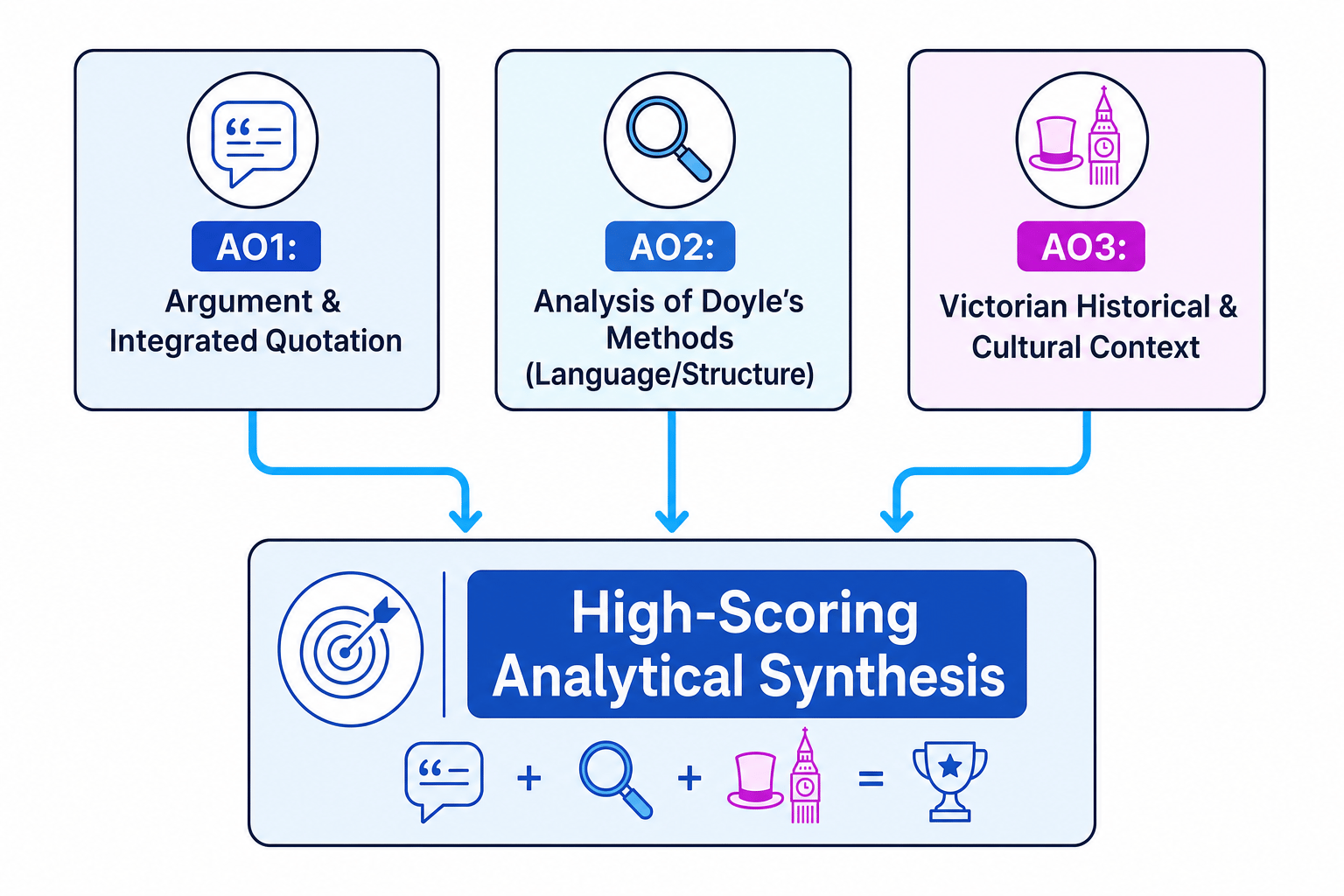
Integrated Analysis
The secret to a Grade 9 essay is ensuring that context (AO3) is never bolted on as a random historical fact. It must be used to explain why Doyle chose a specific word, metaphor, or structural device (AO2) to convey his message (AO1).
To achieve this, use the following structural flow:
- Topic Sentence (Point): State a conceptual, thesis-linked point.
- Evidence (Quote): Embed a short, precise quote seamlessly into your sentence.
- Method (Analysis): Identify Doyle's technique (e.g., zoomorphism, pathetic fallacy, contrast) and analyse the specific connotations of his vocabulary.
- Context (AO3 Integration): Explain how this reflects Victorian anxieties, scientific developments, or social attitudes.
- Link: Return to your thesis statement and answer the prompt.
Crafting a Model Paragraph
Let us walk through how to construct a high-scoring analytical paragraph. We will address a common GCSE essay prompt: Explore how Doyle presents the character of Sherlock Holmes in The Sign of Four.
Developing an analytical paragraph
-
Formulate a conceptual topic sentence (AO1). Focus on Doyle's underlying thematic purpose rather than just character actions.
Example: "Doyle establishes Holmes's extraordinary intellect not as a source of peace, but as a restless burden that distances him from conventional human experience."
-
Integrate precise textual evidence (AO1) and identify literary methods (AO2). Avoid long, block quotations; instead, weave short phrases into your own sentence structure.
Example: "This is illustrated in the opening chapter when Holmes defends his cocaine use, declaring, 'I abhor the dull routine of existence. I crave for mental exaltation.' Doyle's use of the verb 'abhor' carries strong connotations of disgust and loathing, highlighting Holmes's profound alienation from ordinary Victorian life."
-
Analyse the deeper connotations of Doyle's language (AO2). Look for semantic fields, imagery, or structural contrasts.
Example: "The noun phrase 'mental exaltation' creates a sense of spiritual or quasi-religious ecstasy, implying that for Holmes, pure intellectual stimulation is a transcendent necessity. This is structurally contrasted with Watson’s domestic, pragmatic perspective, setting Holmes up as a bohemian figure who operates outside the boundaries of polite society."
-
Weave in relevant Victorian context (AO3) to explain Doyle's intent. Do not just state a historical fact; explain why it matters to this quote.
Example: "This characterisation taps into late-Victorian anxieties surrounding decadence and the limits of the human mind. While the era championed scientific rationalism, there was an underlying fear of degeneration—that extreme intellectual refinement could lead to moral decay or mental instability, a boundary Holmes constantly treads."
-
Link the analysis back to the essay prompt and your thesis statement.
Example: "Therefore, Doyle presents Holmes not merely as a heroic detective, but as a liminal figure whose brilliant rationality comes at the cost of personal peace, reflecting the precarious balance of the Victorian mind."
Crucial Pitfalls to Avoid
Even students with excellent knowledge of the novel can lose marks by falling into common exam traps.
Feature Spotting
"Feature spotting" is when you identify a literary device without explaining its effect (e.g., "Doyle uses a simile here when he says 'like a trained bloodhound' to show Holmes is a good tracker."). If you name a method, you must explain how it helps Doyle convey his deeper message.
Embedding Quotations
Never start a sentence with a quotation. Instead of writing: "Watson says, 'She was a unit, a factor.' This shows..." Write: By reducing Mary Morstan to 'a unit, a factor' in his mental calculation, Holmes demonstrates his clinical refusal to allow emotion to distort his rational processes.
The Context Trap
Avoid writing paragraphs of "pure history" about the British Empire, Victorian police forces, or cocaine laws. If your context does not directly explain a specific word or choice made by Doyle, it will not earn marks for AO3.
In the exam
- Spend 5 minutes planning: Do not start writing immediately. Read the extract, highlight 3–4 key quotes, and write a quick thesis statement.
- Track the question's focus: Keep the key words of the prompt in your mind at all times. Use synonyms of these keywords in every topic sentence to keep your essay tightly focused.
- Use the "Zoom-In" technique: Quote a short phrase, analyse the whole phrase, and then zoom in on a single, high-impact word (e.g., a specific verb or adjective) to squeeze out maximum analytical depth.
- Conclude with authorial intent: In your conclusion, summarise why Doyle wrote this novel. Was he comforting Victorian readers with a sense of order, or exposing the fragile underbelly of the British Empire?
Check yourself
- Can you explain the difference between a simple plot description and a "thesis-driven" argument?
- What is the danger of writing about Victorian history without linking it directly to Doyle's linguistic choices?
- How does the character of Mary Morstan act as a structural contrast to Sherlock Holmes's hyper-rationalism?
