What you'll learn
- The essential facts about An Inspector Calls: writer, setting, form, and exam relevance.
- How Priestley uses the 1912 setting to challenge a 1945 audience.
- Why the play is more than a mystery: it is a moral argument about responsibility.
- How to turn “overview” knowledge into strong analytical points.
The play at a glance
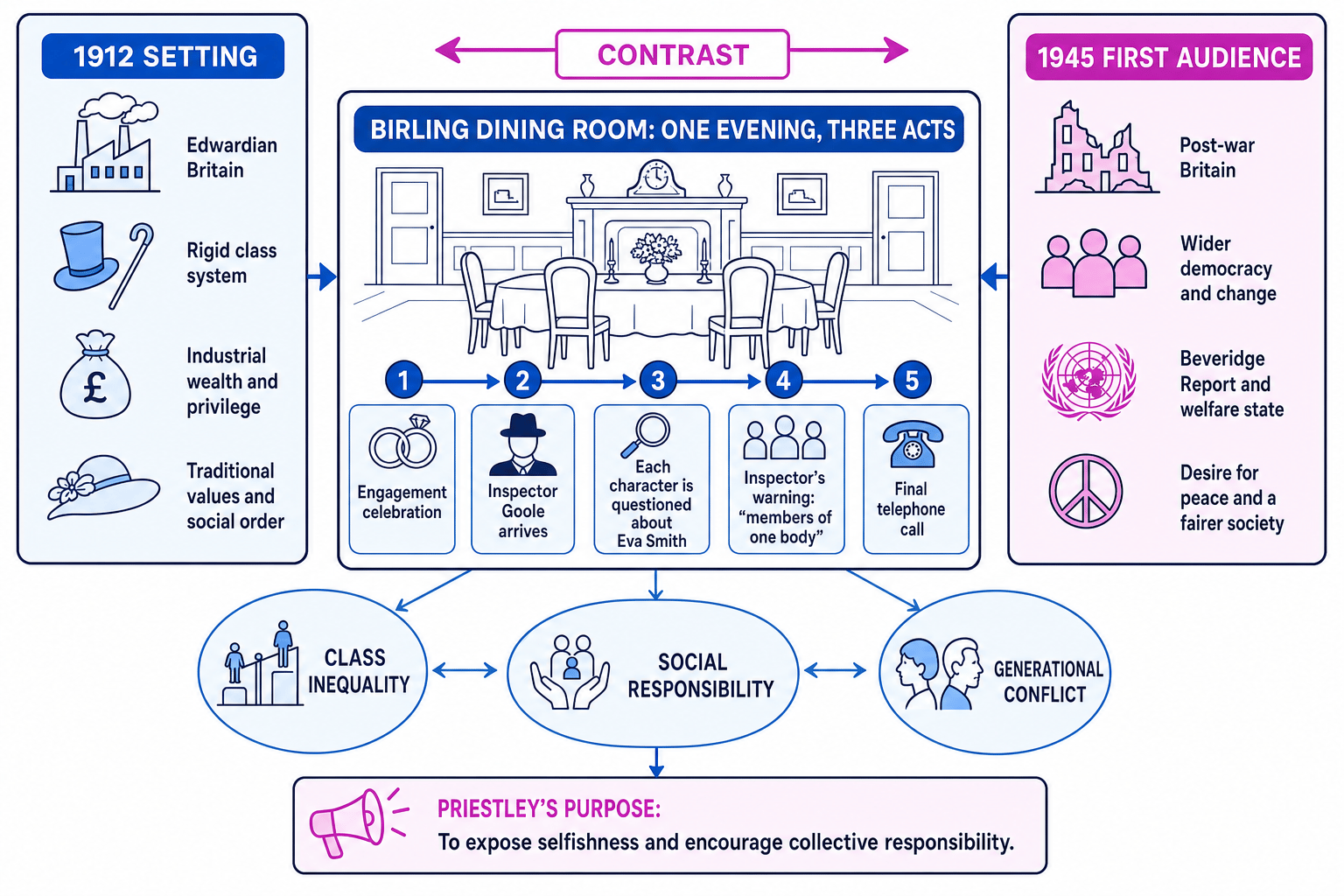
An Inspector Calls is a three-act play by J. B. Priestley. It is set in 1912 in the dining room of the wealthy Birling family, in the fictional industrial town of Brumley. The play was first performed in 1945 in the Soviet Union and in 1946 in London.
The action begins with a family celebration: Sheila Birling has become engaged to Gerald Croft. Then Inspector Goole arrives and questions the family about the death of Eva Smith, a young working-class woman. The play gradually reveals that several characters have contributed to her suffering.
Drama
A drama is a story written for performance on stage. It is made from dialogue — the words characters speak — and stage directions — instructions about movement, setting, lighting, tone, or props.
Because this is a play, remember that Priestley controls not just what characters say, but also what the audience sees: entrances, exits, lighting, silence, interruptions, and the confined dining-room setting.
The overview in one sentence
Priestley uses a tense family investigation to expose selfishness, class prejudice, and moral irresponsibility, while urging the audience to believe that “We are responsible for each other.”
The central conflict: responsibility or selfishness?
At the heart of the play is a conflict between two attitudes.
Mr Birling represents individualism: the belief that people should mainly look after themselves and their own interests. He says that “a man has to make his own way” and dismisses “community” as “nonsense”.
The Inspector represents social responsibility, which means recognising that your actions affect other people, especially people with less power. His final message is direct: “We are members of one body. We are responsible for each other.”
Social responsibility
Social responsibility is the duty to consider how your choices affect other people and society as a whole, not just yourself or your immediate family.
Priestley does not present Eva Smith’s death as one person’s fault only. Instead, the play shows a chain of actions. Each character’s behaviour may seem separate, but together their choices reveal a society where the powerful can damage the powerless.
Building a central argument
- Compare Birling’s language of self-interest — “make his own way” — with the Inspector’s collective language — “members of one body”.
- Priestley creates a clear contrast, meaning he places opposing ideas side by side so the audience can judge between them.
- The pronoun “one” in “one body” suggests unity, while Birling’s focus on “his own way” suggests separation and selfishness.
- This supports the argument that Priestley uses the Inspector to challenge capitalist individualism and promote social responsibility.
Retelling instead of analysing
Do not spend too long explaining everything that happens to Eva Smith. In an essay, focus on what Priestley is criticising through those events: selfish attitudes, class inequality, gender prejudice, and refusal to accept blame.
Why the dates matter
The play is set in 1912, but Priestley wrote it for audiences in 1945, just after the Second World War. This gap is crucial.
Context
Context means the historical, social, and cultural circumstances surrounding a text: when it was set, when it was written, and what its audience would understand.
In 1912, Britain had a strict class system, major inequality, and limited rights for women and workers. Some wealthy industrialists felt confident that society was stable and that progress would continue smoothly.
A 1945 audience knew that this confidence was badly misplaced. They knew about the sinking of the Titanic, the First World War, the Great Depression, and the Second World War. Priestley uses that audience knowledge to make Mr Birling look foolish and morally unreliable.
Dramatic irony
Dramatic irony happens when the audience knows more than a character, so the character’s words have a meaning they do not understand.
A famous example is Birling’s confident claim that the Titanic is “unsinkable, absolutely unsinkable”. A later audience knows the ship sank in 1912, so his certainty becomes absurd.
Reading Birling’s confidence
- Birling calls the Titanic “unsinkable, absolutely unsinkable”, presenting himself as certain and knowledgeable.
- The audience knows the Titanic did sink, so Priestley creates dramatic irony: Birling’s confidence is exposed as ignorance.
- Because Birling is also dismissive about social responsibility, the audience is encouraged to distrust his moral and political views too.
- Priestley therefore uses hindsight to criticise the complacency of powerful Edwardian businessmen.
Form and genre: what kind of play is it?
Form and genre
Form is the type or shape of a text, such as a play, novel, or poem. Genre is the category of story or writing, such as detective fiction, tragedy, or comedy.
An Inspector Calls blends several genres:
- It is a detective drama because an inspector arrives, questions suspects, and uncovers hidden truths.
- It is a morality play because characters are judged according to right and wrong.
- It is a realist domestic drama because the setting is an ordinary family dining room and the situation begins in a believable social world.
- It also has elements of a well-made play, meaning a tightly organised drama where secrets are revealed in a carefully controlled order.
However, Priestley twists the detective genre. In a normal mystery, the audience mainly wants to know who committed the crime. Here, the deeper question is not “Who killed Eva Smith?” but “What kind of society allowed Eva Smith to be destroyed?”
Not just a whodunnit
A whodunnit is a mystery focused on identifying the criminal. Priestley uses that structure to pull you in, but his real purpose is moral and political.
How the investigation creates meaning
- The Inspector questions one character at a time, so each person’s private behaviour becomes public.
- Each revelation adds another link in the chain of responsibility, showing that Eva’s suffering was caused by repeated acts of selfishness.
- The structure makes the audience judge not only individual characters, but also the wider class system that protects them.
- Priestley therefore uses the detective form to turn entertainment into social criticism.
Structure and stagecraft
Structure
Structure means how a text is organised: the order of events, the use of beginnings and endings, turning points, repetitions, and shifts in tension.
The play has a very controlled structure. It takes place in one room, over one evening, across three acts. This makes the drama feel intense and claustrophobic, as if the Birling family cannot escape the consequences of their actions.
Priestley also uses stagecraft, meaning practical theatrical methods such as lighting, props, entrances, exits, pauses, and positioning. The opening stage directions say that the lighting should be “pink and intimate” until the Inspector arrives, when it becomes “brighter and harder”.
Symbolism
Symbolism is when a person, object, place, or stage detail represents a bigger idea beyond its literal meaning.
The lighting is symbolic. Before the Inspector arrives, the family’s world seems warm, comfortable, and protected. After he arrives, the harsher light suggests exposure, truth, and judgement.
Analysing the lighting change
- Priestley contrasts “pink and intimate” with “brighter and harder”, changing the mood of the stage.
- “Pink and intimate” suggests comfort, privacy, and the family’s sheltered privilege.
- “Brighter and harder” suggests interrogation and moral exposure, as if the Inspector brings truth into the room.
- The stagecraft therefore supports the play’s wider message: the Birlings’ comfortable world must be examined and judged.
The ending is also important. Just when some characters think they have escaped consequences, the final telephone call suggests that a real inspector is on his way. This creates a cyclical structure, where the ending partly returns to the beginning and the family may have to face the process again.
Characters as a social cross-section
Priestley’s characters are individuals, but they also represent wider groups and attitudes in society. This is called a social cross-section: a range of people used to show how different parts of society behave.
Mr and Mrs Birling represent wealthy respectability and resistance to change. Sheila and Eric represent the younger generation, who are more capable of guilt and learning. Gerald Croft represents upper-class charm and privilege. Eva Smith never appears on stage, but her absence is powerful: she represents exploited working-class women whose voices are often ignored.
The Inspector is not just a police figure. He acts as a moral force, pushing characters to confess, reflect, and accept responsibility. His name, Goole, sounds like “ghoul”, which may suggest something supernatural or unsettling, but the exam focus should be on his dramatic function rather than guessing exactly “what” he is.
Keep the Inspector focused
You can mention the mystery around Inspector Goole, but do not make your whole essay about whether he is a ghost. It is usually stronger to explain how Priestley uses him as a voice of conscience and judgement.
How overview knowledge helps in essays
In AQA GCSE English Literature, An Inspector Calls appears on Paper 2 as a modern drama text. The exam is closed book, so you need short, accurate quotations and a clear understanding of Priestley’s purpose.
Your overview knowledge helps you write a strong thesis. A thesis is your main argument in response to the question. For example, if the question is about responsibility, your thesis might be:
Priestley presents responsibility as a moral lesson that the older, privileged characters resist, while the younger generation begin to accept it.
That kind of sentence gives your essay direction. It shows that you understand the whole play, not just one scene.
Use overview as your opening lens
Start from Priestley’s message, then zoom into a quotation, method, and effect. The overview is your map; the quotation is your evidence.
In the exam
- Begin with a clear argument about Priestley’s purpose, such as his criticism of selfishness or his support for social responsibility.
- Use short, accurate quotations like “We are responsible for each other”, “cheap labour”, or “fire and blood and anguish”, and link them to methods such as contrast, symbolism, dramatic irony, or structure.
- Keep context connected to meaning: the 1912 setting and 1945 audience matter because Priestley uses hindsight to challenge complacent attitudes.
Check yourself
- Why is it important that the play is set in 1912 but written for a 1945 audience?
- How does the Inspector change the atmosphere and purpose of the family celebration?
- What is the difference between retelling Eva Smith’s story and analysing Priestley’s message?
