Planning is the secret weapon of high-scoring GCSE English Literature students. In the pressure of the exam room, a well-structured essay plan acts as a roadmap, ensuring your writing remains focused, cohesive, and deeply analytical.
For AQA GCSE English Literature, you are required to write a single essay starting with an extract from The Sign of Four and expanding to the wider novel. This guide will show you how to construct highly effective essay plans that seamlessly weave together character, theme, language analysis, and Victorian context.
What you'll learn:
- How to deconstruct an exam question and form a powerful thesis statement.
- How to map out a chronological three-part "argument arc" across the novel.
- How to balance your analysis between the provided extract and the wider text.
- How to integrate language analysis and context systematically into your plan.
The Foundations of GCSE Essay Planning
Before putting pen to paper, you must understand the structure of the exam question. The question will always follow this format:
"Starting with this extract, write about how Conan Doyle presents [a character/theme/idea]..."
To address this effectively, your essay plan must be built on a firm foundation of three core components: a clear thesis, a balanced structure, and a progression of ideas.
Thesis Statement
A thesis statement is a concise, arguable claim that directly answers the exam question. It should not merely state a fact, but rather offer an interpretation of Conan Doyle’s deeper intentions or the message he is conveying to his Victorian audience.
Extract-to-Novel Ratio
The extract-to-novel ratio is the balance of focus in your essay. To achieve a top grade, you must spend roughly one-third of your analysis on the printed extract and two-thirds on key scenes from the wider novel. This is best achieved by weaving both elements together, rather than writing two separate mini-essays.
<keyidea title="The "Starting with..." Trap">
Never write about the extract and then forget about it, or write about the whole novel without touching the extract. The most successful essay plans use the extract as a springboard, using its language and methods to establish a theme, and then tracking that theme's development across the rest of the text.
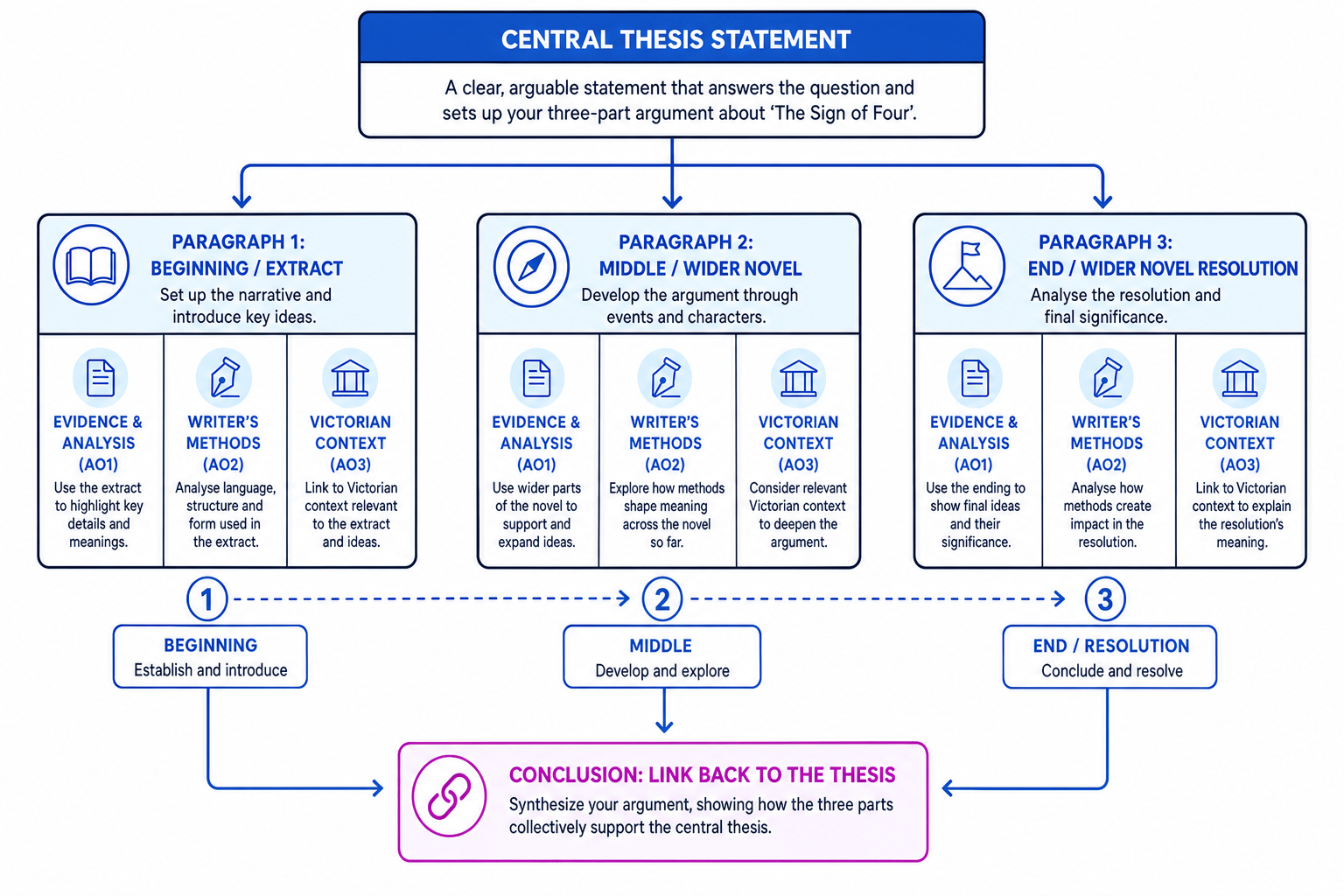
Designing your "Argument Arc"
Your essay should not be a random list of points. Instead, it must follow an argument arc—a structural journey that tracks how a character or theme develops from the beginning, through the middle, to the resolution of the novel.
By tracking Conan Doyle's structural choices, you naturally hit the criteria for evaluating the novel as a deliberate construct.
Step-by-Step Essay Planning Technique
Let us look at how to build a comprehensive plan from scratch. We will walk through the exact intellectual process required to turn a raw exam prompt into a high-scoring essay skeleton.
Planning an essay on the presentation of London
The Prompt: Starting with Chapter 3 (the carriage journey), write about how Conan Doyle presents London in 'The Sign of Four'.
Step 1 — Formulate a thesis statement addressing literal and symbolic meanings
Analyze the prompt to understand the author's underlying purpose. Instead of simply stating that "London is dark and foggy," argue why Conan Doyle presents London this way. Link the physical setting to the psychological anxieties of the Victorian reader.
- Thesis: Conan Doyle presents London not merely as a physical setting, but as a symbolic projection of Victorian anxieties. Through the gothic atmosphere of the city, he reflects the psychological unease surrounding imperial expansion, urban decay, and the hidden moral degradation of the metropole.
Step 2 — Select precise methods and quotes from the extract
Examine the Chapter 3 carriage journey extract. Select two high-yield quotations that feature distinct literary techniques (such as personification, semantic fields, or pathetic fallacy) and note their analytical potential.
- Quote A: "dense drizzly fog" / "mud-coloured clouds" hanging "low over the muddy streets."
- Method: Pathetic fallacy and the sensory semantic field of decay.
- Effect/Context: Reflects the moral obscurity and confusion of the city. Links to Victorian anxieties about the rapid, uncontrolled growth of London (urban sprawl) and the literal smog caused by the Industrial Revolution.
- Quote B: The streets are described as a "labyrinth" where the characters are "losing themselves."
- Method: Metaphor.
- Effect/Context: Implies that London is a dangerous, predatory maze. This taps into the psychological fear of the urban underworld and the threat it posed to respectable citizens.
Step 3 — Build the three-part argument arc using wider-novel reference points
Construct a three-stage plan that moves chronologically through the text, ensuring that every paragraph integrates textual evidence, literary methods, and relevant Victorian context.
- Paragraph 1 (The Beginning / Extract focus): Focus on the journey through London (Chapter 3). Analyse the "yellow fog" and "labyrinth of streets" to show how the physical city represents psychological confusion and moral darkness. Contextualise this with the Victorian fear of the "slum" districts and the divide between the wealthy West End and the impoverished East End.
- Paragraph 2 (The Middle / Wider-novel contrast): Contrast the gloomy streets of London with Thaddeus Sholto's suburban home in Chapter 4, which is described as an "oasis of art in the howling desert of South London." Analyze the juxtaposition of the chaotic outer city with the exotic, aesthetic interior. Contextualise this with the "Aesthetic Movement" of the late 19th century and the Victorian desire to escape urban squalor through art and Eastern exoticism.
- Paragraph 3 (The Climax / Resolution focus): Analyze the dramatic Thames boat chase (Chapters 10–11). Track how the setting shifts to the river, described as a dark, rushing torrent where the characters hunt down the "savage" Tonga. Analyze the contrast between the industrial, mechanical "Aurora" and the primal fury of the chase. Contextualise this with Victorian anxieties about "reverse colonisation" (the fear that the dark forces of the Empire would travel back to infect the heart of London).
Feature-Spotting without Effect
A common pitfall is listing literary devices in your plan (e.g., "Conan Doyle uses personification here") without noting the effect of that device. When planning your quotes, always write down the specific word or phrase you are analyzing and a quick note on how it reinforces your thesis.
The Rule of Three Quotes
For a balanced essay, aim to plan for exactly three quotes from your extract and three quotes from your memory of the wider novel. This guarantees you meet the requirements of analyzing both the extract and the wider text without running out of time.
Integrating Victorian Context (AO3)
You must never treat historical context as a separate history lesson tacked onto the end of a paragraph. Instead, context must be planned as the explanation for Conan Doyle’s choices. Ask yourself: Why did a Victorian writer write this specific detail for a Victorian reader?
The Mirror Analogy
Think of the novel as a mirror. The characters and setting of 'The Sign of Four' are not just fictional creations; they are a direct reflection of the hopes, fears, and developments of late-Victorian society. Your job in your essay plan is to explain how the mirror reflects the real world of 1890.
Key Contextual Links to Plan For:
- Imperialism: The fear of the "other" and the colonial anxieties surrounding India (the Indian Rebellion of 1857 is the historical backdrop to the Agra treasure).
- Class and Crime: The Victorian obsession with physiognomy (the belief that criminal traits could be read on a person's face or body, as seen in the descriptions of Tonga and Jonathan Small).
- Science vs. Emotion: The rise of rationalism, scientific deduction, and the introduction of forensics, epitomized by Sherlock Holmes's cold, mathematical nature.
The Danger of Context Dumping
Avoid adding generic historical facts to your plan that have no relation to your analysis. Telling the examiner when the East India Company was founded is useless unless you link it directly to Major Sholto's greed or Jonathan Small's betrayal of trust.
In the exam
- Spend 5–8 minutes planning: Do not start writing immediately. A structured plan will save you time later by preventing you from repeating yourself or writing into a dead end.
- Deconstruct the prompt first: Circle the key terms in the question (e.g., "fear," "wealth," "friendship") and write your one-sentence thesis statement at the top of your planning sheet.
- Annotate the extract strategically: Highlight no more than three short, high-quality quotes in the extract. Immediately jot down the literary device (method) and its thematic meaning.
- Map your wider-novel links: Write down two or three scenes from the wider novel that mirror, contrast, or resolve the issues raised in the extract. Write down the short quotes you will use to support these scenes.
- Check your balance: Before you begin writing the essay, look at your plan and make sure you have mapped out clear links to Victorian context for each of your main points.
Check yourself
- Can you write a thesis statement that explains why Conan Doyle presents the relationship between Holmes and Watson as a balance of opposites?
- Do you have a list of three distinct quotes from the wider novel that you can use to analyze the theme of imperial greed?
- How does your essay plan ensure that you spend enough time analyzing the language of the printed extract?
