For your AQA GCSE English Literature exam, you do not need to memorize massive blocks of text. Because this is a closed-book exam, your secret weapon is the high-yield quotation: a short, punchy phrase (usually 2 to 6 words) that is rich in literary devices and can be used to answer several different essay questions.
In these study notes, you will learn how to select, memorize, and dissect the most powerful quotations from Arthur Conan Doyle’s The Sign of Four. We will explore how to squeeze every drop of analysis out of these lines to satisfy the exam's assessment objectives.
What you'll learn:
- How to select high-yield quotations that work for multiple themes and characters.
- How to analyze language, structure, and form (AO2) without falling into the "feature-spotting" trap.
- How to weave historical and cultural Victorian context (AO3) seamlessly into your quotation analysis.
The High-Yield Quotation Strategy
When you are in the exam room, your brain has to recall quotes quickly under pressure. Attempting to remember long sentences often leads to misquoting, which can disrupt your academic register.
Instead, aim to memorize short, flexible fragments. A short quotation is easier to embed naturally into your own sentences. This keeps your writing fluid, precise, and highly analytical.
High-Yield Quotation
A high-yield quotation is a brief, highly dense textual reference that contains multiple layers of meaning. It can be linked to more than one character, theme, or context point, giving you maximum marks for minimum memorization.
To gain top marks, you must analyze these quotations using a three-pronged approach:
- Meaning and Theme (AO1): What does the quote tell us about the plot or character at this point in the novella?
- Writer's Methods (AO2): What specific language, structure, or form devices does Conan Doyle use to create this meaning?
- Victorian Context (AO3): How does this quote reflect the anxieties, values, or scientific developments of the late 19th century?
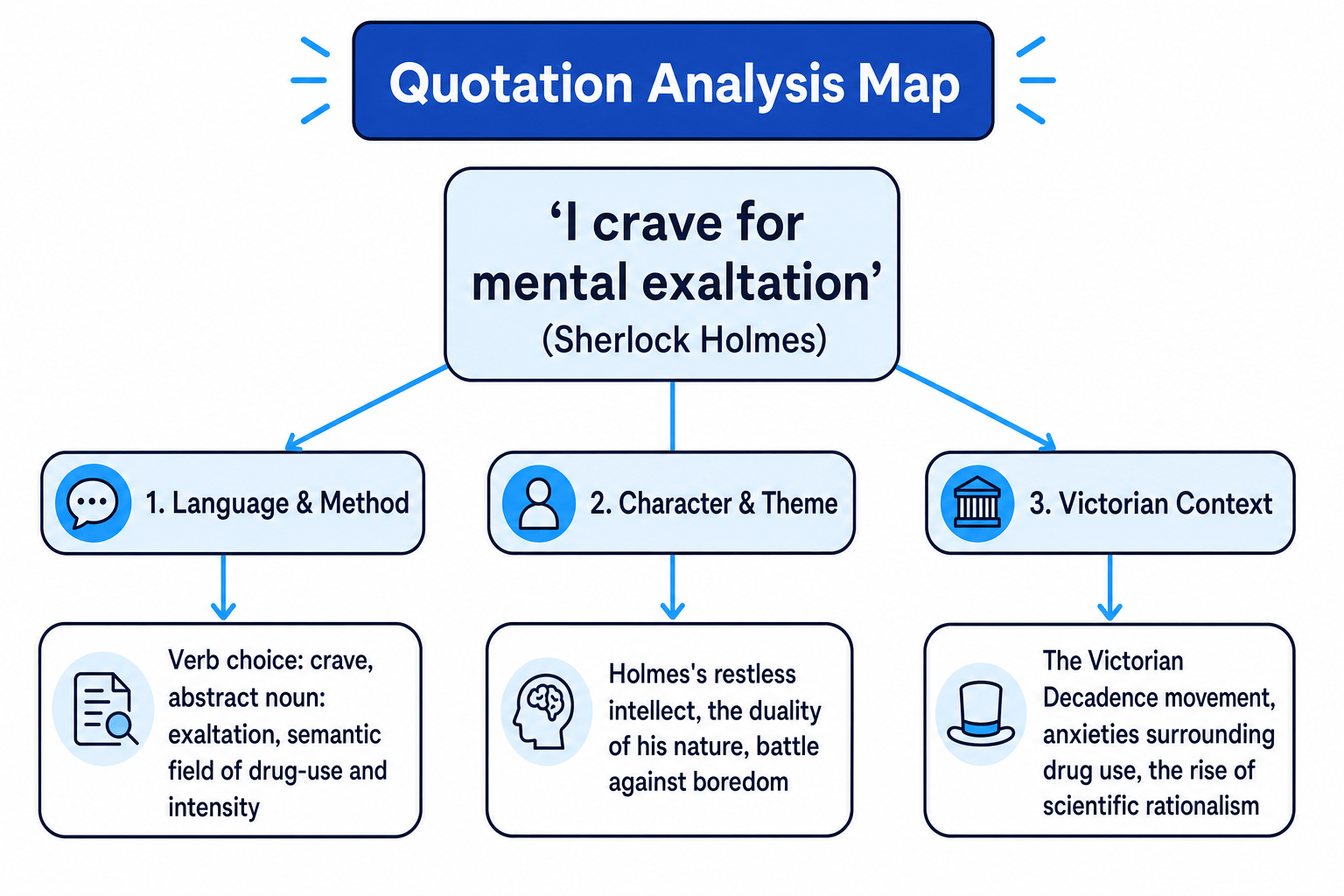
Core Quotations & Analysis
Let us look at three of the most powerful quotations in the novel, broken down by how you can analyze them in your exam.
1. "I abhor the dull routine of existence. I crave for mental exaltation." (Sherlock Holmes, Chapter 1)
This opening statement from Holmes immediately establishes his complex, eccentric personality.
- The Language (AO2): The strong, emotive verb "abhor" highlights his deep, almost physical disgust for ordinary life. This is contrasted with the verb "crave," which carries connotations of intense hunger and physical addiction. The abstract noun phrase "mental exaltation" suggests a desire to transcend the human condition through pure intellect.
- The Context (AO3): Holmes’s restlessness reflects the Victorian Decadent Movement, where some intellectuals sought artificial stimulation and aesthetic purity to escape what they saw as the mundane, industrial reality of late-Victorian Britain. It also introduces his drug use (the "seven-per-cent solution"), which was legal but controversial at the time.
The Duality of Holmes
This quotation illustrates the fundamental tension in Holmes's character: he is a man of supreme scientific logic, yet he is ruled by an emotional, almost romantic need to escape boredom.
2. "An oasis of art in the howling desert of South London." (Watson, Chapter 4)
This quote describes Thaddeus Sholto's home in suburban London, as Watson and Mary Morstan arrive.
- The Language (AO2): Conan Doyle uses a vivid metaphor here. Thaddeus’s home is an "oasis of art," implying it is a place of beauty, culture, and life. This is juxtaposed against the "howling desert" of South London. The personification in "howling" suggests a wild, dangerous, and predatory urban wasteland.
- The Context (AO3): This description captures the deep Victorian anxieties surrounding urban growth and empire. South London is painted as an uncivilized, foreign wilderness (a "desert"), reflecting the fear that the heart of the British Empire was becoming corrupted, lawless, and polluted. It also highlights the Victorian fascination with exoticism and "Aestheticism" (the worship of art and beauty).
Feature-Spotting
Do not just write: "Conan Doyle uses a metaphor when he writes 'oasis of art'." This is feature-spotting and will not score highly. You must explain why the metaphor is used. For example: "Conan Doyle uses the metaphor 'oasis of art' to contrast the refined, exotic wealth of the Sholto family with the gritty, unpolished reality of the working-class London suburbs."
3. "revolting feature", "bestial cruelty", "savage" (Athelnay Jones / Watson, Chapter 8)
These phrases are used to describe Tonga, the islander from the Andaman Islands who assists Jonathan Small.
- The Language (AO2): The semantic field of animalistic language ("bestial," "savage") dehumanizes Tonga. The adjective "revolting" emphasizes the physical and moral disgust the British characters feel toward him.
- The Context (AO3): This language is heavily loaded with Victorian imperialist attitudes and scientific racism. During the 19th century, theories like social Darwinism and physiognomy (the belief that a person's character can be judged by their physical appearance) were widely accepted. Tonga is presented as a caricature of the "primitive colonial other," reinforcing the Victorian belief that British imperialism was a civilizing mission.
Analyzing Sensitive Context
When analyzing the presentation of Tonga, never endorse these Victorian prejudices. Instead, show the examiner that you understand these descriptions as a product of 19th-century imperialist anxiety and xenophobia. Use analytical phrases like "Conan Doyle reflects the xenophobic attitudes of his contemporary audience..."
Putting Analysis Into Practice
To get a Grade 8 or 9, you must be able to assemble your quotation analysis into a cohesive, structured paragraph.
Let's look at a worked example of how to build an analytical point from scratch.
Analyzing Holmes's Duality through Quotation
Analyze how Conan Doyle presents the character of Sherlock Holmes in Chapter 1.
-
State your analytical point clearly (AO1): Begin with a clear statement that directly answers the prompt and introduces the quotation.
Example: "In the opening chapter, Conan Doyle presents Sherlock Holmes as an extraordinary figure who rejects the mundane constraints of Victorian society in pursuit of intellectual stimulation."
-
Embed your quotation smoothly (AO1): Introduce your high-yield quotation naturally within your sentence, rather than dropping it in as a standalone sentence.
Example: "This is demonstrated when Holmes declares that he 'abhor[s] the dull routine of existence' and instead 'crave[s] for mental exaltation.'"
-
Analyze the writer's methods in detail (AO2): Identify key words and literary devices, explaining how they create meaning.
Example: "The powerful verb 'abhor' conveys a visceral, passionate disgust for ordinary life, while the verb 'crave' establishes his intellectual curiosity as an almost biological dependency. Conan Doyle's choice of the noun 'exaltation' elevates Holmes's mental pursuits to a spiritual level, suggesting that ordinary human experiences are insufficient for his restless mind."
-
Connect your analysis to Victorian context (AO3): Link the language choices to the wider historical context or themes of the novel.
Example: "This extreme focus on the intellect reflects the late-Victorian fascination with scientific rationalism and the power of human deduction. However, it also highlights the darker side of Victorian 'decadence'—the idea that highly civilized individuals might turn to dangerous vices, like Holmes's cocaine use, to escape the crushing boredom of modern, industrialized life."
The 'Zoom-In' Technique
When analyzing a quote, always try to "zoom in" on a single, specific word. If you have quoted a short phrase, pick the most powerful verb, adjective, or noun and explain its exact connotations. This shows the examiner you are doing close-level linguistic analysis.
In the exam
- Keep quotes short: Memorize 3-to-5-word fragments. They are easier to remember under pressure and much easier to embed seamlessly into your arguments.
- Follow the 'Rule of Three': For every quotation you use, aim to say three distinct things about it: one about its meaning in the story (AO1), one about its specific language/structural technique (AO2), and one about its Victorian context (AO3).
- Avoid empty introductions: Do not write "This is shown in the quote..." or "As you can see from this quote..." Instead, make the quotation part of your own grammatical sentence: "Holmes reveals his psychological instability when he confesses that he..."
Check yourself
- Can you identify two separate language methods used in the quotation: "An oasis of art in the howling desert of South London"?
- How does the animalistic description of Tonga ("bestial cruelty") link to Victorian anxieties about the British Empire?
- Why is the verb "crave" particularly significant when analyzing the character of Sherlock Holmes in Chapter 1?
