What you'll learn
- How The Sign of Four uses classic detective fiction conventions: clues, suspects, suspense and revelation.
- Why Watson’s narration matters just as much as Holmes’s “science” of detection.
- How to analyse detective methods as writer’s methods, not just plot events.
- How to connect short quotations to effect, meaning and Victorian context.
Detective fiction: the basic idea
Detective fiction is a type of narrative built around a mystery, usually a crime, which is solved through investigation. The reader is invited to follow clues, suspect characters, and test possible explanations before the final solution is revealed.
Detective fiction
Detective fiction is a genre in which a detective investigates a mystery, using observation, reasoning and evidence to uncover the truth.
In The Sign of Four, Conan Doyle gives us many features that later became familiar in detective stories: a brilliant detective, a loyal narrator, a distressed client, strange clues, misleading appearances, police who are less effective than the hero, and a final explanation that makes the puzzle fit together.
Here is the main detective-fiction pattern in the novel:
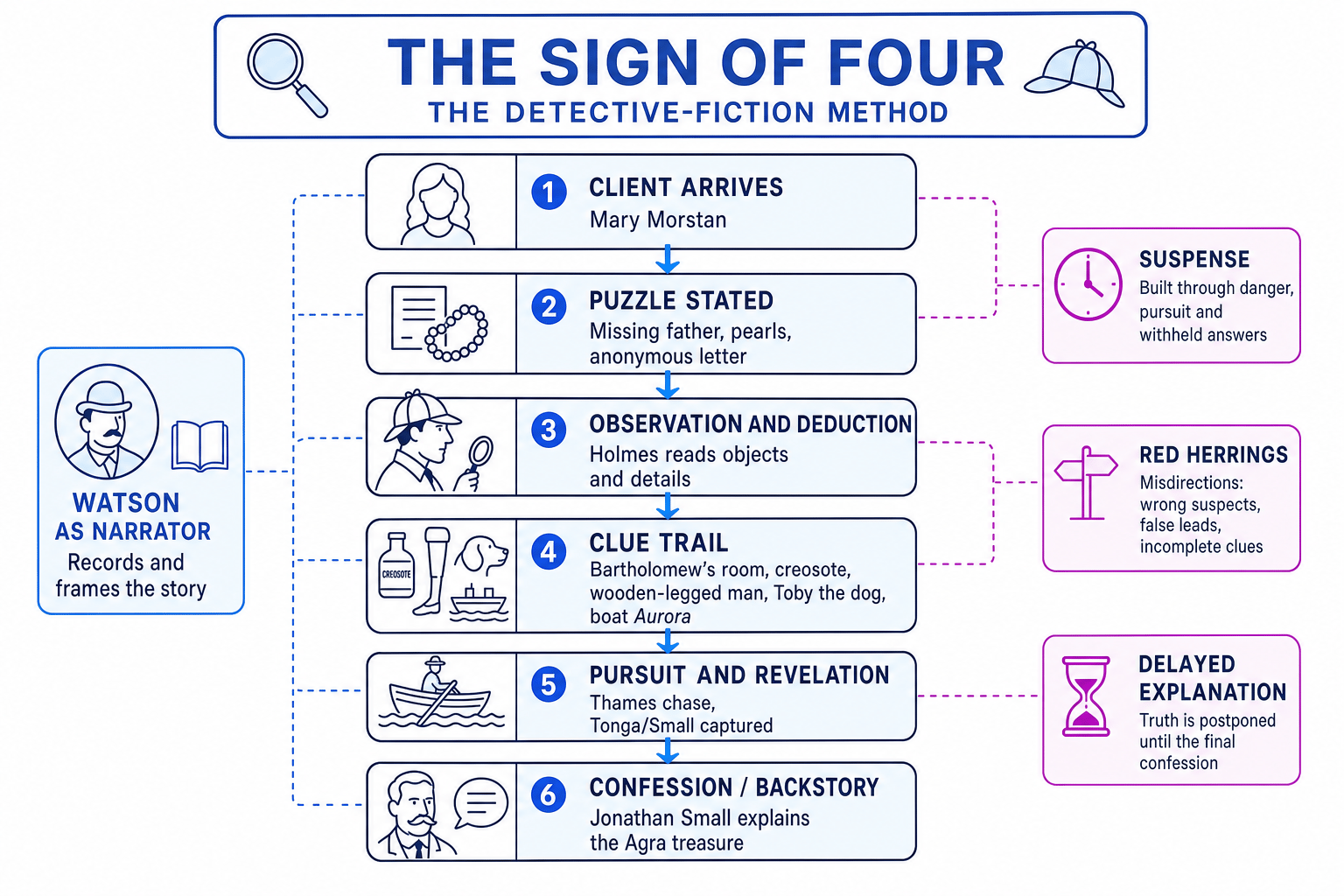
The big method
Doyle makes detection exciting by combining logic with suspense: Holmes appears calm and scientific, but the plot is full of danger, secrecy and delayed answers.
Holmes and “the science of deduction”
Holmes presents detection as a rational process. He believes that tiny details can reveal hidden truths. Early in the novel, he says, “Detection is, or ought to be, an exact science,” which makes his work sound controlled, precise and almost mathematical.
Deduction
Deduction is reasoning from evidence to reach a conclusion. In literature essays, you can use the term more broadly for Holmes’s method of reading clues and making logical inferences.
However, be careful: Holmes does not simply guess. Doyle shows him observing small physical details, linking them to human behaviour, and rejecting explanations that do not fit.
One of the clearest examples is the watch scene in Chapter 1. Watson gives Holmes an old watch, and Holmes infers details about Watson’s brother’s life. The scene is important because it teaches both Watson and the reader how Holmes’s mind works.
Analysing Holmes’s reasoning from the watch
-
Start with the object as evidence. The watch is not just a prop: Doyle turns it into a clue by making Holmes treat scratches, marks and wear as signs of a person’s habits.
-
Link observation to character. Holmes infers that the owner was careless and struggled with drink. This shows that, in Doyle’s detective fiction, objects can reveal moral and social history.
-
Analyse the effect on Watson. Watson is shocked because the conclusions feel almost supernatural, but Holmes insists they come from method. This makes Holmes seem extraordinary while keeping the story within a rational detective framework.
-
Connect to the wider genre. The reader is trained to look closely at details, because Doyle suggests that truth is hidden in ordinary things.
Calling everything deduction
Do not just write “Holmes uses deduction” and stop. Explain what evidence he notices, what conclusion he reaches, and how Doyle makes the reader admire or question his method.
Watson as narrator: the reader’s guide
Watson is a first-person narrator, meaning he tells the story using “I” from his own point of view. He is not as brilliant as Holmes, so he often shares the reader’s confusion.
First-person narrator
A first-person narrator tells the story from their own perspective, using pronouns such as “I” and “we”. This limits what the reader knows to what that narrator sees, hears and understands.
This is a crucial detective fiction method. If Holmes narrated the story directly, he might reveal the solution too early. Because Watson narrates, Doyle can show the clues while delaying the explanation.
Watson also acts as a foil to Holmes.
Foil
A foil is a character whose contrast with another character highlights that character’s qualities.
Watson’s emotional, romantic and sometimes puzzled reactions make Holmes seem more logical and detached. Holmes even criticises Watson’s earlier writing: “You have attempted to tinge it with romanticism.” This is funny because The Sign of Four itself is full of romance, danger and adventure.
A sharp essay point
Watson is not just “the sidekick”. He is Doyle’s method for controlling suspense: he records the case, reacts emotionally, and withholds Holmes’s full reasoning from the reader.
Clues, red herrings and the clue trail
A clue is a detail that helps solve the mystery. A red herring is a misleading clue or false lead that distracts from the truth.
Red herring
A red herring is a clue, suspect or explanation that seems important but misleads the reader or characters away from the real solution.
In The Sign of Four, Doyle creates a trail of clues: Mary Morstan’s pearls and anonymous letter, the death at Pondicherry Lodge, the strange footprint, the creosote scent, Toby the dog, and the steam launch Aurora. Each detail seems strange at first, but later becomes part of the solution.
Holmes famously says, “when you have eliminated the impossible, whatever remains, however improbable, must be the truth.” This is one of the novel’s clearest statements of detective method: truth is reached by testing explanations against evidence.
Using the clue trail in analysis
-
Choose one clue. Take the creosote scent: it seems like a small physical detail, not an emotional or dramatic moment.
-
Explain its narrative function. Doyle uses it to move the investigation forward because Holmes can track it with Toby. The clue turns observation into action.
-
Analyse the reader’s experience. The reader may not yet understand the full meaning of the scent, so the clue creates curiosity rather than instant clarity.
-
Link to detective fiction. Doyle makes the solution feel fair because the evidence has been placed in the story before Holmes explains it.
Suspense and delayed revelation
Suspense is the feeling of tension created when the reader wants to know what will happen next. Doyle builds suspense by giving partial information, then delaying the full explanation.
Suspense
Suspense is tension or anticipation created when a writer withholds an outcome, answer or danger from the reader.
The murder at Pondicherry Lodge is a strong example. The setting is strange and threatening, and Bartholomew Sholto’s death appears almost impossible. Doyle uses the atmosphere of the room, the shocking body, and the mysterious “sign of four” to make the case feel more than ordinary crime.
This is where detective fiction overlaps with Gothic writing.
Gothic
Gothic writing uses fear, darkness, mystery, threatening settings and disturbing imagery to unsettle the reader.
Doyle does not rely only on calm reasoning. He also uses eerie scenes, sudden danger and grotesque details to make the case exciting. That means the novel is both a puzzle and an adventure.
Explaining delayed revelation
-
Identify what Doyle withholds. At first, the reader does not know who killed Bartholomew Sholto, how the killer entered, or what the “sign of four” means.
-
Explain how the withholding affects pace. Because the answers are delayed, the reader follows Holmes from scene to scene, waiting for each clue to become meaningful.
-
Connect the structure to the ending. Jonathan Small’s final confession reorganises the story: events that seemed bizarre become part of a longer history involving the Agra treasure.
-
Link to effect. The delayed explanation rewards the reader with a sense of order restored, which is a key pleasure of detective fiction.
Police, amateurs and Holmes’s superiority
Detective fiction often contrasts the brilliant private detective with official police. In The Sign of Four, Athelney Jones is confident but frequently wrong. He arrests the wrong people at Pondicherry Lodge, while Holmes quietly follows the evidence.
This contrast makes Holmes seem more impressive. It also creates humour, because the official detective appears certain even when he misunderstands the case.
The method here is structural: Doyle places Holmes beside a less effective detective so that Holmes’s intelligence stands out.
Holmes versus the police
Doyle does not just tell us Holmes is brilliant; he proves it by making official investigators jump to simple conclusions while Holmes notices what others ignore.
Adventure fiction and imperial mystery
Although The Sign of Four is detective fiction, it also borrows from adventure fiction, a genre involving danger, journeys, pursuit and physical action. The Thames chase, the hidden treasure and Jonathan Small’s backstory all make the novel feel larger than a single London crime.
The final confession takes the reader away from Baker Street and into the history of the Agra treasure. This expands the mystery into the British Empire and the Indian Rebellion of 1857.
For AQA, this is useful context: Victorian readers were often fascinated by empire, “exotic” treasure and threats returning to London from abroad. Doyle uses those interests to make the mystery feel dangerous and unusual.
Victorian stereotypes
When analysing Tonga and the imperial material, do not repeat the novel’s racial assumptions as if they are true. You can say Doyle uses dehumanising Victorian stereotypes to create fear and “otherness”, while modern readers may find this presentation disturbing.
The final confession: order restored
Many detective stories end with an explanation. In The Sign of Four, Jonathan Small’s confession is important because it fills in the missing history behind the crime.
This is a structural method. Doyle begins with mystery, then moves through clues and pursuit, before ending with a long backstory. The story’s chronology is therefore not straightforward: the causes of the crime happened years earlier, but the reader only learns them at the end.
Structure
Structure means the way a writer organises a text, including the order of events, shifts in pace, openings, endings and patterns of revelation.
The confession makes the plot feel complete, but it also complicates the reader’s judgement. Small is guilty, yet his story of betrayal encourages some sympathy. Doyle’s detective method therefore does more than identify a criminal: it reveals a chain of greed, revenge and injustice.
Quick quotation bank for methods
| Quotation | Method | How to use it |
|---|---|---|
| “Detection is, or ought to be, an exact science” | Genre statement / characterisation | Shows Holmes’s rational, controlled view of detective work. |
| “You have attempted to tinge it with romanticism” | Metafictional humour / narrator contrast | Highlights the tension between Holmes’s logic and Watson’s dramatic storytelling. |
| “when you have eliminated the impossible…” | Aphorism / detective reasoning | Presents Holmes’s method as systematic and memorable. |
| “I would rather have Toby’s help than that of the whole detective force of London” | Humour / contrast with police | Shows Holmes values practical evidence over official authority. |
Closed-book quotation strategy
Learn short fragments rather than long sentences. A phrase like “exact science” or “eliminated the impossible” is enough if you analyse it closely.
Writing about detective methods in essays
A strong paragraph should move from method to meaning. Avoid retelling the plot. Instead, ask: what detective convention is Doyle using, and what effect does it have on the reader?
A useful structure is:
- Point: Doyle presents detection as rational and scientific.
- Evidence: Holmes calls detection an “exact science”.
- Method: The metaphor of science makes investigation seem precise and controlled.
- Effect: The reader trusts Holmes’s intelligence and expects the mystery to be solved logically.
- Link: This is central to the detective genre because it promises that hidden disorder can be turned into explanation.
Plot summary instead of analysis
Do not write a paragraph that only says what clue comes next. For literature, the key question is how Doyle constructs the mystery and why that affects the reader.
In the exam
-
Start with the detective method Doyle is using, such as Watson’s limited narration, the clue trail, suspense, or final confession.
-
Use a short, accurate quotation and zoom in on one or two words, such as “science”, “impossible” or “romanticism”.
-
Link the method to the reader’s experience: curiosity, uncertainty, admiration for Holmes, fear, or satisfaction when the solution is revealed.
Check yourself
- How does Watson’s narration help Doyle delay the solution to the mystery?
- Why is Holmes’s phrase “exact science” important for the detective genre?
- How does the final confession change the reader’s understanding of the crime?
