In your GCSE English Literature exam, you will be asked to write an essay on a theme or character in The Sign of Four. Because the exam is closed-book, you cannot read the novel during the test. Success depends on knowing the novel’s structural spine.
By focusing on a few key chapters, you can master the entire plot, trace the development of themes like imperialism and science, and memorize highly versatile quotations that apply to almost any essay prompt.
What you'll learn
- How Conan Doyle structures a Victorian detective novella to build suspense and resolve mystery.
- Deep thematic and linguistic analysis of four crucial chapters: Chapters 1, 4, 6, and 10.
- How to analyze extracts from these key chapters to secure top marks for language and structural analysis.
Understanding Narrative Structure in Detective Fiction
Before looking at specific chapters, we must understand how Conan Doyle structures his detective narrative. Unlike a standard linear novel, a detective story is a double narrative: it tells the story of the investigation (which moves forward in time) while simultaneously reconstructing the story of the crime (which happened in the past).
To map this progression, we look at the narrative arc—the path of tension through the novel.
Narrative Arc
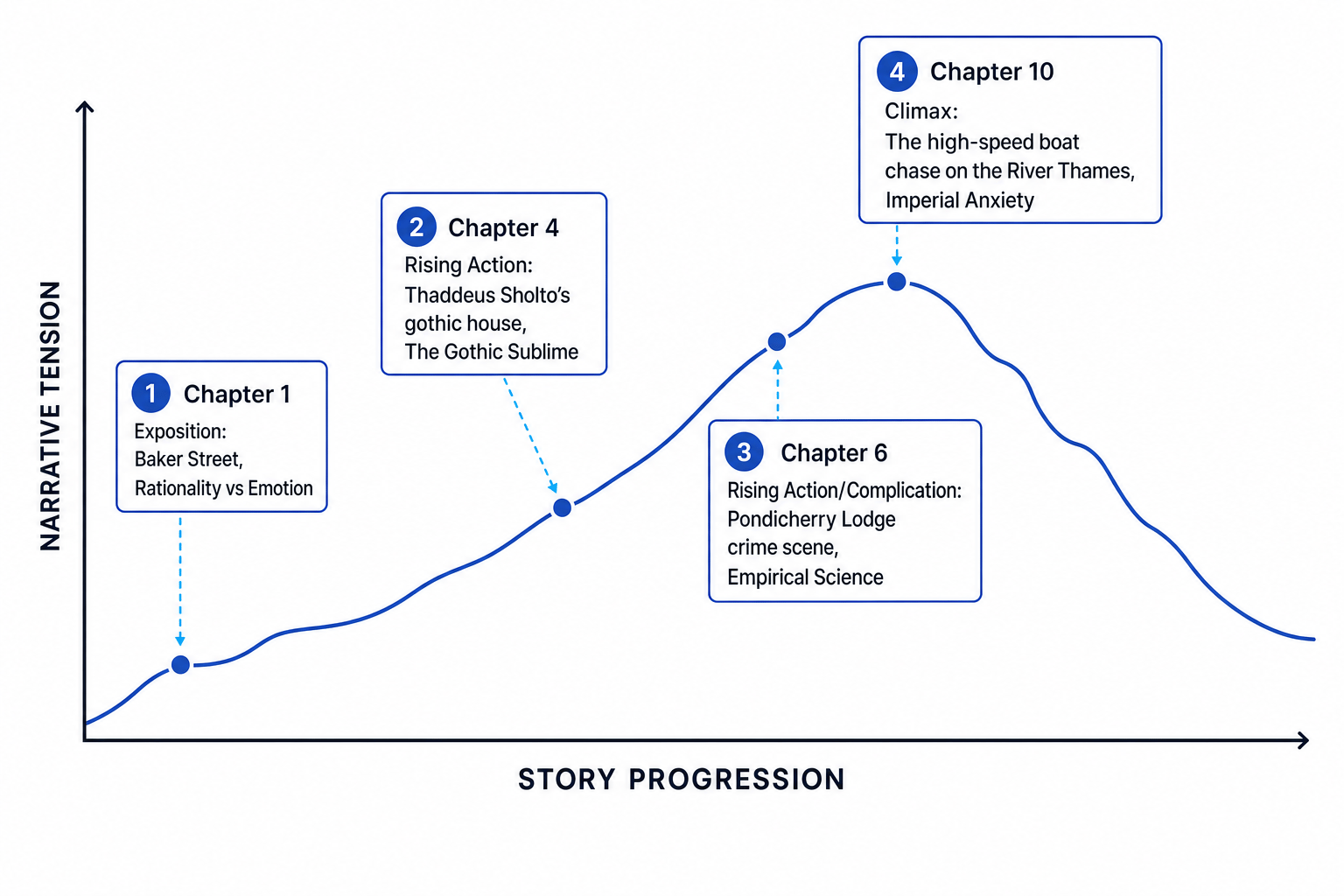
The narrative arc is the chronological construction of a plot, typically tracking a rise in tension from the exposition (introduction), through the rising action and climax (the peak of tension), to the resolution (the untangling of the plot).
In The Sign of Four, Conan Doyle relies on specific chapters to anchor this arc. The diagram below illustrates how the narrative tension moves across these critical chapters.
Chapter 1: The Science of Deduction (Exposition)
Chapter 1 establishes the status quo and introduces the novel’s central intellectual tension. Here, we meet Sherlock Holmes and Dr. John Watson in their natural habitat: 221B Baker Street.
The Contrast of Minds
The novel opens not with a mystery, but with a shocking action: Holmes injecting a "three-per-cent solution" of cocaine. This immediately establishes Holmes’s dual nature. He is a man of pure intellect who craves mental stimulation:
"I rebel against stagnation. Give me problems, give me work..."
Through Watson’s disapproval ("My constitution has recently dreaded any extra strain"), Conan Doyle establishes Watson as the moral and emotional anchor for the reader. This dynamic is crucial:
- Holmes represents the extreme of Victorian rationalism and scientific detachment.
- Watson represents middle-class Victorian morality, emotion, and human empathy.
The Theme of Science vs. Emotion
Chapter 1 acts as a philosophical debate. Holmes argues that detection is—or ought to be—an exact, cold science, warning that love and romance are "antagonistic to clear reasoning." This directly foreshadows Watson's romantic subplot with Mary Morstan, creating structural tension between Holmes’s logic and Watson’s humanity.
Chapter 4: The Story of the Bald-Headed Man (Rising Action)
In Chapter 4, the characters leave the safety of Baker Street and travel into the suburban wilderness of South London to meet Thaddeus Sholto. This chapter is vital because it showcases Conan Doyle's use of the Gothic genre.
Gothic Literature
A genre of fiction characterized by atmospheres of mystery, terror, darkness, and the supernatural, often featuring decaying settings, psychological vulnerability, and a sense of uncanny dread.
The Journey into Darkness
As Watson, Holmes, and Mary Morstan travel in a cab, Conan Doyle uses pathetic fallacy (attributing human emotions to nature or setting) to mirror the confusion of the mystery:
"A dense drizzly fog lay low over the great city. Mud-coloured clouds drooped sadly over the muddy streets."
The "yellow fog" acts as a metaphor for the obscurity of the crime, but it also reflects Victorian anxieties about the rapid expansion of London. The city is presented as a labyrinthine, threatening monster.
Thaddeus Sholto's Imperial Oasis
When they arrive at Thaddeus's home, the atmosphere shifts from the dreary London fog to an exotic, oriental dreamscape:
"The room was of the tiniest, but elegantly clad and hung with the richest silks and tapestries... Two great tiger-skins..."
This setting introduces the theme of Empire and Imperialism. Thaddeus’s wealth is entirely derived from India, but it is displayed in a chaotic, decadent fashion. This reflects Victorian unease with the spoils of the British Empire: wealth obtained through colonial exploitation brings moral corruption and physical decay.
Chapter 6: Sherlock Holmes Gives a Demonstration (The Complication)
Chapter 6 takes place at Pondicherry Lodge, the site of Bartholomew Sholto's murder. This chapter serves as the classic locked-room mystery scene.
Empirical Science in Action
While the professional police force, represented by the bumbling Athelney Jones, jumps to wild, subjective conclusions, Holmes demonstrates the power of objective, empirical observation.
Empiricism vs. Incompetence
Conan Doyle structures Chapter 6 to contrast Holmes’s scientific method with the police's reliance on guesswork. Jones arrests the innocent Thaddeus Sholto based on circumstantial evidence, while Holmes examines physical clues: a drop of water, a footprint, a tiny poisoned thorn.
The Threat of the "Other"
It is in this chapter that Holmes discovers the footprint of a "foreign" accomplice—Tonga. This discovery taps into Victorian xenophobia (fear of foreigners) and anxieties about the British Empire. The murder is not committed with a civilized British weapon, but with a primitive, exotic "poisoned thorn," symbolizing the deadly, unpredictable blowback of colonial conquest.
Chapter 10: The End of the Islander (Climax)
Chapter 10 is the action-packed climax of the novel: the high-speed chase down the River Thames.
The Chase on the Thames
The River Thames, the commercial artery of the British Empire, becomes a dark, gothic highway as Holmes and Watson pursue the steam launch Aurora. The chase represents the struggle of British industrial progress and order against the chaotic forces of the foreign "other."
The Presentation of Tonga
Tonga is described using dehumanizing, animalistic language that reflects late 19th-century racial prejudices and social Darwinist theories:
"never did I see a features so deeply marked with all bestiality and cruelty... his eyes glowed with a stony, fierce look..."
Watson and Holmes shoot Tonga, and he falls into the Thames. This act of violence is framed as a necessary defense of Victorian civilization against "savagery." Mechanized British technology (the police boat) triumphs over the primitive islander, resolving the physical threat to the empire.
Worked Example: Analyzing Gothic Atmosphere in Chapter 4
When analyzing a key chapter in your exam, you must show how Conan Doyle uses language (AO2) to reflect the historical and social context of the Victorian era (AO3).
Let's walk through how to plan and write an analytical paragraph based on the journey through London in Chapter 4.
Analyzing Gothic atmosphere in Chapter 4
Prompt: How does Conan Doyle use language to present the setting of London in Chapter 4?
- Formulate a clear thesis statement (AO1/AO2): State directly how the setting is presented and what its deeper thematic purpose is.
- Draft: Conan Doyle uses gothic language and pathetic fallacy to present London as a dark, threatening labyrinth, reflecting Victorian anxieties about the moral decay of the city.
- Select precise evidence (AO1): Choose a short, highly analytical quotation.
- Selection: "...dense drizzly fog... Mud-coloured clouds drooped sadly..." and the description of the streets as "long, desert streets" with "coarse glare[s] of gas-lamps."
- Identify the writer's methods (AO2): Pinpoint specific devices (pathetic fallacy, personification, sensory language) and analyze their effects on the reader.
- Analysis: The personification of the clouds drooping "sadly" creates a melancholic, oppressive atmosphere. The adjective "desert" suggests isolation and danger within a crowded metropolis, while the harsh noun phrase "coarse glare" of the gas-lamps highlights the unnatural, industrial grime of London.
- Link to historical context (AO3): Explain why a Victorian writer would depict London this way.
- Context: This dark portrait of London reflects the late-Victorian anxiety surrounding urban degeneration, overcrowding, and the fear that the heart of the British Empire was becoming a place of crime and moral darkness.
- Synthesize into a polished analytical paragraph: Combine these steps into a cohesive response.
- Final Paragraph:
In Chapter 4, Conan Doyle utilizes gothic imagery and pathetic fallacy to present London as an oppressive, labyrinthine space, reflecting Victorian anxieties about urban degeneration. As the characters journey to South London, Watson observes that a "dense drizzly fog lay low over the great city," with "mud-coloured clouds" that "drooped sadly." The personification of the clouds drooping "sadly" immediately establishes a melancholic and claustrophobic mood, suggesting that the city itself is burdened by moral decay. This is reinforced by the description of the "long, desert streets," where the adjective "desert" evokes a profound sense of isolation and vulnerability within the crowded capital. The only illumination comes from the "coarse glare of gas-lamps," a harsh sensory image that highlights the unnatural, polluted nature of the industrial metropolis. By casting London in this sinister, gothic light, Conan Doyle tap into late 19th-century anxieties that the heart of the British Empire was a breeding ground for mystery, crime, and moral darkness, preparing the reader for the unsettling exoticism of Thaddeus Sholto's home.
- Final Paragraph:
Treating settings as simple backdrops
Many students write that the fog in Chapter 4 "makes it hard for the characters to see." While true on a plot level, this gains very few marks. Always analyze setting as a symbolic force. The fog represents mystery, intellectual confusion, and the moral obscurity of the crimes committed in India that have now polluted London.
The Versatility of Chapter 1
If you get a question on Sherlock Holmes, Dr. Watson, Science vs. Emotion, or Friendship, Chapter 1 is your goldmine. Memorizing the opening dialogue about Holmes’s drug use and intellectual boredom provides you with quotes that fit all of these themes.
In the exam
- Track the structural shift: If your exam extract is from an early chapter (like Chapter 1 or 4), contrast the domestic safety of Baker Street with the exotic, dangerous world the characters are about to enter.
- Analyze structural foils: When discussing the characters in any key chapter, always highlight how Watson acts as a structural foil to Holmes—his emotional responses highlight Holmes's cold, calculating nature.
- Integrate context seamlessly: Never write a separate "history paragraph." Instead, weave context directly into your language analysis (e.g., “The use of the noun 'beast' to describe Tonga reflects Darwinian fears of regression common in late-Victorian society...”).
Check yourself
- Why does Conan Doyle choose to open the novel with Holmes injecting cocaine rather than with the arrival of Mary Morstan?
- How does the description of Thaddeus Sholto's house in Chapter 4 contrast with the external setting of the London streets?
- What does the bumbling nature of Athelney Jones in Chapter 6 reveal about Doyle's view of the official police force compared to Holmes's private "science of deduction"?
