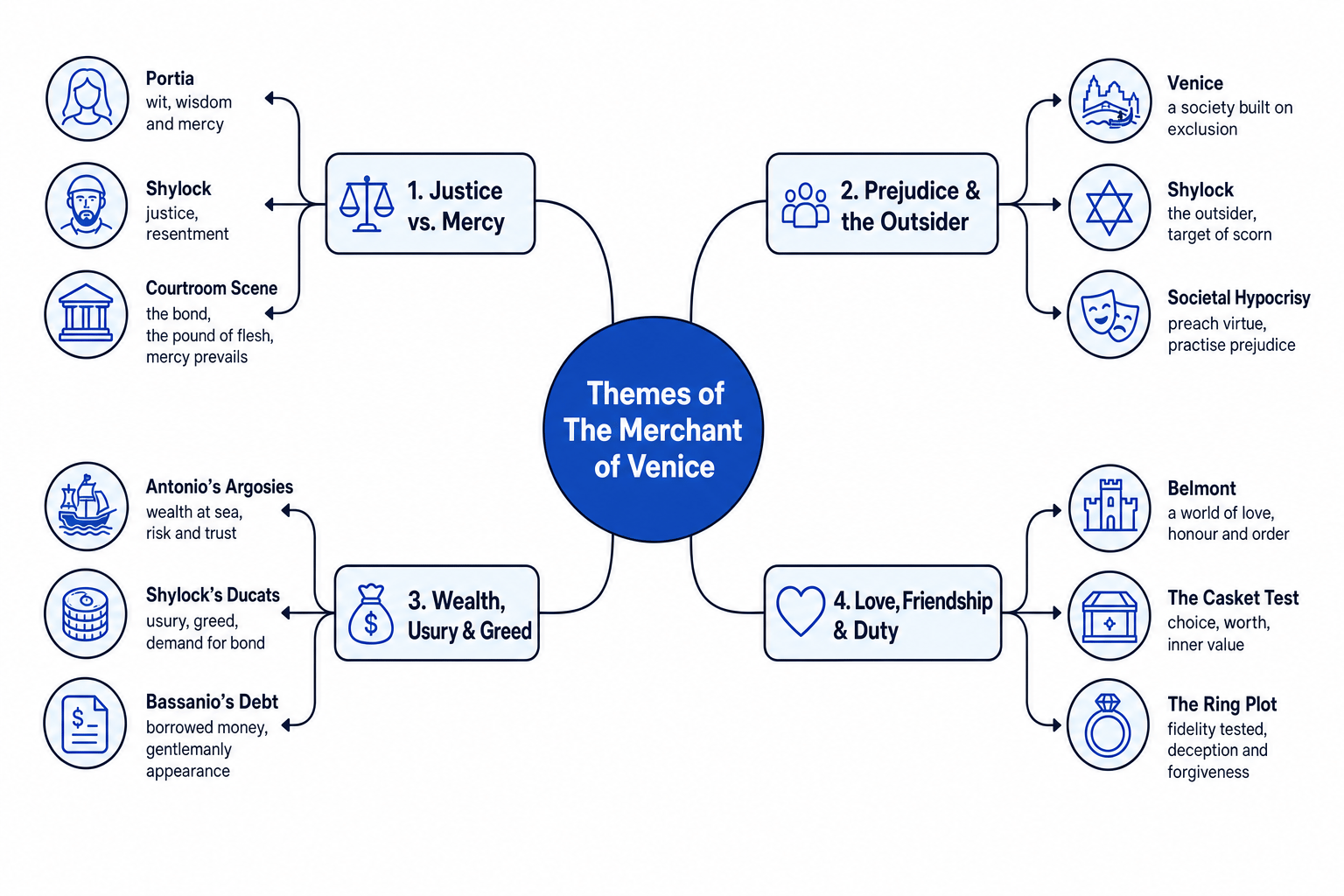
The Merchant of Venice is one of Shakespeare’s most morally complex plays. Classified as a "comedy," it frequently crosses the border into tragedy, largely due to how it treats its central themes. Understanding these themes is your key to unlocking high marks in your GCSE English Literature exam.
What you'll learn:
- How to analyse the tension between justice and mercy in Venetian law.
- How Shakespeare exposes the insidious nature of prejudice and social exclusion.
- How the play juxtaposes wealth and material greed against love and loyalty.
1. Justice versus Mercy
The conflict between justice (adhering strictly to the law) and mercy (forgiveness and compassion) is the moral heart of the play. This clash is primarily dramatised through the legal battle between Shylock and Antonio, culminating in the famous trial scene of Act 4, Scene 1.
Justice (Old Testament Law) vs. Mercy (New Testament Grace)
In the context of the play's religious conflict, justice is often aligned with Shylock's demands for the strict enforcement of Venetian law and his contract. Mercy is framed by the Christian characters as a divine attribute that transcends human law, requiring charity and forgiveness.
The Courtroom Conflict
Shylock demands his "bond" (a pound of Antonio’s flesh) because Antonio has defaulted on his loan. He relies on the strict, literal letter of the law:
"I stand here for law." (Act 4, Scene 1)
To Shylock, justice is transactional. He has bought his pound of flesh, and he expects Venice to deliver it.
Conversely, Portia (disguised as the lawyer Balthazar) argues that justice must be tempered with mercy. In her famous monologue, she states:
"The quality of mercy is not strained; / It droppeth as the gentle rain from heaven..." (Act 4, Scene 1)
She argues that mercy cannot be forced ("strained"); it is a natural blessing that benefits both the giver and the receiver.
The Hypocrisy of Mercy
While the play champions mercy in theory, Shakespeare invites us to notice a glaring contradiction in how it is practised.
When Shylock is defeated by a legal loophole (Portia points out that his bond allows for "no jot of blood"), the Christian court demands his total submission. Antonio "mercifully" lets Shylock keep half his wealth, but under two devastating conditions:
- Shylock must convert to Christianity.
- He must leave his remaining estate to his estranged daughter, Jessica, and her Christian husband, Lorenzo.
To an Elizabethan audience, forcing a conversion might have been viewed as saving Shylock's soul (an act of "mercy"). However, to modern audiences—and arguably in Shakespeare’s deeper characterisation—this act strips Shylock of his identity, highlighting the hypocritical nature of Christian "mercy" in Venice.
Mercy is conditional
While Portia claims mercy is "above this sceptred sway," the play's climax reveals that in Venice, mercy is only granted on the terms of the dominant Christian majority.
2. Prejudice, Outsiders, and Xenophobia
The Merchant of Venice is deeply preoccupied with how society treats those it deems "outsiders."
Xenophobia and Antisemitism
Xenophobia is the dislike of or prejudice against people from other countries. Antisemitism is hostility, prejudice, or discrimination directed specifically against Jewish people.
Shylock as the Marginalised "Other"
In Elizabethan England, Jewish people had been officially banished since 1290. Shakespeare's audience would have had very little direct contact with Jewish communities, relying instead on crude cultural caricatures.
Within the play, Shylock is routinely dehumanised by the Christian characters, who refer to him as:
- "The devil... in the likeness of a Jew" (Act 3, Scene 1)
- An "inexorable dog" (Act 4, Scene 1)
- "Misbeliever, cut-throat dog" (Act 1, Scene 3)
Antonio admits to spitting on Shylock and kicking him, yet still expects Shylock to lend him money. This prejudice fuels Shylock’s desire for revenge. His villainy is not innate; it is a direct product of the abuse he has suffered.
Shylock’s Humanity: "Hath not a Jew eyes?"
Shakespeare gives Shylock one of the most powerful humanist speeches in English literature, defending his shared humanity:
"Hath not a Jew eyes? Hath not a Jew hands, organs, dimensions, senses, affections, passions? [...] If you prick us, do we not bleed? If you tickle us, do we not laugh? If you poison us, do we not die? And if you wrong us, shall we not revenge?" (Act 3, Scene 1)
Look closely at the structure of Shylock's speech
The first part of the speech uses a list of rhetorical questions to establish physical and emotional equality between Jews and Christians. However, the climax of the speech is a dark warning: if they are equal in humanity, they are also equal in their desire for vengeance.
3. Wealth, Usury, and Value
Venice is depicted as a bustling, global commercial hub. The play constantly contrasts Venice (a cold, transactional world of commerce and contracts) with Belmont (a romantic, fairy-tale world of love, music, and wealth). However, wealth infects both worlds.
Usury vs. Venture Capitalism
The play sets up a moral conflict between two financial systems:
- Usury (practised by Shylock): Lending money at high-interest rates.
- Venture Capitalism (practised by Antonio): Investing in overseas trade.
Usury
The practice of lending money and charging interest. In Shakespeare's time, usury was officially condemned by the Christian Church as sinful and unnatural, because it allowed money to "breed" money without physical labour.
Antonio lends money out of friendship and charges no interest, which actively drives down Shylock's business. Shylock resents this deeply:
"He lends out money gratis and brings down / The rate of usance here with us in Venice." (Act 1, Scene 3)
The Commercialisation of Love
Even in the romantic paradise of Belmont, love is expressed in the language of money. Bassanio does not merely seek Portia because he loves her; he admits to Antonio that he needs to marry her to solve his severe debt:
"In Belmont is a lady richly left, / And she is fair..." (Act 1, Scene 1)
Notice the order of his description: Portia is "richly left" (wealthy) before she is "fair" (beautiful). Furthermore, when Bassanio succeeds in the casket test, Portia describes herself as wanting to be "trebled twenty times myself" in value for him. Love in this play is rarely pure; it is almost always bound up with financial transactions.
Viewing Belmont as a pure paradise
Do not write that Belmont is a place of pure, unblemished romance compared to the corrupt world of Venice. Belmont's romantic trials are also governed by wealth (Portia's inheritance) and rigid contracts (her father's will and the casket test).
Worked Example: Theme Analysis
Let's look at how to construct a high-scoring analytical paragraph on the theme of Prejudice and Revenge.
Analyzing Shylock's motives for revenge
Question: Explore how Shakespeare presents the relationship between prejudice and revenge in The Merchant of Venice.
-
Step 1: Write a focused thesis statement (Point) Draft a clear opening sentence that directly addresses the prompt and introduces authorial intent.
"Shakespeare presents Shylock’s desire for bloody revenge not as an inherent character flaw, but as a direct psychological consequence of the systemic antisemitism he suffers at the hands of Venetian society."
-
Step 2: Embed a precise, short quotation (Evidence) Introduce a relevant quote naturally into your sentence, ensuring accurate attribution.
"This is most apparent when Shylock confronts Salarino and Solanio in Act 3, Scene 1, declaring that the cruelty he plans to execute is a lesson he learned from his oppressors: 'The villainy you teach me I will execute.'"
-
Step 3: Analyze the language and methods used (Analysis - AO2) Break down specific words or techniques, examining how they create meaning.
"The noun 'villainy' carries a double meaning here. While the Christian characters view Shylock as the archetype of evil, Shakespeare uses the verb 'teach' to invert this dynamic. This verb frames the Christians as the active instigators of cruelty and Shylock as their passive student. The simple future tense 'I will execute' conveys an icy, deliberate resolve, demonstrating how systemic degradation hardens the victim’s heart and transforms prejudice into a reciprocal cycle of violence."
-
Step 4: Connect to context and authorial intent (Context - AO3) Explain why Shakespeare constructed this moment this way, linking it to the wider social context of Elizabethan England.
"By presenting Shylock's quest for a pound of flesh as a mirror of Christian behaviour, Shakespeare challenges his Elizabethan audience’s prejudices. Rather than allowing them to comfortably mock a Jewish caricature, he forces them to recognize that the 'villainy' they condemn is a monster of their own creation, reflecting the deep-seated xenophobia of early modern London."
In the exam
When writing about the themes of The Merchant of Venice, keep these strategies in mind to maximise your marks:
- Focus on structural contrasts: Always compare the cold, transactional setting of Venice with the romantic, wealthy setting of Belmont. This shows a sophisticated understanding of how Shakespeare uses structure to explore themes of wealth and love.
- Examine the language of business: Look out for financial metaphors in scenes about love or friendship. When Bassanio calls Antonio his "chiefest friend," or when Portia talks about her "worth," highlight how the language of the market infects human relationships.
- Avoid one-dimensional character readings: Do not treat Shylock simply as a victim or simply as a villain. High-scoring essays show complexity. Argue that Shakespeare deliberately creates a character who is both a victim of brutal societal prejudice and, ultimately, a ruthless, vengeful antagonist.
Check yourself
Before moving on, make sure you can answer these three key questions about the play's themes:
- How does Shakespeare use Portia's forced conversion of Shylock to expose the hypocrisy of Christian mercy?
- In what ways does Bassanio's quest to win Portia blend the themes of love and money?
- What is the difference between usury and venture capitalism in the play, and why did this distinction matter to an Elizabethan audience?
