To truly understand Shakespeare's The Merchant of Venice, you must step back into the late 16th century. Elizabethan society was vastly different from our own, and the play's main conflicts—money, religion, justice, and gender—reflect the anxieties, prejudices, and values of Shakespeare’s contemporary audience.
In your GCSE exam, integrating this historical backdrop is vital. It is not about listing dry historical facts; instead, you need to show how these contextual factors shape the characters' actions, the play's structure, and how an Elizabethan audience would have reacted compared to a modern reader.
What you'll learn
- How Elizabethan attitudes toward Judaism and the historical presence of Jewish people in England shape the presentation of Shylock.
- The stark socio-cultural contrast between the play's two settings: the commercial city of Venice and the romantic estate of Belmont.
- The economic realities of usury and the moral dilemmas surrounding money-lending in early modern England.
- How the legalistic pursuit of justice in the play reflects Elizabethan religious debates about Old Testament law versus Christian mercy.
1. Anti-Semitism and the Elizabethan Audience
To a modern audience, the treatment of Shylock is deeply uncomfortable. He is spat upon, insulted, and ultimately forced to convert to Christianity. To understand why Shakespeare wrote such a complex, polarizing figure, we must look at the prevailing attitudes of his time.
Anti-Semitism
Anti-Semitism is hostility, prejudice, or discrimination directed against Jewish people. In Elizabethan England, this was not just a personal bias but a systemic, state-sanctioned attitude rooted in religious and cultural history.
In 1290, King Edward I signed the Edict of Expulsion, legally banishing all Jewish people from England. For over 300 years, there was no open Jewish community in the country. Therefore, the vast majority of Shakespeare's audience had never met an openly Jewish person. Their understanding of Jewish people was built entirely on myth, stereotype, and caricature.
The Rodrigo Lopez Affair (1594)
Just a few years before Shakespeare wrote The Merchant of Venice (around 1596–1598), a major political scandal gripped London. Roderigo Lopez, a Portuguese Jewish convert and the personal physician to Queen Elizabeth I, was accused of conspiring with Spanish agents to poison the Queen.
Despite thin evidence, Lopez was convicted of high treason and executed at Tyburn in 1594 amid a wave of intense public anti-Semitism. The public fury surrounding the "Lopez affair" meant that anti-Jewish sentiment was at an absolute peak when Shakespeare sat down to write his play.
The Literary Precedent: The Jew of Malta
Shakespeare was also reacting to the popular theater of his day. Christopher Marlowe’s hit play The Jew of Malta featured Barabas, a Jewish villain who is an unvarnished caricature of pure evil—poisoning wells, murdering nuns, and gloating over his crimes.
While Shakespeare’s Shylock shares some of these villainous tropes, Shakespeare does something revolutionary: he gives his Jewish antagonist a complex psychological motivation, famously captured in the "Hath not a Jew eyes?" speech.
The Paradox of Shylock
An Elizabethan audience would have viewed Shylock primarily as a comic, villainous caricature, deserving of his ultimate downfall and forced conversion. However, Shakespeare's writing is complex enough that Shylock is also presented as a victim of Christian hypocrisy, allowing modern audiences to view him as a tragic, deeply wronged figure.
2. The Two Settings: Venice vs. Belmont
The Merchant of Venice is structured around a binary geographical opposition. Shakespeare sets his play in two distinct locations, each representing a different set of values, social structures, and atmospheric moods.
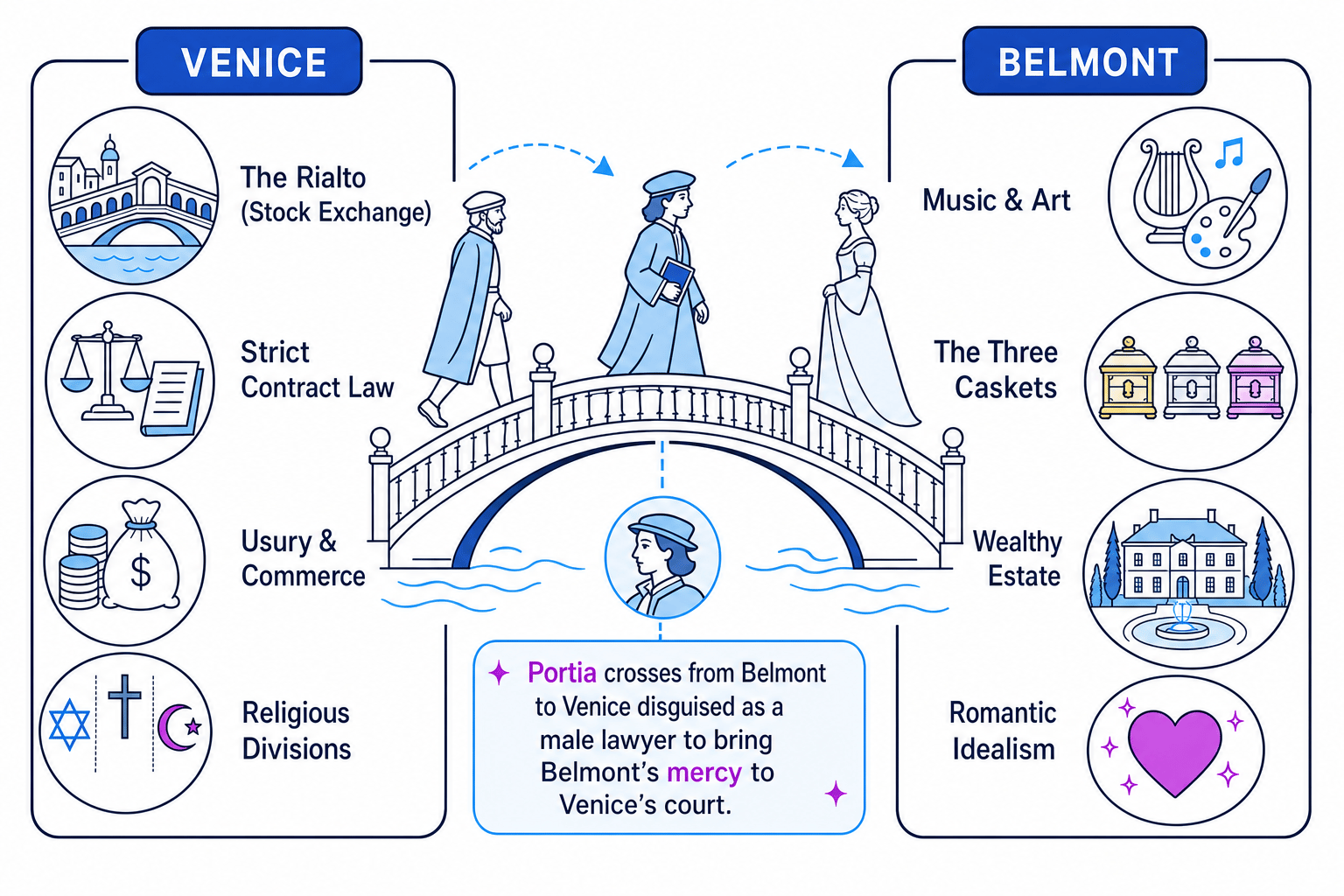
Venice: The Commercial Hub
In the 16th century, Venice was a legendary city-state. It was a global superpower of commerce, renowned for its immense wealth, its multicultural trade, and its strict, impartial legal system.
- The Rialto: The Venetian stock exchange, representing cold, calculation, masculinity, and capital.
- The Law: Venice's survival depended on foreign merchants trusting its legal system. If the Duke of Venice bypassed the law to save Antonio, it would ruin the city’s international trade reputation. This is why Portia cannot simply plead for Antonio’s life on emotional grounds; she must use the letter of the law.
Belmont: The Romantic Escape
Belmont is a fictional, idealized country estate. Its name literally translates to "beautiful mountain."
- The Atmosphere: Belmont is associated with music, poetry, romance, and moonlit nights. It is a world of aristocratic leisure, contrasting sharply with the transactional, high-stakes trade of Venice.
- The Caskets: While Venice is governed by modern commercial contracts, Belmont is governed by a fairytale-like lottery devised by Portia’s late father. It represents old wealth, inheritance, and divine providence.
Structure is Meaning
In your essays, track how characters move between these two settings. Characters travel to Belmont to seek love and escape the stress of debt, but they must return to Venice to face the harsh realities of law, contracts, and conflict. The play's resolution in Act 5 returns to Belmont, restoring harmony through music and love after the cold tension of the Venetian courtroom.
3. Usury and the Elizabethan Economy
At the heart of the play's plot is a financial transaction: Antonio borrows money from Shylock, using his own flesh as collateral. This introduces the controversial economic concept of usury.
Usury
Usury is the practice of lending money at interest. In early modern Europe, this was a highly controversial practice bound up with religious doctrine and moral anxiety.
Historically, the Christian Church forbade usury, basing its stance on biblical passages (such as Luke 6:35, which commands believers to "lend, hoping for nothing back"). To Christians, making money out of nothing (charging interest on time, which belongs to God) was a sin of greed.
In contrast, Jewish law permitted Jews to lend money at interest to non-Jews. Because Jewish people in medieval and early modern Europe were barred from owning land or entering professional guilds, moneylending became one of the few livelihoods open to them.
The Christian Dilemma
By the late 16th century, England was rapidly transition from a feudal society to a commercial, capitalist economy. Merchants like Antonio needed capital to fund their trading voyages. Despite the religious ban on usury, the English economy could not function without borrowing money.
This created a massive hypocritical tension:
- Christians desperately needed loans to fuel their businesses.
- Christians condemned the moneylenders (often Jewish people) who provided those very loans, calling them parasites and sinners.
Antonio spits on Shylock and calls him a "dog" because Shylock charges interest ("he lends out money gratis," Shylock complains of Antonio in Act 1, Scene 3, which lowers the going rate of interest in Venice). Shylock’s defense of usury, comparing it to Jacob breeding Laban’s sheep, shows his belief that venture and profit are natural and justified.
4. Justice, Law, and Mercy
The climax of the play in the Act 4 courtroom scene is a philosophical battle between two opposing legal and religious ideologies: the Old Testament Law and the New Testament Gospel of Grace.
| Old Testament Ideology (Associated with Shylock) | New Testament Ideology (Associated with Portia/Antonio) |
|---|---|
| Focuses on the letter of the law and strict contractual justice. | Focuses on the spirit of the law and divine mercy. |
| Symbolized by the Lex Talionis ("an eye for an eye", or a pound of flesh). | Symbolized by Christ’s sacrifice, offering redemption regardless of merit. |
| Shylock demands: "I stand here for law." | Portia argues: "In the course of justice, none of us / Should see salvation." |
Sided Readings of the Courtroom Scene
Do not write that Portia represents pure Christian mercy while Shylock represents pure Jewish cruelty. While Portia delivers a beautiful speech on how mercy is "twice blest," her actual treatment of Shylock at the end of the trial is merciless. She strips him of his wealth, his identity, and his religion. Shakespeare is highlighting the hypocrisy of Venice: they preach mercy but practice ruthless legalism when it suits them.
Integrating Historical Context into Character Analysis
Your exam essays must seamlessly blend context (AO3) with close language analysis (AO2). Avoid "bolting on" historical facts at the end of a paragraph. Instead, use context to explain why Shakespeare chose specific words, images, or structures.
Analyzing Shylock's Defense of Humanity
Observe how we can weave historical context into an analysis of Shylock’s famous monologue in Act 3, Scene 1:
"Hath not a Jew eyes? hath not a Jew hands, organs, dimensions, senses, affections, passions?"
-
Formulate a clear thesis point: Start by asserting how Shakespeare uses the speech to challenge the prevailing prejudices of his contemporary audience.
Example: "In Act 3, Scene 1, Shakespeare subverts the typical Elizabethan caricature of the monstrous Jewish villain by asserting Shylock's shared humanity."
-
Embed precise textual evidence and analyze methods: Quote from the speech, identifying Shakespeare’s linguistic techniques.
Example: "Through a rapid succession of rhetorical questions, such as 'Hath not a Jew eyes? hath not a Jew hands...', Shakespeare uses parallel syntax to emphasize the physiological equality between Christians and Jews. The accumulation of physical nouns ('organs, dimensions, senses') strips away religious labels to focus on the biological reality of the human body."
-
Integrate historical context (AO3) to show the effect: Explain how this would resonate with an Elizabethan audience vs. a modern audience.
Example: "For an Elizabethan audience accustomed to viewing Jewish people as subhuman 'other' figures—a prejudice intensified by the recent execution of Roderigo Lopez in 1594—this speech would have been highly unsettling. Shakespeare forces a deeply anti-Semitic audience to confront their own hypocrisy. However, the speech is not entirely noble; Shylock concludes by arguing that just as Christians teach 'revenge,' he will 'execute' the same. Thus, Shakespeare contextually grounds Shylock's malice not in inherent racial evil, but as a direct product of the systemic abuse he suffers under Christian Venetian law."
In the exam
- Never treat context as a history lesson: Only mention historical facts (like the 1290 expulsion or the Lopez trial) if you can link them directly to a specific quote or character action in the extract or play.
- Remember AO4 (SPAG): The Shakespeare question is the only place on Paper 1 where you are explicitly marked for your spelling, punctuation, and grammar (worth 4 marks). Keep your sentences controlled, spell character names correctly (e.g., Shylock, Portia, Bassanio), and use precise literary terms.
- Contrast the audiences: High-level essays often discuss how reactions to the play have shifted over time. Acknowledge how a modern post-Holocaust audience might feel deep sympathy for Shylock, whereas an Elizabethan audience would likely have cheered his forced conversion as a "saving" of his soul.
Check yourself
- Why did the Elizabethan audience have almost no real-life contact with Jewish people, and how did this affect their reception of Shylock?
- What economic tension in Elizabethan England made the practice of usury both highly necessary and deeply hated?
- How does the structural contrast between Venice and Belmont reflect the thematic tension between law and mercy?
