When Shelagh Delaney wrote A Taste of Honey in 1958 at just 19 years old, she wanted to address the realities of working-class life that she felt were completely missing from British theatre. Instead of polite, middle-class drawing-room comedies, she put the lived experiences of working-class women, single mothers, queer men, and Black sailors directly onto the stage.
By exploring these themes, Delaney challenged the social norms of post-war Britain and gave a voice to those living on the margins of society.
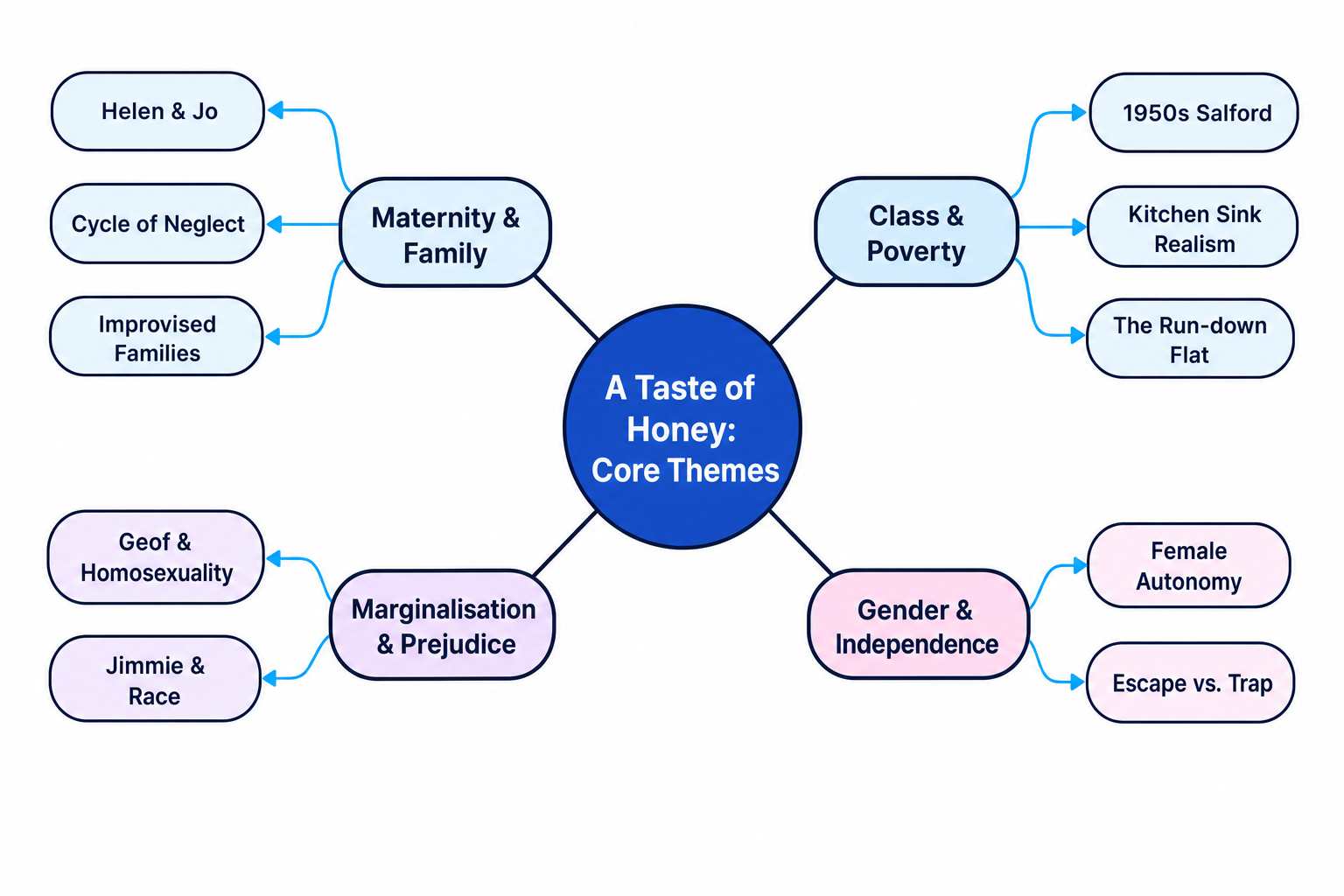
What you'll learn
- How to identify and analyse the core themes of motherhood, social class, and marginalisation in A Taste of Honey.
- How Delaney uses the genre of "Kitchen Sink Realism" to convey the harsh realities of 1950s working-class life.
- How to link these central themes directly to their historical, social, and cultural contexts (AO3) to score top marks in your GCSE essay.
Maternity, Family, and the Cycle of Neglect
At the very heart of the play is the volatile, co-dependent, and often destructive relationship between Helen and her daughter, Jo. Delaney presents a family structure that is highly unconventional for the 1950s—devoid of a father figure, financially unstable, and emotionally volatile.
Generational cycle of neglect
The generational cycle of neglect is a pattern of behaviour where a parent's inability to provide emotional or physical security is repeated by their child when they grow up and have children of their own.
Helen is a self-proclaimed "semi-demi-respectable woman" who prioritises her own financial survival and sexual desires over Jo's well-being. She frequently abandons Jo to pursue relationships with men, such as the younger, abusive Peter.
Jo's deep resentment of Helen is matched by an underlying craving for her mother's approval. We see this tense dynamic in their sharp, fast-paced dialogue:
Jo: "You’re always rebuilding our life." Helen: "It needs it."
When Jo becomes pregnant by Jimmie, a Black sailor who returns to sea, she faces the prospect of becoming a single mother herself. This development threatens to trigger the generational cycle of neglect.
However, Delaney introduces Geof—a young, gay art student—who steps in to act as a surrogate mother and father figure. Geof and Jo create an "improvised family," which offers Jo a temporary sanctuary of care and domestic safety that Helen never provided.
The breakdown of traditional family structures
Delaney suggests that biological family ties do not automatically guarantee love or care. Instead, genuine support and maternal care are often found in "improvised families" built on mutual vulnerability, such as the temporary domestic partnership between Jo and Geof.
Social Class and Kitchen Sink Realism
In the late 1950s, a new cultural movement emerged in British theatre and literature, focusing on the gritty, unvarnished lives of the working class.
Kitchen Sink Realism
Kitchen Sink Realism is a cultural movement in British theatre, art, and film that depicts the domestic lives of working-class characters in harsh, realistic environments, focusing on themes of poverty, cramped housing, and social disillusionment.
Delaney uses the setting of a run-down, damp flat in Salford to instantly establish the themes of poverty and social class. The flat has a "comfortless, old-fashioned" atmosphere, with a shared bathroom down the hall and a view of a gasworks and a cemetery. This physical setting is a powerful visual metaphor for the characters' economic entrapment.
To highlight this class divide, Delaney contrasts Jo and Helen’s precarious existence with Peter’s relative wealth. Peter uses his money to control Helen, while Helen uses her relationship with Peter to temporarily escape the realities of working-class life.
Unlike the male "Angry Young Men" playwrights of the era, who focused on class frustration from a male perspective, Delaney provides a unique "female gaze" on poverty. She highlights how working-class women are doubly disadvantaged by both their class and their gender, leaving them with very few routes to financial security.
Confusing escape with resolution
Do not write that Helen or Jo successfully escape poverty. While Helen marries Peter for his money, this relationship quickly sours and she is forced to return to the dingy flat. Similarly, Jo's brief "taste of honey" with Jimmie and her cosy domestic setup with Geof are both temporary. The play ends where it began, illustrating the inescapable trap of working-class poverty.
Marginalisation and Prejudice
A Taste of Honey was highly revolutionary for its sympathetic portrayal of characters who were deeply marginalised by 1950s society.
Marginalisation
Marginalisation is the social process of pushing individuals or groups to the fringes of society, denying them power, resources, and a voice.
Delaney explores marginalisation through three main axes:
Homosexuality (Geof)
In 1958, male homosexual acts were illegal in the UK, and gay men faced severe social stigma, police harassment, and imprisonment. Delaney presents Geof not as a caricature, but as a deeply compassionate, sensitive, and dignified character.
While Helen directs homophobic slurs at him (calling him a "pansy" and "sister boy"), Jo accepts him completely. Geof's marginalisation makes him uniquely empathetic to Jo’s plight, as they are both outsiders surviving in a hostile world.
Race (Jimmie)
Jimmie, a Black sailor in the Royal Navy, represents a rare and positive depiction of a Black character on the 1950s British stage. His relationship with Jo is tender and affectionate, free from the cynical transactional nature of Helen and Peter's relationship.
However, their relationship is shadowed by the casual racism of the era. Helen is horrified when she suspects the baby might be mixed-race, revealing the deep-seated racial prejudices of post-war Britain.
Gender and Female Autonomy
Both Helen and Jo are marginalised by a patriarchal society that offers women very few career opportunities.
Without financial independence, women are forced to rely on men for survival. Helen openly admits that she has always relied on men to pay her way, while Jo struggles to find a path to self-sufficiency, ultimately facing the prospect of raising a child alone in a society that ostracises unmarried mothers.
Use AO3 context to explain character actions
When analysing the characters' desperate decisions—such as Helen marrying a man she dislikes, or Jo considering giving her baby away—always link their choices to the limited social security and severe prejudice of 1950s Britain. Their actions are driven by survival, not necessarily malice.
Analysing a Theme in Action
To achieve top marks (AOs 1, 2, and 3), you must demonstrate how Delaney uses language, staging, and context to present her core themes. Let's look at how to construct a high-scoring analytical paragraph.
Analysing Delaney's presentation of social class through setting
Walk through these steps to write a high-level analytical paragraph on how Delaney uses the opening description of the flat to establish the theme of social class and entrapment.
-
State your main analytical point (AO1): Start with a clear statement that links the play's physical setting directly to the theme of working-class struggle.
Draft: Delaney uses the bleak, claustrophobic setting of the Salford flat at the start of the play to symbolise the economic entrapment and lack of opportunity experienced by the working-class characters.
-
Introduce and embed a precise quotation (AO1): Introduce your evidence naturally into your sentence, ensuring you quote accurately.
Draft: Immediately upon entering the flat, Jo notices the grim surroundings, commenting that the view outside consists of a "gasworks" and a "cemetery," while complaining about the "damp" and the "dirty canal" nearby.
-
Analyse Delaney's dramatic methods (AO2): Examine the specific language choices, symbolism, or stage directions, using precise literary terminology.
Draft: The industrial nouns "gasworks" and "canal" function as symbols of the bleak, polluted landscape of post-war industrial Salford, reflecting the dirty reality of their everyday existence. Furthermore, the juxtaposition of the "gasworks" (representing grueling, underpaid industrial labour) with the "cemetery" (representing death and decay) acts as a structural foreshadowing of the characters' bleak futures. This suggests that the working classes are trapped in a physical and social landscape where they are ground down by labour until they die, leaving no room for beauty or aspiration.
-
Link your analysis to the wider social context and the writer's purpose (AO3): Explain why Delaney chose to write this way, linking it to Kitchen Sink Realism and 1950s society.
Draft: Through this set design, Delaney firmly aligns her play with the mid-20th-century movement of Kitchen Sink Realism. By forcing the audience to look at a cramped, "comfortless" room, Delaney challenges the escapist middle-class theatre of her time. She demands that her contemporary audience confront the structural poverty and urban neglect that trapped millions of working-class women in post-war Britain.
In the exam
- Focus on the "How" and "Why": Don't just list the themes. Explain how Delaney presents them through language, structure, and stage directions, and why she wanted the 1958 audience to think about these issues.
- Weave Context (AO3) into your analysis: Never "tack on" historical facts at the end of a paragraph. Instead, weave them directly into your language analysis. For example, discuss Geof's marginalisation alongside the legal status of homosexuality in the 1950s.
- Compare character viewpoints: The characters often have contrasting attitudes towards the same theme. For instance, contrast Helen's cynical, survivalist view of sex and relationships with Jo's romantic, idealistic desire for "a taste of honey." This shows a highly sophisticated, perceptive engagement with the text.
Check yourself
- How does the physical setting of the flat reflect the theme of social class and poverty?
- In what ways does Geof challenge the traditional mid-20th-century ideas of masculinity and family?
- What does the phrase "a taste of honey" represent for Jo, and why is this taste so brief?
