To write a top-tier essay on The Merchant of Venice, you must move beyond simply retelling what happens. The examiner is not looking for a plot summary; they are looking for an analytical understanding of how Shakespeare structures his play to create tension, contrast ideas, and manipulate audience reactions.
This guide breaks down the narrative arc of the play, tracks how its dual settings function structurally, and teaches you how to write about plot choices analytically.
What you'll learn
- How to navigate the play's dual-plot structure (Venice vs. Belmont)
- The structural milestones of the five-act Shakespearean dramatic arc
- How to analyze shifts in dramatic tension to secure high marks in AO2 (Structure)
1. Understanding Shakespearean Dramatic Structure
To discuss the plot of The Merchant of Venice effectively, you first need to understand the structural blueprint Shakespeare uses.
Five-Act Structure
The traditional dramatic arc of a Shakespearean play, moving systematically through five stages:
- Exposition (introduction of conflict and characters)
- Rising Action (complications and growing tension)
- Climax (the turning point of maximum tension)
- Falling Action (unravelling of consequences)
- Resolution (the establishment of a new order, usually ending in marriage for comedy or death for tragedy)
While The Merchant of Venice is classified as a comedy, it contains deep tragic elements. It achieves this unique tone by running two major plots alongside each other.
Dual-Plot (or Parallel) Narrative
A structural technique where the writer develops two distinct, independent storylines that run parallel to one another and eventually collide.
In this play, the two plots are:
- The Venetian Bond Plot: A commercial, high-stakes conflict involving Antonio, Bassanio, and Shylock. This plot carries a tense, near-tragic tone.
- The Belmont Caskets Plot: A romantic, fairy-tale quest involving Portia and her suitors. This plot carries a lighter, comedic tone.
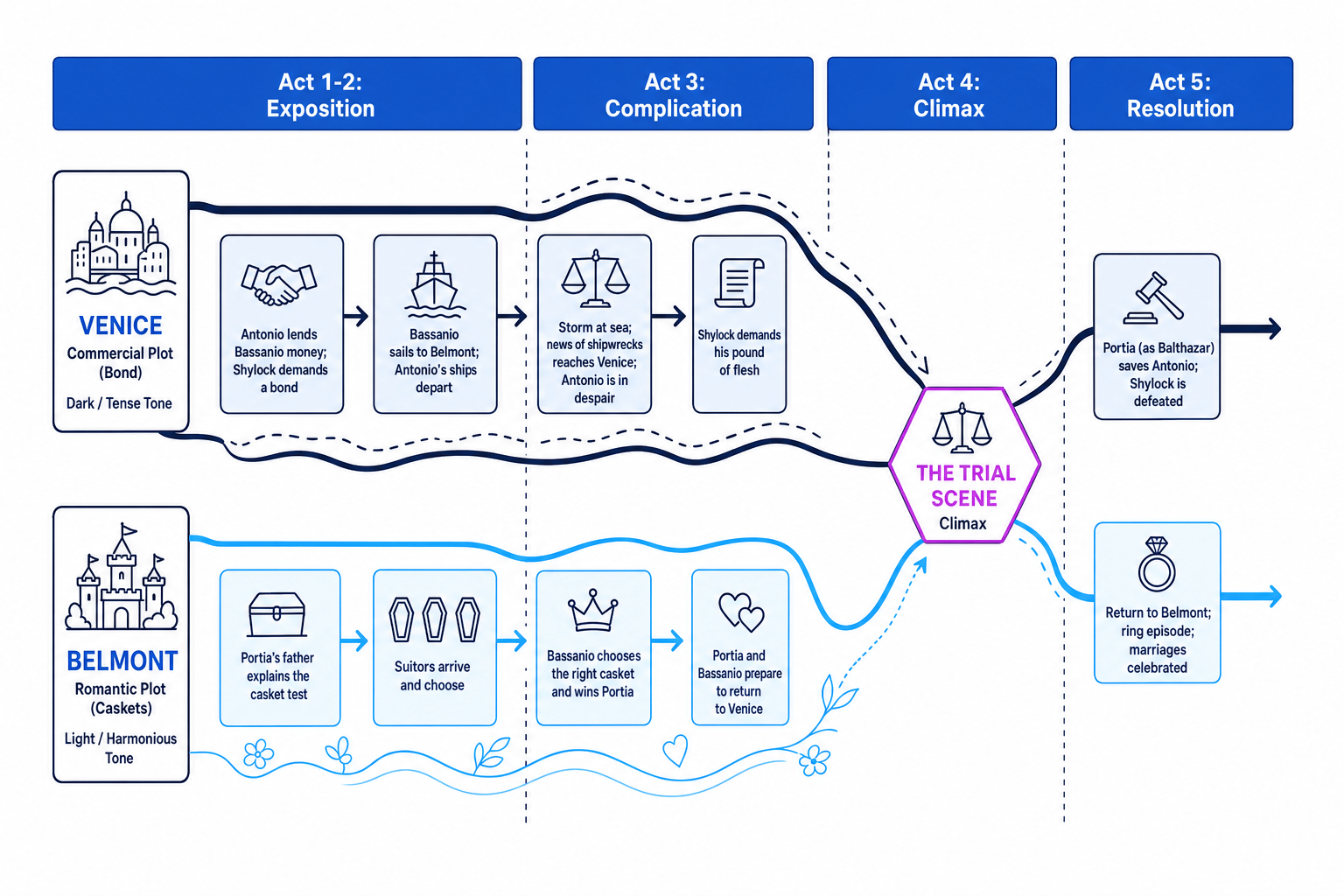
2. The Act-by-Act Breakdown
Let's trace how these two parallel plots develop, intersect, and resolve across the five acts.
Act 1: The Exposition
We are introduced to our two primary settings and the central problems of our main characters.
- In Venice: Bassanio needs money to woo the wealthy heiress Portia in Belmont. He asks his friend Antonio, a wealthy merchant. Because Antonio's money is tied up in mercantile ships at sea, they turn to the Jewish moneylender, Shylock. Shylock agrees to lend 3,0003,0003,000 ducats, but demands a "merry bond": if Antonio cannot pay it back on time, Shylock may cut "a pound of flesh" from Antonio's body.
- In Belmont: Portia laments the "lottery of my destiny" left by her late father's will. Suitors must choose between three caskets (gold, silver, and lead). If they choose correctly, they win her hand; if they fail, they must swear never to marry.
Act 2: Rising Action and Subplots
The tension rises as characters make choices that complicate the initial situations.
- The Belmont Caskets: The Prince of Morocco chooses the gold casket and fails. Later, the arrogant Prince of Arragon chooses the silver casket and also fails.
- Venetian Subplots: Shylock's daughter, Jessica, elopes with the Christian nobleman Lorenzo, stealing her father's gold and jewels. This deeply angers and humiliates Shylock, hardening his resolve against Christians. Bassanio sets sail for Belmont.
The structural function of Jessica's elopement
Jessica's elopement in Act 2 is the structural hinge that turns Shylock's professional rivalry with Antonio into a deeply personal quest for revenge. It bridges the gap between Venice and Belmont, as the eloped lovers eventually seek refuge in Belmont.
Act 3: Complication and Crisis
The two plots reach a point of crisis.
- In Venice: Rumours spread that Antonio’s ships have wrecked. Shylock, grieving his daughter and facing mockery on the streets, delivers his famous "Hath not a Jew eyes?" speech, vowing to exact his bond: "The villainy you teach me I will execute" (Act 3, Scene 1).
- In Belmont: Bassanio arrives. Guided by love rather than greed, he chooses the humble lead casket and wins Portia. They declare their love, and Bassanio's friend Gratiano reveals he will marry Portia's lady-in-waiting, Nerissa.
- The Collision: A letter arrives from Venice. Antonio has defaulted on his loan, and Shylock demands his pound of flesh. Bassanio rushes back to Venice with gold provided by Portia. Portia and Nerissa secretly plan to follow them, disguised as male lawyers.
Act 4: The Climax (The Trial Scene)
The two plotlines collide directly in a Venetian courtroom.
- Antonio is resigned to his fate. Shylock refuses double the repayment amount, demanding his legal right to the bond.
- Portia enters disguised as Balthazar, a young "doctor of the laws." She first appeals to Shylock's mercy ("The quality of mercy is not strained," Act 4, Scene 1). When Shylock refuses, Portia seemingly agrees that the law must stand.
- Just as Shylock prepares his knife, Portia points out a structural loophole in the contract: the bond allows "a pound of flesh" but not a single drop of blood. Furthermore, as an alien who has attempted to take the life of a Venetian citizen, Shylock’s property is confiscated, and his life is at the Duke's mercy.
- Antonio spares Shylock's life on two conditions: he must bequeath his estate to Jessica and Lorenzo upon his death, and he must immediately convert to Christianity. Shylock, broken, departs.
Ignoring the emotional climax
Many students treat Portia's legal victory as a purely triumphant moment. However, Shakespeare structures this climax to be deeply uncomfortable. Shylock is stripped of his religion, wealth, and identity. A top essay must acknowledge this structural ambiguity: the "comedy" of Antonio's rescue is achieved through the near-tragic destruction of Shylock.
Act 5: Resolution (The Ring Plot)
The play moves away from the dark courtrooms of Venice back to the moonlit gardens of Belmont.
- Before leaving Venice, Portia and Nerissa (still disguised as men) trick Bassanio and Gratiano into giving up the rings they swore they would never part with.
- In Act 5, the women tease their husbands about the missing rings before revealing their disguise.
- News arrives that three of Antonio’s ships have safely returned to port. The play ends with a celebration of marriages, restoring the comic harmony.
3. How to Analyze Plot Structure in Your Essays
In the exam, you must show the examiner that you understand why Shakespeare ordered the events of the play the way he did. To do this, use analytical steps that link structural choices to meaning.
Analyzing the structural shift between Acts 4 and 5
Analyze how Shakespeare structures the play to resolve the dramatic tension between the climax of the trial and the play's conclusion.
- Identify the structural transition: Note the stark shift in setting and tone from the end of Act 4 (the oppressive, legalistic courtroom of Venice) to the beginning of Act 5 (the pastoral, musical, moonlit setting of Belmont).
- Examine the dramatic method: Point to the "ring plot" as a structural device used to transition the audience from high-stakes legal tragedy to light-hearted relationship comedy.
- Formulate the analytical argument (PEEL format):
- Point: Shakespeare uses the transition from Venice to Belmont in Act 5 to re-establish the traditional comic order and release the oppressive tension of the courtroom trial.
- Evidence: Act 5 opens with Lorenzo and Jessica exchanging romantic, classical references under "the sweet wind" of a moonlit night, immediately followed by the playful argument over the rings ("What ring gave you, my lord?", Act 5, Scene 1).
- Method: The juxtaposition of settings and the introduction of a low-stakes domestic farce (the ring game).
- Effect/Link: By shifting from the high-stakes threat of physical mutilation in Venice to a playful test of marital fidelity in Belmont, Shakespeare signals to the audience that the dangerous, tragic elements of the play have been safely contained. This structural escape allows the play to close on a note of harmony and resolution, satisfying the structural requirements of a Shakespearean comedy.
The Act 5 isolation
Do not overlook Act 5. Many students write brilliant essays about Shylock and the trial scene, but completely ignore Act 5. In Shakespearean drama, the final act is vital because it establishes the "new normal." Leaving Act 5 out of your essay suggests a weak understanding of the play's complete structural arc.
In the exam
- Never recount the plot for its own sake. Only mention plot points to back up an analytical argument about character, theme, or structure.
- Explicitly use structural terminology. Terms like juxtaposition, exposition, climax, parallel plot, resolution, and comic relief will elevate your essay and secure AO2 marks.
- Link structure to context (AO3). Explain how the contrasting settings of Venice (a modern, commercial, diverse powerhouse) and Belmont (an old-world, romantic, aristocratic estate) reflect Elizabethan anxieties about money, class, and social change.
Check yourself
- Why does Shakespeare introduce Belmont in Act 1, Scene 2, immediately after introducing Venice in Act 1, Scene 1?
- How does the sudden news of Antonio's lost ships in Act 3 disrupt the romantic bliss of Bassanio's successful casket choice?
- What is the structural purpose of the "Ring Plot" in Act 5?
