The Merchant of Venice is one of Shakespeare’s most complex and controversial works. On the surface, it follows the conventions of a romantic comedy, but its dark themes of prejudice, revenge, and justice push it into the territory of a "problem play." To succeed in your AQA GCSE English Literature exam, you must understand how Shakespeare balances these opposing forces.
What you'll learn
- How Shakespeare uses the contrasting settings of Venice and Belmont to structure the play's main conflicts.
- Why the play's genre is highly contested, blending elements of romantic comedy and tragedy.
- The core ideological tensions, such as justice versus mercy and self-interest versus love.
1. The Dual Settings: Venice vs. Belmont
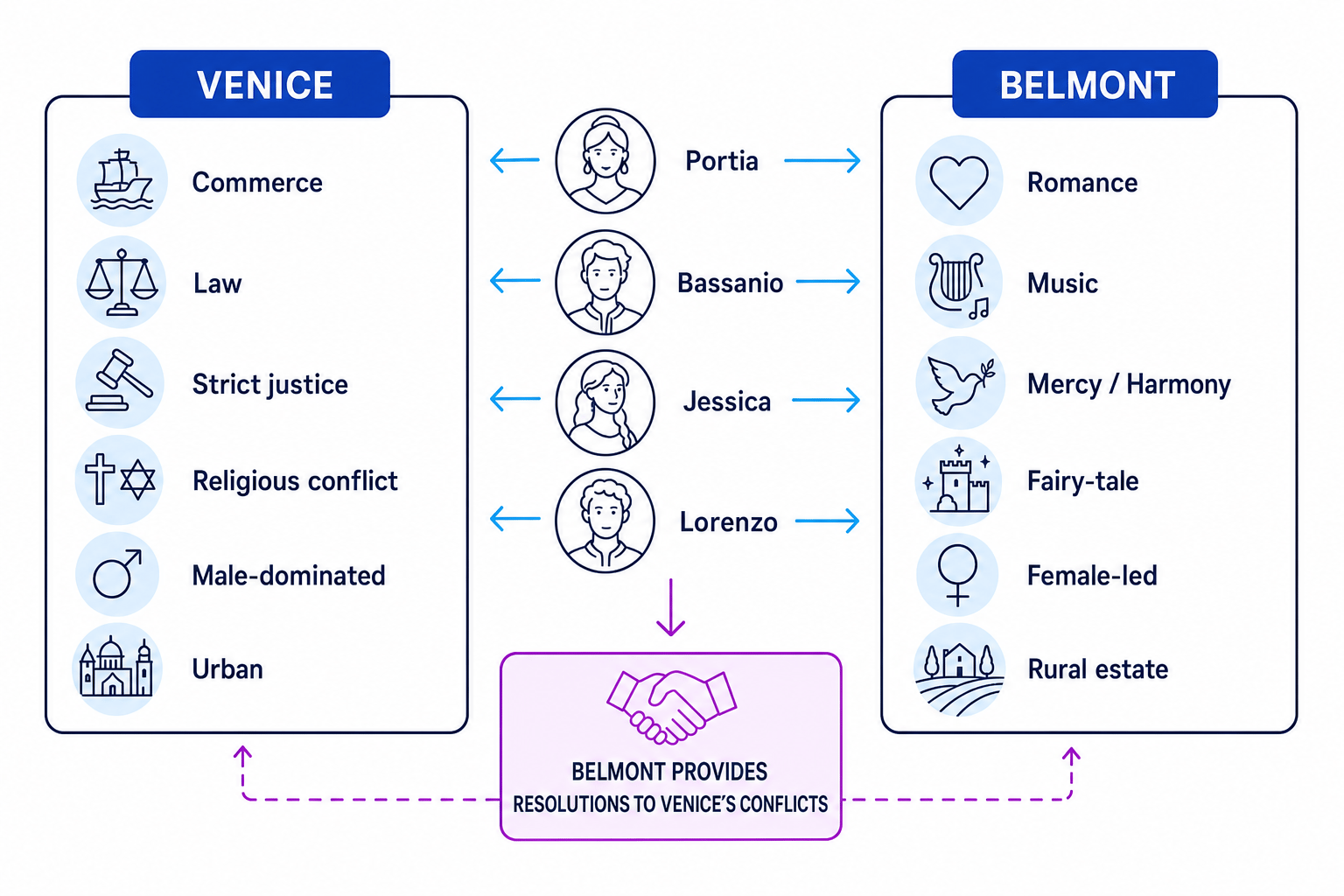
To understand the structure of the play, you must first understand its geography. Shakespeare divides the action between two distinct locations. This structural device is known as a binary opposition, where two contrasting concepts or settings are placed against each other to highlight their differences.
Binary Opposition
A binary opposition is a structural pattern in literature where two mutually exclusive or opposing terms, ideas, or settings are contrasted against one another (for example, light/darkness, order/chaos, or Venice/Belmont).
Venice: The World of Commerce and Law
In the Elizabethan imagination, Venice was a bustling, cosmopolitan trading hub. It was famous for its wealth, its strict legal system, and its diverse population. In the play, Venice represents:
- The Public Sphere: A male-dominated environment ruled by business, contracts, and hard mathematical calculation.
- Conflict: A place of deep-seated religious and racial tension, particularly between the Christian majority and the Jewish minority represented by Shylock.
- Anxiety: The play opens in Venice with Antonio declaring, "In sooth, I know not why I am so sad" (1.1). This sets an immediate tone of melancholy and financial anxiety.
Belmont: The World of Romance and Music
Belmont is Portia’s country estate. It is a fictional, idealized space that functions like a fairy tale. Belmont represents:
- The Private Sphere: A female-led household where decisions are governed by love, family legacy (the lottery of the caskets), and music.
- Harmony: A place where conflicts are resolved, relationships are solidified, and the harsh realities of Venetian law are temporarily suspended.
- Lyrical Language: The characters in Belmont speak in rich, poetic verse filled with classical allusions, contrasting with the sharp, transactional prose often used in Venetian business dealings.
The Setting Dynamic
Shakespeare uses the physical movement of characters between Venice and Belmont to drive the plot. Venice creates problems (debts, legal threats, racial hostility), while Belmont provides the clever solutions and romantic resolutions.
2. The Genre Puzzle: Comedy, Tragedy, or Problem Play?
When you study The Merchant of Venice, you will quickly notice that it does not fit neatly into a single category. Under the AQA specification, analyzing how Shakespeare manipulates dramatic form is highly rewarded.
Tragicomedy
A tragicomedy is a play that blends the elements of both tragedy and comedy. It typically features serious, potentially tragic developments that are ultimately resolved happily for the main characters.
The Comedic Arc
For the Christian characters, the play functions as a traditional Elizabethan comedy. It contains:
- The Obstacle to Love: Portia is bound by her dead father’s casket test, and Bassanio lacks the funds to court her.
- Disguise and Cross-Dressing: Portia and Nerissa disguise themselves as young male lawyers (Balthazar and Stephano) to enter the courtroom.
- The Happy Ending: Act 5 takes place entirely in Belmont, featuring romantic reunions, playful banter about rings, and the restoration of wealth.
The Tragic Arc
For Shylock, the play resembles a tragedy.
- He is subjected to systematic abuse, loses his daughter Jessica, loses his wealth, and is ultimately forced to convert to Christianity—destroying his religious and cultural identity.
- Shylock’s famous monologue, "Hath not a Jew eyes?" (3.1), humanizes him in a way that disrupts the lighthearted tone of a traditional comedy, forcing the audience to confront the devastating human cost of prejudice.
Ignoring the Elizabethan Perspective
Do not write about Shylock only as a modern tragic hero. While modern audiences often view Shylock with deep sympathy, an Elizabethan audience, shaped by widespread anti-Semitism, would likely have viewed him as a comic villain (the "covetous usurer") whose defeat was a cause for celebration. To gain top marks for context, you must discuss how these shifting interpretations affect our reading of the play.
3. Core Ideological Tensions
The dramatic energy of the play comes from several central debates that Shakespeare leaves unresolved.
Justice vs. Mercy
This is the central moral debate of the play, reaching its climax in the Act 4 courtroom scene.
- Shylock demands strict justice according to the letter of the law: "I stand here for law" (4.1). He insists on his "pound of flesh" as written in his legal contract with Antonio.
- Portia (disguised as Balthazar) argues for the superiority of mercy: "The quality of mercy is not strained; / It droppeth as the gentle rain from heaven" (4.1).
- The Irony: The Christian characters who preach mercy show very little of it to Shylock once they win the legal battle, highlighting the hypocrisy within Venetian society.
Usury vs. Venture Capitalism
The conflict between Antonio and Shylock is not just religious; it is deeply economic.
Usury
Usury is the practice of lending money at interest. In Elizabethan England, this was historically condemned by the Christian Church as sinful, but was a standard practice in Jewish communities where other professions were legally barred.
- Antonio practices "venture capitalism"—risking his capital on overseas trade ships. He lends money out of friendship without charging interest.
- Shylock defends interest-bearing loans as a legitimate business practice, comparing his thrift to the biblical story of Jacob's sheep. This economic clash fuels their mutual hatred.
Worked Example
Formulating a balanced thesis statement on the contrast of settings
A typical exam question might ask you to explore how Shakespeare presents the contrast between Venice and Belmont. Follow these steps to draft an introduction that integrates structure, context, and a clear argument.
-
Address the physical and symbolic function of both settings: Begin by defining what each setting represents on an ideological level, rather than just stating where they are located.
Drafting: Shakespeare constructs a stark structural division between the commercial, male-dominated world of Venice and the romantic, female-led oasis of Belmont.
-
Introduce the tension or conflict between these worlds: Show how these settings interact. Belmont cannot exist without Venice’s money, and Venice cannot survive its legal crises without Belmont’s wit.
Drafting: While Venice is driven by rigid law, mercantilism, and religious hostility, Belmont operates as a fairy-tale realm of music, harmony, and mercy. However, Shakespeare reveals that these worlds are deeply codependent; the romantic luxury of Belmont is financed by the stressful, high-stakes commerce of Venice.
-
Conclude with a thesis statement linking setting to the play's overall genre/meaning: Summarize how this contrast helps the audience understand the play's deeper moral complexities.
Drafting: Ultimately, by shifting the action between these binary spaces, Shakespeare highlights the tension between public duty and private desire, suggesting that the harmony of Belmont is built upon the systemic exclusion and exploitation found in Venice.
In the exam
- Focus on SPaG (AO4): Remember that the Shakespeare question is the only literature essay where you are awarded up to 4 extra marks for Spelling, Punctuation, and Grammar. Leave 2 minutes at the end to check your capital letters for character names (Shylock, Portia, Antonio) and your use of apostrophes.
- Track Structural Shifts: Don't just analyze individual words. Look at the larger picture. If you get an extract from Venice, contrast it in your essay with how things are handled in Belmont to demonstrate your understanding of the play's overall structure.
- Embed Short Quotations: Avoid long, block quotes. Instead, weave single words or short phrases directly into your sentences (e.g., Antonio is trapped by his "sadness" while Shylock demands his "bond"). This keeps your writing analytical and fast-paced.
- Link Language to Context (AO3): If you are discussing Shylock’s demands for justice, link it to the Elizabethan tension between the Old Testament (associated with law and retribution) and the New Testament (associated with grace and mercy).
Check yourself
- Can you explain why The Merchant of Venice is often classified as a "problem play" rather than a simple comedy?
- What are three key differences between the settings of Venice and Belmont?
- How does the concept of "usury" drive the personal conflict between Antonio and Shylock?
