Understanding the plot of A Taste of Honey is about more than just memorising what happens. You need to understand how Shelagh Delaney structures the action to explore themes of class, gender, race, and family in 1950s working-class Manchester.
What you'll learn:
- The chronological sequence of events across Act 1 and Act 2
- Key structural turning points, including complications, climaxes, and the cyclical ending
- How to link specific plot movements to Delaney's broader social commentary
The Genre: Kitchen Sink Realism
Before diving into the scene-by-scene action, it is important to understand the theatrical tradition in which Delaney was writing.
Kitchen Sink Realism
Kitchen Sink Realism is a cultural movement that developed in the late 1950s in Britain. It features working-class protagonists living in harsh, realistic environments (often industrial northern towns) and addresses taboo social issues such as poverty, premarital sex, homosexuality, and interracial relationships.
Unlike traditional 1950s drawing-room dramas that focused on wealthy middle-class families in pristine living rooms, A Taste of Honey opens in a "comfortless flat" with damp walls and a shared bathroom. The plot is driven not by grand, melodramatic events, but by the everyday struggles of survival, abandonment, and the search for love.
Act 1: Abandonment and Escape
Act 1 establishes the central characters, their volatile relationship, and their separate attempts to escape their bleak reality.
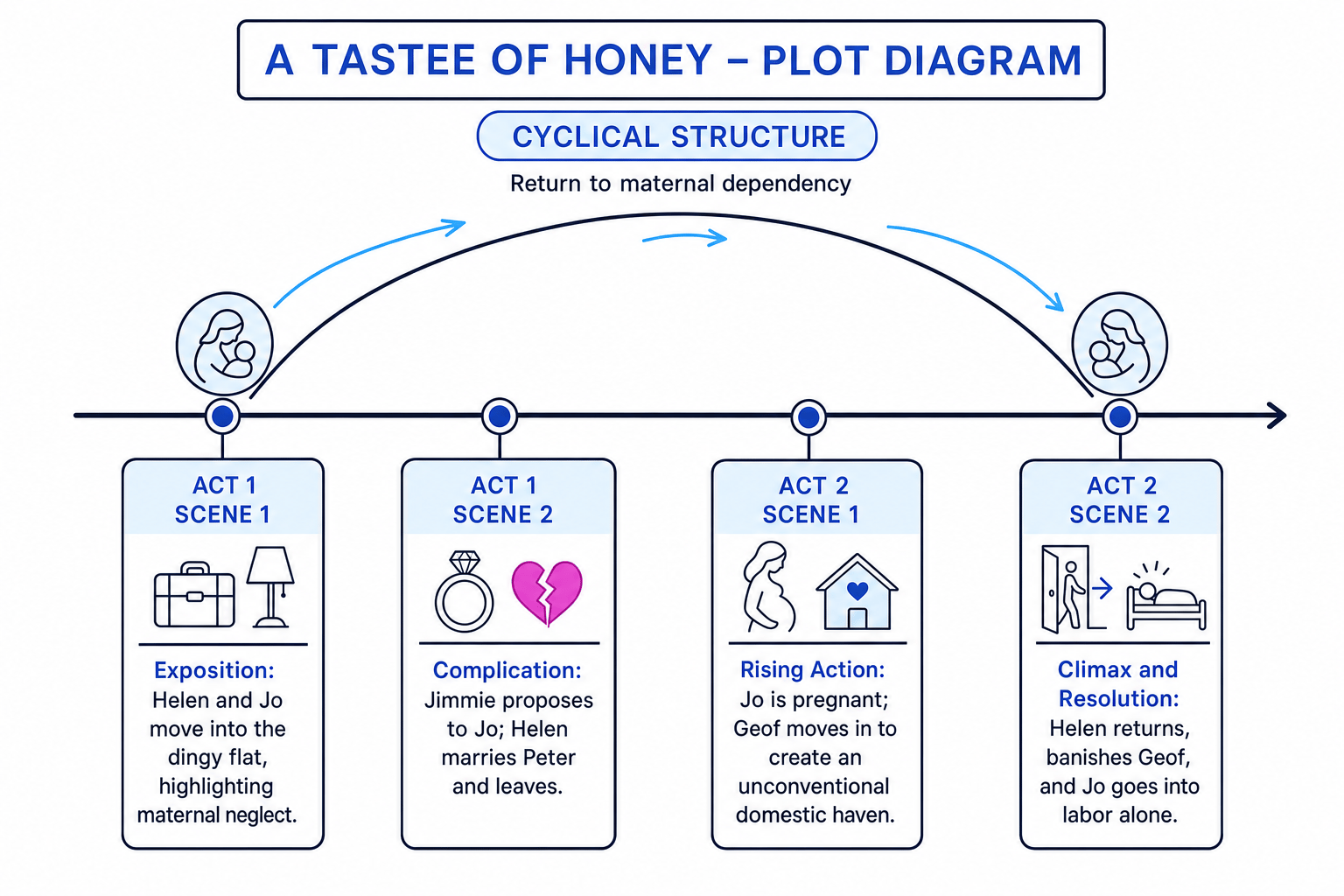
Act 1, Scene 1: The Exposition of Neglect
The play opens in media res (in the middle of things) as Helen, a "semi-demi-monde" mother, and her teenage daughter, Jo, move into a dingy, drafty flat in Manchester. From the outset, their relationship is characterized by bickering, role-reversal, and mutual dependency.
Helen is self-absorbed and constantly looking for her next male benefactor, while Jo is cynical, artistic, and deeply resentful of her mother’s lifestyle. We learn about their poverty, Helen's heavy drinking, and Jo's schoolgirl status. The scene ends with the arrival of Peter, a wealthy, younger car salesman with one eye who has been pursuing Helen. Peter represents Helen’s escape route from poverty, but his arrival immediately displaces Jo.
Act 1, Scene 2: The Parallel Escapes
Some time has passed. Jo has begun a secret romantic relationship with Jimmie, a Black sailor in the Royal Navy. Jimmie offers Jo a "taste of honey"—a fleeting moment of genuine affection, romance, and escape. He proposes to her with a toy ring, which she wears on a ribbon around her neck. He promises to return to marry her in six months.
Meanwhile, Helen prepares to marry Peter. Despite Jo's pleas and obvious vulnerability, Helen chooses financial security and social status over her maternal duties. The act ends with Helen departing for her new life with Peter, leaving the teenage Jo completely alone in the flat to fend for herself.
The 'Taste of Honey' Motif
The play's title comes from the brief, fleeting moments of happiness the characters experience. Jo's romance with Jimmie and her later domestic peace with Geof are not permanent solutions to her poverty, but temporary "tastes" of sweetness in an otherwise bitter life.
Act 2: Unconventional Domesticity and the Cycle Returns
Act 2 shifts the focus to Jo’s attempts to build an alternative family unit, only for the outside world and her mother to dismantle it.
Act 2, Scene 1: The Safe Haven
Several months later, Jo is heavily pregnant with Jimmie’s baby (Jimmie has gone back to sea and has not returned). She has befriended Geof, a young, homosexual art student who has been evicted from his lodgings. Geof moves in with Jo, acting as a surrogate father, housekeeper, and maternal carer.
Deuteragonist
The deuteragonist is the second most important character in a drama, often acting as a foil or close companion to the protagonist. In Act 2, Geof takes on this role, offering emotional and practical support to Jo.
Together, Jo and Geof establish a highly functional, non-traditional domestic partnership. Geof buys a cot, cleans the flat, and prepares Jo for motherhood, subverting the traditional heterosexual family structure of the 1950s. They find comfort in each other’s company, free from the harsh judgments of society.
Act 2, Scene 2: The Intrusion and Cyclical Ending
The fragile peace is shattered when Helen returns. Her marriage to Peter has collapsed because of his heavy drinking and infidelity, and she has been thrown out. With nowhere else to go, Helen barges back into the flat, immediately reasserting her dominance.
Helen treats Geof with homophobia and hostility, eventually driving him out of the flat. She takes over the role of carer, but her care is erratic, loud, and self-serving. When Helen discovers that Jo’s baby will be mixed-race, she reacts with shock and disgust, briefly leaving the flat to get a drink.
The play ends on a poignant, cyclical note. Jo is left alone in the flat, experiencing the first pains of labor, comfortless once again, humming a song Geof taught her.
Confusing the Climax
Do not mistake Helen’s return as a happy resolution. Although she returns to care for Jo, her presence destroys the genuine, supportive community Geof created. The climax is tragic because it reinforces the cycle of maternal neglect; Jo is left in labor, abandoned by Geof, with only her unreliable mother to rely on.
Narrative and Structural Arc
Delaney structures the play to highlight the inescapable nature of working-class poverty and social marginalisation. The narrative is circular, meaning the characters end up almost exactly where they began.
The Role of Music and Dance
Delaney uses music (such as Jo humming or playing the cornet) and stylized dance breaks between scenes. This is a technique influenced by Bertolt Brecht’s Epic Theatre, designed to remind the audience they are watching a play and to prevent them from becoming too sentimentally involved, forcing them instead to think critically about the social issues presented.
Analysing Structural Shifts in Act 2, Scene 1
To score highly in your GCSE exam (specifically for AO2), you must be able to analyse how Delaney structures her scenes to convey meaning. Let's look at a practical example of how to break down a key structural shift.
Analysing a structural shift in Act 2, Scene 1
Analyze how Delaney uses structure in Act 2, Scene 1 to present the relationship between Jo and Geof.
-
Identify the structural context and shift: At the start of Act 2, Scene 1, Delaney shifts the action from the chaotic, hostile environment of Act 1 to a calm, domestic space. We transition from Helen’s abandonment of Jo to Geof’s voluntary integration into Jo's life.
-
Select and analyse textual evidence of this domestic shift: When the scene opens, Geof is actively tidying and making the flat comfortable. Jo observes, "You’re just like a big sister to me." Delaney uses this dialogue to instantly establish a non-threatening, subverted domestic dynamic. By comparing a male companion to a "big sister," Delaney highlights how Geof fills the maternal void left by Helen, replacing traditional gender roles with fluid, empathetic support.
-
Link the structural shift to context and writer's intent: By structuring the middle of the play around Jo and Geof’s domestic harmony, Delaney presents a brief utopia. She demonstrates to a 1950s audience that an unwed, pregnant teenage girl and a marginalized gay man can form a more loving, stable home than a traditional nuclear family or a biological mother. This heightens the tragedy of the play's climax, when Helen returns to dismantle this safe space.
In the exam
- Track the structure, not just the plot: When writing your essay, structure your response chronologically or highly logically. Explain how a character or theme develops across the play (e.g., "In Act 1, Jo is... however, by Act 2, she has...").
- Avoid plot retelling: Never just write a summary of what happens. Every plot point you mention must be tied directly to a writer's method (e.g., characterisation, setting, structural parallelism) and its effect on the audience.
- Focus on the beginning and the end: Examiners love analyses of the play’s cyclical structure. Compare the opening of Act 1, Scene 1 (moving into a cold, empty flat) with the ending of Act 2, Scene 2 (Jo left alone in that same flat). This demonstrates a sophisticated understanding of form.
Check yourself
- Why is the relationship between Jo and Jimmie structurally important for Act 2?
- How does Geof's arrival in Act 2, Scene 1 structurally contrast with Peter's arrival in Act 1, Scene 1?
- What is the significance of the cyclical ending of the play?
