Welcome to your study guide for Shelagh Delaney’s landmark 1958 play, A Taste of Honey. Written when Delaney was just 19 years old, this text disrupted the polite, middle-class conventions of British theatre. It brought the raw reality of working-class northern life directly onto the stage, addressing issues that were highly taboo at the time.
This overview will equip you with a high-level map of the play’s background, its radical structural techniques, and the central themes that the AQA examiners want you to explore.
What you'll learn:
- How Shelagh Delaney challenged postwar British theatrical conventions through the genre of Kitchen Sink Realism.
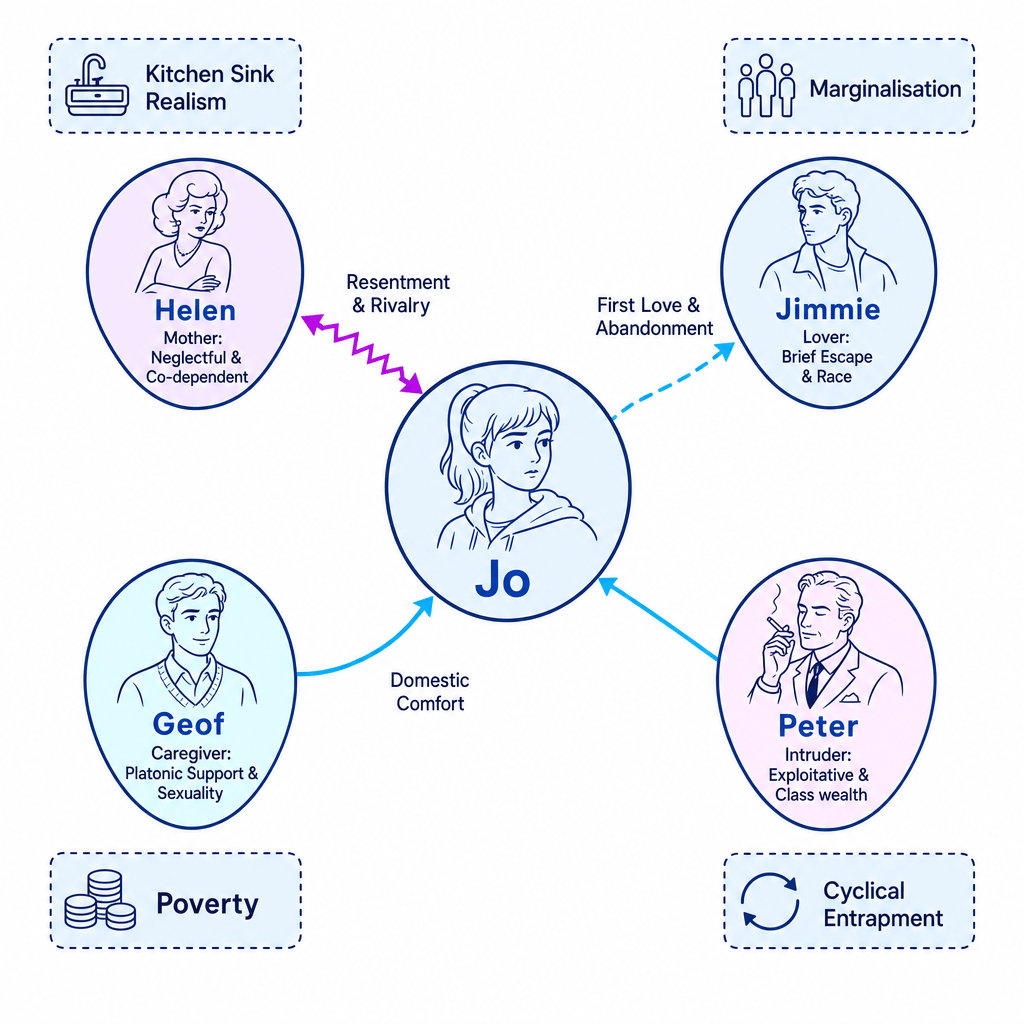
- The complex, co-dependent relationship dynamics between Jo, Helen, Geof, Jimmie, and Peter.
- How to connect the play’s gritty Salford setting to broader social contexts of class, race, gender, and sexuality in the 1950s.
Introduction to the Play
Set in the industrial town of Salford, Lancashire (now part of Greater Manchester) in the late 1950s, A Taste of Honey follows the turbulent life of seventeen-year-old Jo and her neglectful, alcoholic mother, Helen. When Helen abandons Jo to marry her younger, wealthier lover, Peter, Jo begins a brief, passionate romance with a Black sailor named Jimmie.
After Jimmie returns to sea, leaving Jo pregnant, she forms a domestic partnership with Geof, a young, homosexual art student who steps in as a caregiver. The play is a funny, tender, and often harsh examination of survival on the margins of society.
Kitchen Sink Realism
Kitchen Sink Realism is a British cultural movement of the late 1950s and 1960s. It features working-class protagonists living in cramped, industrial environments, dealing with real-world issues like poverty, abortion, and single parenthood, using colloquial, everyday dialogue.
Before Delaney's play, British theatre was dominated by polite, upper-middle-class drawing-room dramas. A Taste of Honey shattered this mold by giving a voice to characters who had been completely invisible on stage.
A Radical Act of Representation
At a time when male writers (known as the "Angry Young Men") dominated the theatre, Delaney offered an "Angry Young Woman's" perspective. She put working-class women, a gay man, and an interracial relationship at the dead-center of her narrative—decades before these topics were widely accepted in public discourse.
Character Relationships and the Plot Dynamic
To write a high-scoring GCSE essay, you must understand that Delaney does not write traditional "villains" or "heroes." Instead, her characters are deeply flawed human beings doing whatever they must to survive.
The diagram below maps out how these characters connect and how their struggles relate to the play’s overarching themes:
The Central Duet: Jo and Helen
The play's emotional core is the co-dependent, cyclical relationship between mother and daughter. Helen is self-absorbed and relies on men for financial security. Jo, while desperate to escape her mother's fate, frequently mimics Helen's defensive wit and cynical outlook. They wound each other constantly, yet they are tethered by a shared vulnerability and a lack of alternative options in a society that offers no safety net for single women.
Form and Style: The Influence of Joan Littlewood
While the play belongs to the Kitchen Sink Realism movement, its theatrical style is highly unique. This is largely due to its production history. Delaney’s script was brought to life by director Joan Littlewood at the Theatre Workshop in London.
Littlewood used techniques inspired by Bertolt Brecht’s "Epic Theatre" to keep the audience critically engaged, rather than just passively watching a sad story.
Epic Theatre & Verfremdungseffekt
Epic Theatre is a theatrical style designed to make the audience think intellectually about social issues, rather than just feeling empathy. It uses a Verfremdungseffekt (estrangement or alienation effect) to remind the audience they are watching a play, preventing them from escaping into a fantasy world.
In A Taste of Honey, this style manifests through:
- Direct Address / Breaking the Fourth Wall: Characters (especially Helen and Jo) regularly turn and speak directly to the audience, making us co-conspirators in their lives.
- On-stage Jazz Band: A live band was used to play musical cues, introducing characters and punctuating dramatic moments. This gave the play a vaudeville or music-hall energy.
- Dance-like Movement: Characters often dance or move rhythmically across the stage to express feelings of escape or joy that words cannot capture.
Analyzing a Key Structural Shift
To achieve a Grade 7 or above, you must demonstrate how Delaney uses language, form, and context (AO2 and AO3) together to create meaning. You cannot just list literary devices; you must analyze how they work in a specific moment of the play.
Let's look at how to construct a paragraph analyzing the dramatic opening of Act 1, Scene 1, where Jo and Helen first enter their dismal new "comfortless" flat.
Analyzing Jo and Helen's Opening Dynamic
Analyze how Delaney uses setting and dialogue in the opening scene of Act 1 to establish the theme of domestic entrapment.
- Select a precise quotation that links character to the setting. Identify Jo's description of the flat's view: "It’s a dirty city... This place is a tomb."
- Identify the literary methods at play. Delaney uses a physical setting (the cramped, filthy flat in Salford) as a symbolic extension of the characters' internal states. The metaphor "This place is a tomb" foreshadows the cycle of poverty and hopelessness that traps both mother and daughter.
- Integrate the historical and social context (AO3). Connect this setting to the reality of the post-war industrial North of England. In the late 1950s, cities like Salford suffered from severe industrial pollution and a housing crisis, leaving working-class families stuck in substandard, rented tenements with communal toilets.
- Analyze the dramatic effect and the writer's intent. Explain how this immediate sense of claustrophobia establishes the play's genre. By starting in media res with characters dragging heavy suitcases into a grim space, Delaney immediately establishes the nomadic, unstable nature of Jo and Helen's lives. The bickering dialogue shows their defense mechanism: humor and sarcasm are used to mask the despair of their immediate physical entrapment.
Pitfalls to Avoid in your Overview Essay
As you begin your study of A Taste of Honey, keep these common exam traps in mind.
Treating Helen as a Pure Villain
Many students write essays claiming Helen is simply an "evil" or "bad" mother. This is too simplistic. Helen is a product of her environment. In 1950s Britain, a single, working-class mother had no welfare state or social respectability to fall back on. Her reliance on men like Peter is a desperate survival strategy, not just greed.
Keep Quotes Short and Dynamic
Because the exam is closed-book, do not try to memorize long monologues. Instead, memorize short, punchy, "loaded" phrases that you can easily weave into your sentences (e.g., "a taste of honey", "dirty city", "I'm not frightened of the darkness").
Do Not Ignore the Comedy
Despite the grim subject matter, A Taste of Honey is incredibly funny. It is a comedy-drama. If you write your essays with a purely tragic, depressing tone, you are missing Delaney's use of music-hall wit and "gallows humor" as a coping mechanism for the working class.
Summary & Next Steps
Now that you have a firm grasp of the play's overview, you are ready to dive deeper into the specific characters, themes, and scenes that make A Taste of Honey such a powerful piece of literature.
In the exam
- Always balance text and context: Never talk about Jimmie or Geof without explaining how 1950s societal attitudes toward race and homosexuality shape their vulnerability.
- Focus on the stagecraft: Remember that this is a play, not a novel. Comment on stage directions, props (like the lightbulb, the childhood drawings, or the crib), and the presence of the live jazz band.
- Address the ending's ambiguity: The play does not end with a neat resolution. Highlight how the cyclical structure (Helen returning, Geof being pushed out) emphasizes the inescapability of working-class struggle.
Check yourself
- Why did Shelagh Delaney's play shock the middle-class audiences of London's West End in 1958?
- What are two key features of "Kitchen Sink Realism" that are visible in the opening scene of the play?
- How does the influence of Joan Littlewood's "Epic Theatre" show up in the way the characters interact with the audience?
