What you'll learn
- How to turn a Merchant of Venice question into a clear argument.
- How to build analytical paragraphs that cover the extract and the wider play.
- How to use quotations, methods and context without sounding “bolted on”.
- How to study model essays without memorising them word-for-word.
What a model essay is actually for
A model essay is not a script to copy in the exam. The question you get will probably be worded differently, and the extract will be chosen by AQA. Instead, use model essays to learn habits: how to shape an argument, how to analyse short quotations, and how to link Shakespeare’s methods to big ideas such as justice, mercy, prejudice, love, money and power.
Model essay
A model essay is a strong sample answer that shows you how to structure an argument, select evidence, analyse Shakespeare’s methods and connect ideas to relevant context.
In The Merchant of Venice, the best essays usually explore tensions rather than giving one simple view. For example, Shylock can be presented as both a victim of Christian prejudice and a threatening revenger; Portia can be intelligent and powerful, but also limited by patriarchal rules; Venice can seem civilised, yet its justice is harsh and unequal.
Think in tensions
A high-level essay often argues that Shakespeare presents an idea as complicated: not simply “Shylock is evil” or “Portia is good”, but “Shakespeare makes the audience judge both the cruelty Shylock suffers and the cruelty he later chooses.”
The basic shape of a Shakespeare essay
In AQA Paper 1, the Shakespeare question gives you an extract and asks you to explore a character, theme or idea in that extract and in the play as a whole. Because the exam is closed book, you should memorise short, accurate quotations that can be adapted to several questions.
This diagram shows the basic movement of a strong answer: question focus, thesis, analytical paragraphs, and conclusion.
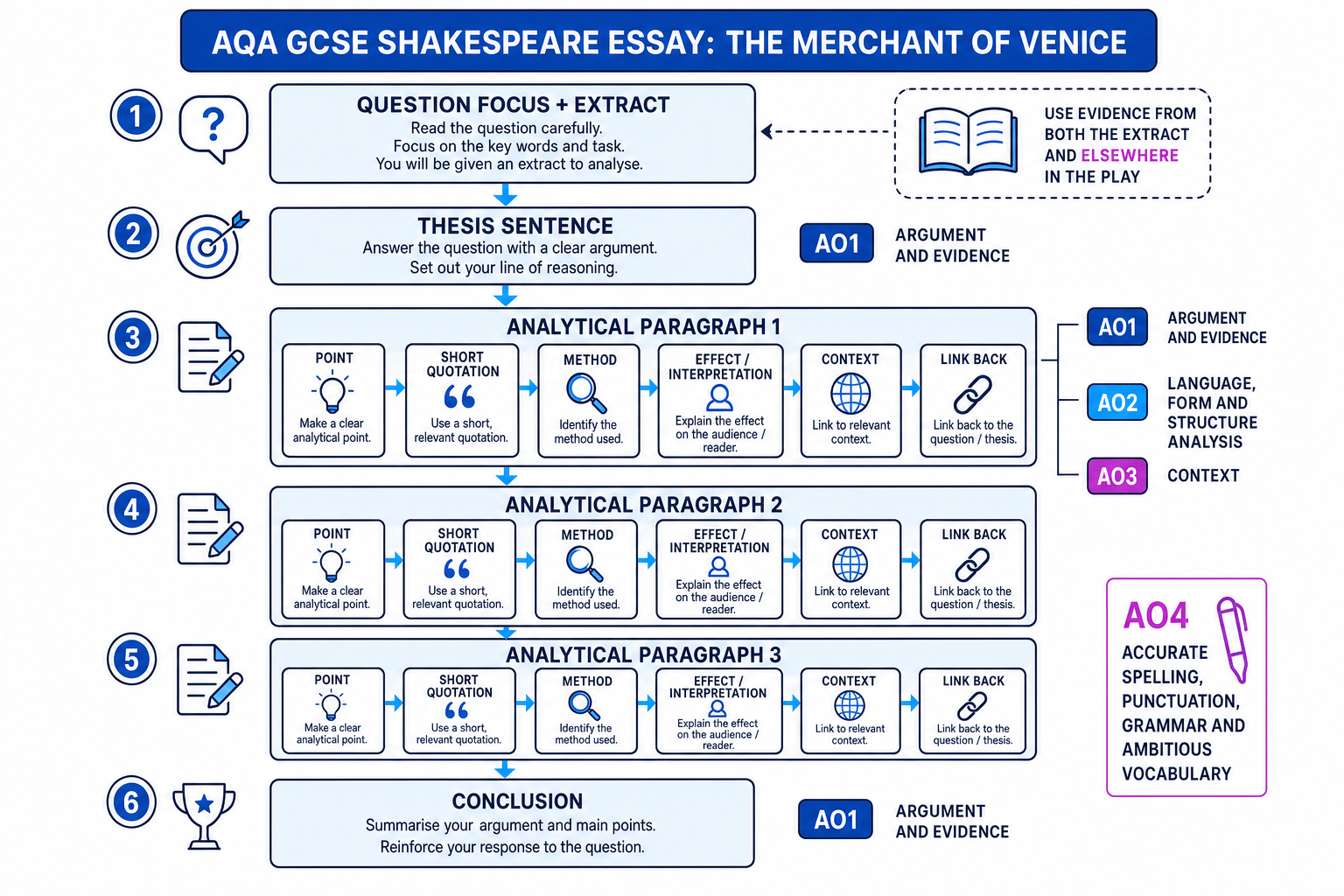
Thesis
A thesis is your main argument: a clear overall answer to the question that your whole essay will prove.
Analytical paragraph
An analytical paragraph is a paragraph that makes a point, supports it with evidence, analyses Shakespeare’s methods, explains effects and links back to the question.
From question to thesis
Before writing, decide what the question is really asking. Most Merchant of Venice questions focus on a character or theme, but the best answers go further by asking: what is Shakespeare suggesting, challenging or exposing?
For example, a question might ask:
Starting with this extract, explore how Shakespeare presents mercy in The Merchant of Venice.
A basic answer might say: “Shakespeare presents mercy as important.” That is true, but too general. A stronger answer identifies a tension: mercy is praised as a Christian ideal, yet the Christians do not always show it generously.
Turning a question about mercy into a thesis
-
Identify the key idea in the question: mercy means compassion, forgiveness and choosing not to punish someone as harshly as the law allows.
-
Find the tension in the play: Portia praises mercy in “The quality of mercy is not strain’d”, but the trial scene ends with Shylock being stripped of wealth, religion and dignity.
-
Choose evidence from both the extract and wider play: the trial scene can be linked to Shylock’s earlier complaint, “You call me misbeliever, cut-throat dog”, because his desire for revenge grows from repeated humiliation.
-
Write a thesis that makes an argument: Shakespeare presents mercy as a noble Christian ideal, but he also exposes the hypocrisy of a society that praises mercy while denying it to Shylock.
Use a balanced thesis
Try using phrases like “at first”, “however”, “yet”, “Shakespeare complicates this by…”. These help you create an argument that develops rather than repeats.
Building a high-quality paragraph
A strong paragraph does not just “spot a technique”. It explains how Shakespeare’s choices shape the audience’s response.
Method
A method is a deliberate choice made by the writer. In Shakespeare, this could be language, imagery, metaphor, dramatic irony, stage action, structure, soliloquy, verse, prose or contrast between characters.
A useful paragraph pattern is:
- Point — answer the question directly.
- Evidence — use a short quotation or precise reference.
- Method — name the writer’s choice.
- Effect — explain what the audience understands or feels.
- Context — connect to relevant beliefs or attitudes.
- Link — return to the question.
Building a paragraph on Shylock as a victim
-
Make a point that responds to the question: Shakespeare presents Shylock as a victim of public abuse, not simply as a villain.
-
Select a short quotation: in Act 1 Scene 3, Shylock reminds Antonio, “You call me misbeliever, cut-throat dog”.
-
Analyse the method: the aggressive nouns “misbeliever” and “dog” create a semantic field of religious hatred and dehumanisation.
-
Explain the effect: the audience is encouraged to understand Shylock’s bitterness as a response to repeated humiliation, even if they do not approve of his revenge.
-
Add relevant context: in Shakespeare’s England, antisemitic stereotypes were common, and Jewish people had been officially expelled from England since 1290, so many audience members would have inherited hostile ideas about Jewish identity.
-
Shape it into a model paragraph: Shakespeare presents Shylock as a victim of Christian prejudice by showing how routinely he is insulted. In Act 1 Scene 3, Shylock tells Antonio, “You call me misbeliever, cut-throat dog”. The nouns “misbeliever” and “dog” create a semantic field of religious hatred and dehumanisation, suggesting that Shylock is treated as morally inferior and almost less than human. This makes his anger more understandable, because Shakespeare shows that his desire for revenge grows out of years of abuse. For a contemporary audience influenced by antisemitic stereotypes, this moment might confirm suspicion of Shylock, but a modern audience is more likely to notice the cruelty of the Christian society around him. Therefore, Shakespeare complicates Shylock’s role: he is dangerous, but he is also damaged by prejudice.
Technique spotting
Do not write: “This is a metaphor, which makes the reader interested.” Always explain what the method suggests about the character, theme or conflict.
Using context without letting it take over
Context
Context means the historical, social, religious or literary circumstances that shape how the text was written and received.
For The Merchant of Venice, useful context often includes: Christian ideas about mercy, Elizabethan antisemitism, patriarchal control of women, the importance of wealth and trade in Venice, and the power of law. But context should support your interpretation, not replace analysis.
A weak context sentence sounds like this:
In Elizabethan times, people were antisemitic.
A stronger sentence links context to Shakespeare’s presentation:
Shakespeare draws on Elizabethan antisemitism through the stereotype of the Jewish moneylender, but he also unsettles that prejudice by giving Shylock the humanising speech “Hath not a Jew eyes?”
Bolted-on context
Avoid dropping in context as a separate history fact. Link it to a quotation and explain how it changes the audience’s understanding of Shakespeare’s presentation.
A short model response to study
Here is a compact model response for a common type of question:
How does Shakespeare present Shylock as both a victim and a villain?
Shakespeare presents Shylock as a morally complicated figure: he is victimised by Christian prejudice, but he also becomes villainous when he chooses revenge over mercy. By making Shylock both wounded and threatening, Shakespeare forces the audience to question the justice of Venice itself.
At first, Shakespeare presents Shylock as a victim of repeated abuse. In Act 1 Scene 3, Shylock reminds Antonio, “You call me misbeliever, cut-throat dog”. The harsh nouns “misbeliever” and “dog” reveal that Antonio’s hatred is both religious and personal. Shakespeare’s animal imagery dehumanises Shylock, suggesting that Venetian Christians treat him as less than human. This helps the audience understand why Shylock is bitter, especially when he later asks, “Hath not a Jew eyes?” The rhetorical question challenges the audience to recognise his shared humanity. Although many Elizabethan spectators would have inherited antisemitic assumptions, Shakespeare gives Shylock language that exposes the cruelty of those assumptions.
However, Shakespeare also presents Shylock as villainous when his suffering turns into revenge. In Act 3 Scene 1, Shylock declares, “The villainy you teach me, I will execute”. The verb “execute” sounds cold and legalistic, linking Shylock’s revenge to death and punishment. Shakespeare structures Shylock’s argument so that he blames the Christians for teaching him cruelty, but this does not fully excuse his choice to demand “a pound of flesh”. The grotesque image of flesh makes his revenge seem physically brutal, not merely financial. As a result, the audience may pity Shylock’s suffering while fearing what he becomes.
By the trial scene, Shakespeare makes this conflict even sharper. Shylock insists, “I crave the law”, showing his faith in the strict justice of Venice. Yet when Portia asks him to show mercy, he refuses, which makes him appear merciless. Ironically, the Christians then punish him harshly, forcing him to convert and taking much of his wealth. His defeated line, “I am content”, is painfully brief, suggesting exhaustion rather than true acceptance. Therefore, Shakespeare presents Shylock as both victim and villain, but the play also questions whether a society built on prejudice can honestly claim to be merciful.
How to learn from the model
Do not memorise the whole response. Instead, steal the moves:
- It starts with a clear argument.
- It uses short quotations accurately.
- It analyses individual words, such as “dog”, “execute” and “law”.
- It includes context only when it helps the interpretation.
- It keeps linking back to the question’s wording: victim and villain.
Memorise flexible quote clusters
For Shylock, learn a small cluster that can fit many questions: “cut-throat dog”, “Hath not a Jew eyes?”, “The villainy you teach me”, “I crave the law”, “I am content”. These can support essays on prejudice, revenge, justice, mercy and power.
Writing conclusions
A conclusion should not repeat every paragraph. It should give a final judgement about Shakespeare’s presentation.
A weak conclusion says:
In conclusion, Shakespeare presents Shylock as a victim and a villain.
A stronger conclusion says:
Ultimately, Shakespeare presents Shylock as both victim and villain to expose the moral contradictions of Venice: the Christians condemn his cruelty, yet their own treatment of him often seems equally merciless.
That final version is better because it returns to the big idea of the play, not just the character.
In the exam
-
Spend a few minutes planning a thesis and three paragraph ideas before you start writing.
-
Use the extract early, then move confidently to the wider play with short remembered quotations.
-
Analyse Shakespeare’s methods and meanings together: do not name techniques unless you explain their effect.
-
Keep context precise and relevant; one sharp contextual link is better than a long history paragraph.
-
Leave time to check expression, spelling, punctuation and vocabulary, because AO4 is assessed on the Shakespeare answer.
Check yourself
-
Can you write a thesis that presents Shylock, Portia or mercy as complicated rather than simple?
-
Can you analyse one word from a quotation, instead of explaining only the general meaning?
-
Can you link a contextual idea directly to Shakespeare’s presentation, rather than adding it separately?
