Writing a top-tier essay on Shelagh Delaney’s A Taste of Honey requires more than just memorising plot points or listing dramatic devices. To secure the highest marks in your GCSE English Literature exam, you must treat the play as a conscious piece of art and the characters as deliberate constructs designed to challenge 1950s social norms.
This guide will show you how to synthesize textual analysis, dramatic form, and historical context into a cohesive, fluid, and persuasive argument.
What you'll learn
- How to structure a high-scoring paragraph that seamlessly blends analysis, stagecraft, and context.
- Techniques for treating characters as "constructs" rather than real people.
- How to integrate precise, short quotes under closed-book exam conditions.
Understanding the Exam Demands
For AQA Paper 2, Section A, you will answer one essay question on A Taste of Honey. You will have a choice of two questions—usually one focuses on a character or relationship, and the other on a key theme.
Because this is a closed-book exam, you will not have the text in front of you. You must rely on a bank of memorable, versatile quotes and a deep understanding of Delaney's dramatic methods.
Kitchen Sink Realism
A British cultural movement of the late 1950s and 1960s that featured working-class protagonists living in gritty, industrial environments. It explored controversial social issues like poverty, unplanned pregnancy, racism, and homophobia, which were previously ignored in mainstream British theatre.
Authorial Intent
The critic's term for what the writer is trying to achieve through their work. Instead of asking "What does Helen do?", ask "What is Delaney using Helen's character to expose about post-war British society?"
To score highly, your essay must hit three core Assessment Objectives (AOs):
- AO1 (Clear line of argument & references): A focused thesis statement that directly answers the question, supported by precise, embedded quotations.
- AO2 (Analysis of writer's methods): Detailed analysis of how Delaney uses language, form, and stagecraft (such as lighting, music, and physical props) to convey meaning.
- AO3 (Social/historical context): Exploration of how the play reflects and challenges the conservative, class-bound, and patriarchal society of 1950s Britain.
The Paragraph Architecture
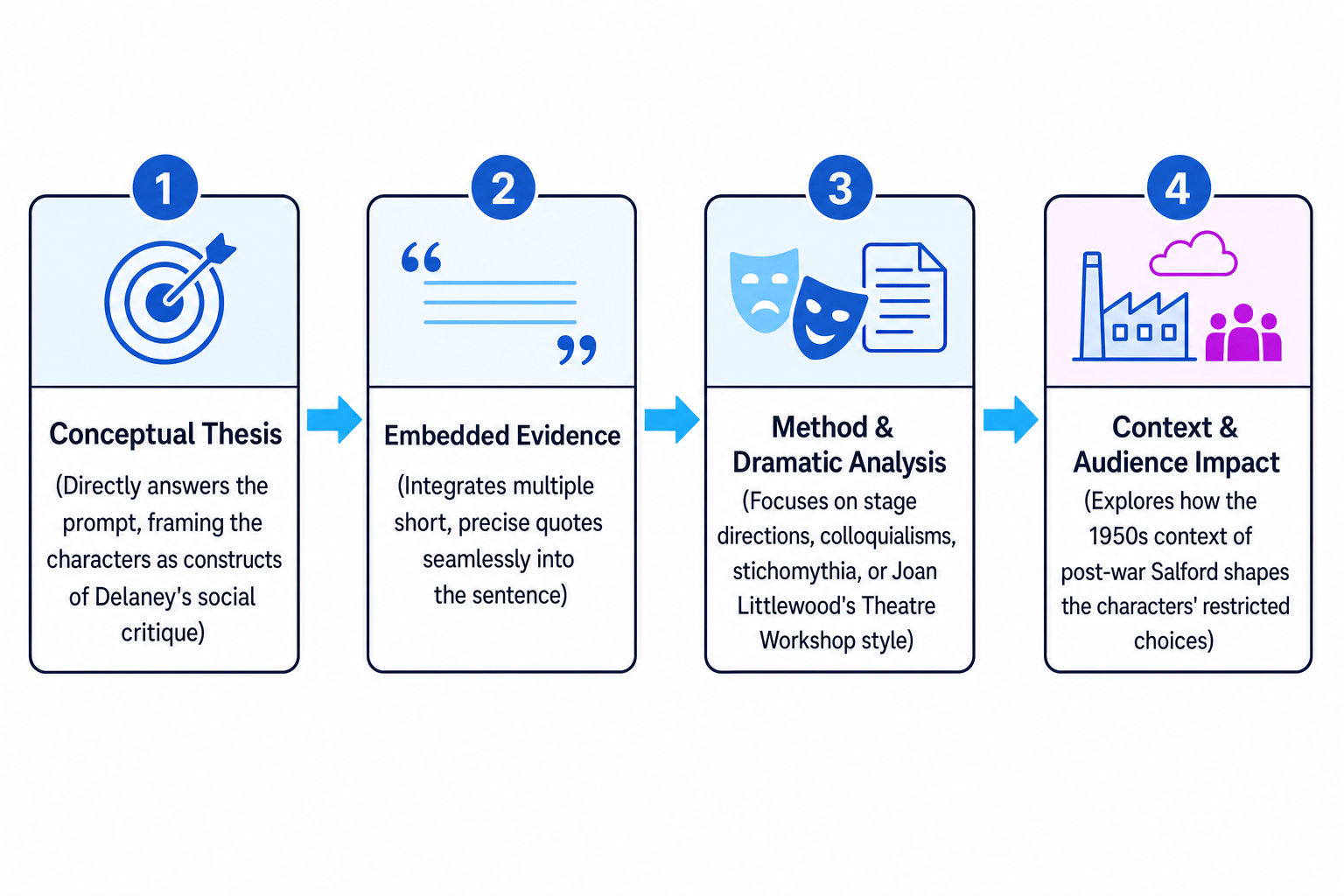
To ensure you satisfy all the assessment objectives in every paragraph, you should follow a clear, cyclical structure. The diagram below illustrates how your ideas should flow from a conceptual claim to deep analysis, and finally to a broader social conclusion.
Characters as Constructs
Never write about Jo, Helen, Geof, or Jimmie as if they are real people with independent minds. Always frame them as constructs created by Delaney to highlight specific socio-economic struggles. Instead of writing "Jo is lonely", write "Delaney constructs Jo as a neglected adolescent to expose the emotional toll of maternal abandonment in impoverished environments."
Paragraph Construction: Step-by-Step
Let's walk through how to build a Grade 9 analytical paragraph.
We will use the following typical exam prompt: How does Delaney present the complex relationship between Helen and Jo?
Constructing an analytical paragraph
-
Formulate a conceptual thesis statement. Start by establishing what the relationship represents on a socio-political level, rather than just describing their bickering.
Drafting: Delaney constructs the volatile mother-daughter dynamic between Helen and Jo to expose how systemic poverty erodes domestic stability and forces women into self-preservation. Rather than presenting a conventional, nurturing maternal relationship, Delaney illustrates a cyclical struggle for survival where affection is sacrificed for economic security.
-
Integrate precise, embedded evidence. Introduce your first piece of evidence seamlessly into your sentence, ensuring the context of the quote is clear but brief.
Drafting: From the play's opening in the dreary Salford flat, their dialogue is characterised by mutual hostility and resentment. Helen's immediate dismissiveness is evident when she tells Jo, "You’ve got no faith in me," only for Jo to retort, "I’ve got no faith in anybody."
-
Analyse dramatic methods (stagecraft and dialogue). Examine the specific devices Delaney uses. Here, we can focus on the fast-paced, combative dialogue known as stichomythia, which mirrors their fractured bond.
Drafting: This rapid-fire, combative stichomythia highlights the deep-seated mistrust between the two women. The repetitive structure of "no faith" establishes a shared disillusionment; Helen has been hardened by her reliance on men for financial survival, and she has passed this cynicism down to her daughter. Delaney's use of colloquial, naturalistic language strips the scene of any theatrical glamour, grounding their conflict in the harsh realities of working-class survival.
-
Weave in social context (AO3) linked to authorial intent. Conclude the paragraph by explaining how this dynamic would impact a 1950s audience and what Delaney was trying to critique.
Drafting: Through this combative dynamic, Delaney directly challenges the idealised, middle-class domesticity popularized in post-war media. In 1958, British audiences were accustomed to polite, bourgeois dramas. By presenting a mother who abandons her daughter for a wealthy lover ("Peter"), Delaney exposes how the economic vulnerability of single mothers in the welfare state forces them to prioritise financial convenience over maternal duty, trapping successive generations in the same cycle of neglect.
Feature spotting without effect
Do not simply point out a technique and move on. For example, writing: "Delaney uses stichomythia when Jo and Helen argue" will not get you high marks. You must explain how this technique affects the audience and why Delaney chose it (e.g., "The stichomythia creates an unrelenting, claustrophobic atmosphere that mirrors their economic confinement").
Planning a Whole Essay: The Blueprint
To achieve a cohesive essay, your individual paragraphs must be tied together by a central, evolving thesis. Below is an essay plan responding to a thematic prompt: How does Delaney present the theme of marginalisation in A Taste of Honey?
Thesis Statement
"Delaney presents marginalisation not as an individual moral failing, but as an inevitable consequence of a rigid, patriarchal 1950s class system. By centering her play on working-class women, a gay man, and a Black sailor, Delaney challenges the dominant social hierarchies of post-war Britain, offering her audience a raw glimpse of survival on the societal periphery."
                    ┌────────────────────────────────────────┐
                    │               THESIS                   │
                    │   Marginalisation is systemic, not     │
                    │   moral; it exposes 1958 inequalities. │
                    └───────────────────┬────────────────────┘
                                        │
         ┌──────────────────────────────┼──────────────────────────────┐
         ▼                              ▼                              ▼
┌──────────────────┐           ┌──────────────────┐           ┌──────────────────┐
│   PARAGRAPH 1    │           │   PARAGRAPH 2    │           │   PARAGRAPH 3    │
│ Economic & Class │           │ Racial Prejudice │           │ Queer Isolation  │
│  Marginalisation │           │   & Maternity    │           │  & Chosen Family │
│                  │           │                  │           │                  │
│  • Helen & Jo's  │           │  • Jimmie & Jo's │           │  • Geof as a gay │
│    survival      │           │    interracial   │           │    man           │
│  • Shifting slum │           │    romance       │           │  • Domestic ease │
│    flats         │           │  • "Half-caste"  │           │    vs. social    │
│  • Cycle of      │           │    baby fears    │           │    ostracism     │
│    poverty       │           │                  │           │                  │
└──────────────────┘           └──────────────────┘           └──────────────────┘
Paragraph 1: Economic and Gender Marginalisation (Helen and Jo)
- Focus: How poverty and gender intersect to trap women.
- Evidence: The shifting, damp slum flats; Helen’s reliance on men ("He's got a wallet full of reasons"); Jo’s fear of becoming like her mother.
- Analysis: The domestic setting acts as a physical metaphor for their entrapment. The chaotic, unpacked suitcases symbolise rootlessness and transience.
- Context: The post-war economic boom did not benefit everyone; working-class women in northern industrial towns like Salford remained severely restricted by a lack of social mobility and childcare.
Paragraph 2: Racial Marginalisation and Taboo (Jimmie)
- Focus: The temporary escape from marginalisation through Jo's romance with Jimmie, followed by the harsh return of societal prejudice.
- Evidence: The "toy ring" which Jimmie gives Jo; Helen's outraged reaction to the pregnancy ("supposing it's half-caste").
- Analysis: Jimmie’s character is associated with warmth and the exotic ("He's a prince"), contrasted sharply with the grey Salford landscape. However, his departure on the ship reinforces his transient status, leaving Jo to bear the societal shame of an unmarried, interracial pregnancy.
- Context: 1950s Britain saw increased immigration (the Windrush generation), which was met with widespread racism. Unmarried mothers of mixed-race children faced intense social ostracism.
Paragraph 3: Sexuality and the Domestic Sanctuary (Geoffrey)
- Focus: How Geof’s queer identity isolates him from wider society but allows him to create a nurturing, alternative domestic space with Jo.
- Evidence: Helen’s homophobic slurs ("miserable little queer"); Geof’s domestic care ("I've never fastend a button for a man before"); Jo's declaration that Geof would "make a funny father."
- Analysis: Delaney utilises the domestic space of the flat to create a temporary "sanctuary" for these two marginalised individuals. Geof rejects traditional toxic masculinity, adopting a maternal role that Helen abandoned.
- Context: Homosexuality was illegal in the UK until 1967. By presenting a sympathetic, multi-dimensional gay character in 1958, Delaney took a revolutionary political stance, challenging the Theatre Censor (the Lord Chamberlain) who banned direct depictions of homosexuality.
The Power of Stagecraft
Do not limit your analysis to spoken words. Discuss the music (the use of the cornet to signal loneliness or transition), the props (the light bulb without a shade, the dirty comfort of the bed), and the movements (characters dancing or pacing). This proves to the examiner that you understand A Taste of Honey as a performance piece (AO2).
In the exam
- Spend 5 minutes planning: Do not start writing immediately. Write down your thesis statement and a brief 3-point plan (like the blueprint above) to ensure your essay maintains a clear direction.
- Anchor your thesis in Authorial Intent: Ensure your introduction answers why Delaney wrote this play. Use phrases like: "Delaney uses the microcosm of the Salford flat to critique..." or "Delaney deconstructs post-war complacency by..."
- Embed your context naturally: Avoid dropping in random historical facts (e.g., "The NHS was set up in 1948"). Instead, always tie context back to the text: "Jo's dread of childbirth reflects the inadequate support available to working-class, single mothers in the newly established welfare state."
- End with a thematic conclusion: Do not just summarise what you have already written. Conclude by summarizing how the play's ending leaves the characters' situations unresolved, reinforcing Delaney's message that social traps are cyclic and difficult to escape.
Check yourself
- Can you explain how Delaney’s play differs from the traditional "well-made plays" of the early 20th century?
- How does the physical setting of the Salford flat reflect the psychological state of Jo and Helen?
- Which short, versatile quotes can you recall that highlight Geof's marginalisation and his contrasting domestic warmth?
