To secure a high grade in your GCSE English Literature exam, you must look beyond what happens in the plot and investigate how Shakespeare constructed the play. This means analyzing the specific choices Shakespeare made in his language, form, and dramatic structure to convey deeper thematic messages.
What you'll learn:
- How Shakespeare structures the play's locations to create a stark thematic contrast.
- The dramatic effect of switching between blank verse and prose.
- How character-specific language techniques reinforce key themes like mercy, justice, and prejudice.
1. Understanding Dramatic Form: Comedy or Tragedy?
To analyze The Merchant of Venice effectively, you first need to understand its literary form.
Form
The form of a text refers to its genre and overarching literary shape. In Elizabethan theatre, plays were generally classified as either Comedies, Tragedies, or Histories.
At first glance, The Merchant of Venice is structured as a Shakespearean Comedy. In the Renaissance tradition, a comedy does not simply mean "funny"; it is defined by a specific structural trajectory:
Order/Stability ➔ Confusion/Conflict ➔ Resolution (often ending in Marriage)
In this play, we see typical comic elements:
- The marriage plot: Bassanio must win Portia through the casket test.
- Disguise and gender-swapping: Portia and Nerissa disguise themselves as young male lawyers.
- The resolving marriages: The play ends in Act 5 with three couples united in Belmont.
However, modern critics often classify it as a problem play or a tragi-comedy. This is because the tragic weight of Shylock’s storyline—his intense persecution, the loss of his daughter, and his forced conversion—threatens to shatter the light-hearted comic frame.
The problem of Shylock's tragedy
While the Christian characters achieve their happy, comic resolution in Belmont during Act 5, Shylock is entirely absent from the final act, having been stripped of his wealth and identity in Act 4. The play's form is intentionally uneasy, forcing the audience to question whether the "happy ending" is truly happy.
2. Structural Juxtaposition: Venice vs. Belmont
One of Shakespeare's most powerful structural tools in this play is juxtaposition.
Juxtaposition
Juxtaposition is the act of placing two contrasting ideas, characters, or settings close together to highlight their differences and create deeper meaning.
The structure of The Merchant of Venice alternates systematically between two highly contrasting worlds: the commercial hub of Venice and the romantic estate of Belmont.
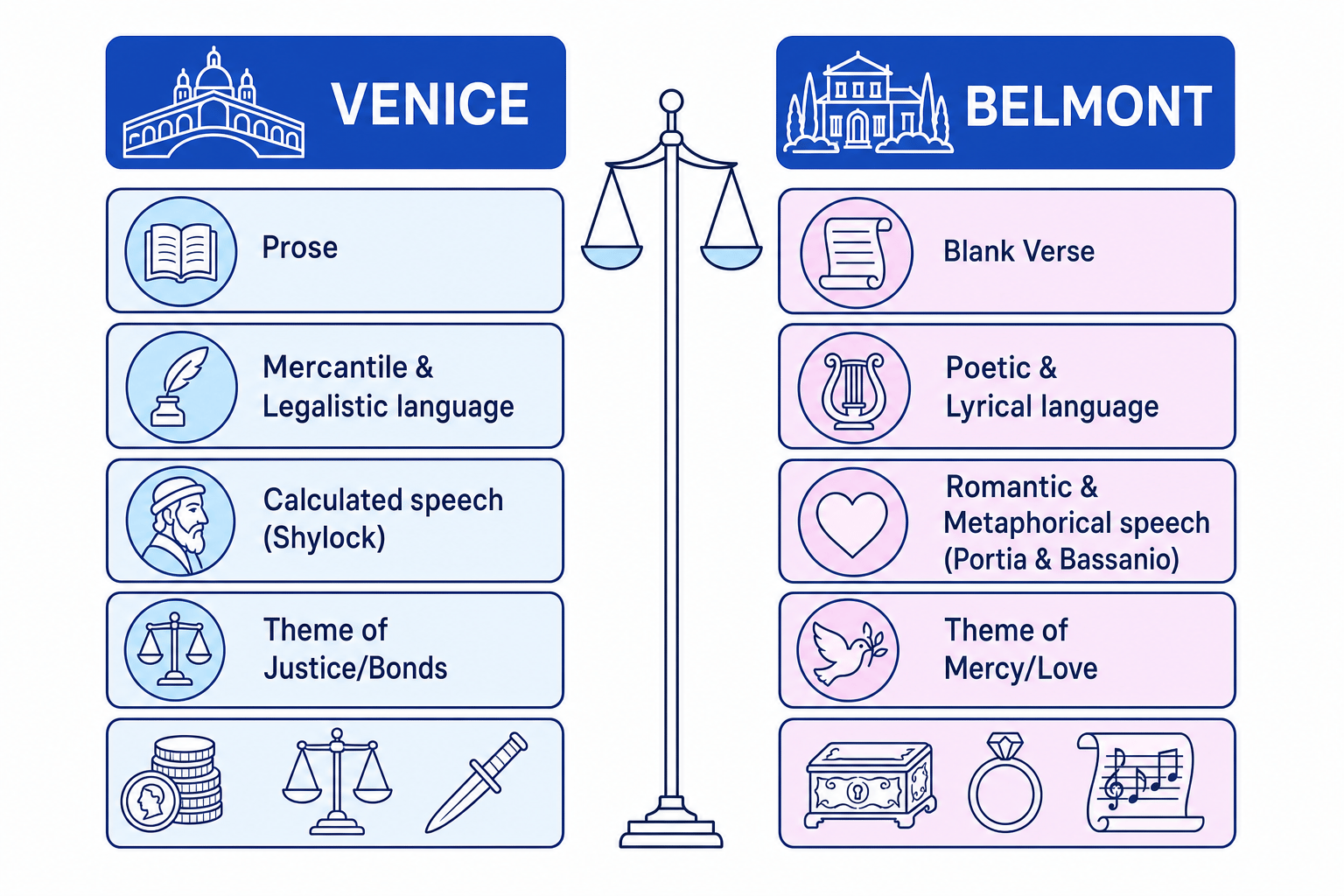
Venice: The World of Men, Money, and Law
- Atmosphere: Realistic, tense, volatile, and highly competitive.
- Language: Heavy use of financial, legalistic vocabulary ("bonds", "usury", "forfeiture", "merchandise").
- Characters: Dominated by male merchants and lenders (Antonio, Shylock, Bassanio).
- Social dynamic: Bound by strict civil laws and contract law to protect global trade.
Belmont: The World of Women, Music, and Art
- Atmosphere: Fairytale-like, idealistic, lyrical, and harmonious.
- Language: Poetic, rich in classical mythology, metaphors of nature, and musical references.
- Characters: Centred around Portia, Nerissa, and their suitors.
- Social dynamic: Governed by the romantic lottery of the caskets and the spiritual concept of mercy.
By jumping back and forth between these two settings, Shakespeare structurally reinforces the clash between his play's central themes: justice (associated with Venice) and mercy (associated with Belmont).
Look for the crossing of boundaries
The dramatic climax occurs in Act 4, Scene 1 (the courtroom scene) when the world of Belmont (in the person of Portia, disguised as Balthazar) enters the world of Venice to resolve the conflict. Note how she must adopt the harsh, legalistic language of Venice to save Antonio, showing that Belmont cannot entirely escape Venetian reality.
3. The Mechanics of Blank Verse and Prose
Shakespeare carefully chooses whether his characters speak in poetry (blank verse) or everyday speech (prose). Understanding this distinction is vital for your AO2 (analysis of language, form, and structure) marks.
Blank Verse
Blank verse is unrhymed poetry written in iambic pentameter. This means each line consists of five rhythmic units (called "feet"), where each foot contains one unstressed syllable followed by one stressed syllable (da-DUM).
A standard line of iambic pentameter contains exactly 10 syllables:
Syllables=5 feet×2 syllables/foot=10 \text{Syllables} = 5 \text{ feet} \times 2 \text{ syllables/foot} = 10 Syllables=5 feet×2 syllables/foot=10For example, when Bassanio describes Portia in Act 1, Scene 1, he speaks in perfect blank verse:
"In Bel / mont is / a la / dy rich / ly left"
Prose
Prose is ordinary, conversational speech without a regular metrical rhythm or rhyme scheme. In a Shakespearean play script, prose text is printed all the way to the right-hand margin of the page, unlike verse lines which have fixed line breaks.
The Social and Emotional Rules of Verse and Prose
Generally, Shakespeare uses these forms to convey social status and emotional states:
- Social Status: High-status characters (such as noblemen, princes, and wealthy heiresses) speak in blank verse to reflect their education and refinement. Lower-status characters (such as Lancelot Gobbo) speak in prose to reflect their common, uneducated background.
- Emotional State: If a high-status character is experiencing intense grief, madness, or moral decay, they may lose their poetic control and slip into prose. Conversely, when characters are expressing noble, elevated thoughts, they rise to verse.
Assuming Shylock only speaks in prose
Many students think that because Shylock is a social outcast, he only speaks in prose. This is incorrect. Shylock moves fluidly between prose and blank verse. When he is being calculated, rational, or cold, he often uses precise, sharp blank verse. When he is highly emotional, frantic, or talking about domestic, everyday matters, he shifts to prose.
4. Analyzing Language: Shylock's Rhetoric vs. Portia's Poetry
To write a high-level essay, you must analyze how Shakespeare's language choices construct his characters' mindsets.
Shylock’s Legalistic and Repetitive Language
Shylock's language is often characterized by commercial vocabulary, repetition, and rhetorical questions. He uses words like "bond", "thrift", "interest", and "forfeit". His grammar is structured like a legal contract, emphasizing strict literalism.
Consider how he repeats key phrases in Act 3, Scene 1:
"I will have my bond; speak not against my bond: / I have sworn an oath that I will have my bond."
This structural repetition (known as epistrophe, where a word is repeated at the end of successive clauses) reflects his rigid, unyielding obsession with legal justice.
Portia’s Poetic and Rhetorical Elegance
In contrast, Portia’s language is highly metaphorical and rhythmic, showcasing her intelligence, high status, and capacity for mercy. Her most famous speech, "The quality of mercy" (Act 4, Scene 1), uses natural metaphors to argue that mercy is a divine attribute:
"The quality of mercy is not strained; It droppeth as the gentle rain from heaven Upon the place beneath..."
Analyzing Shylock's Shift to Prose
Let's walk through an analysis of Shylock's famous "Hath not a Jew eyes?" speech from Act 3, Scene 1. Although Shylock is a wealthy businessman capable of verse, Shakespeare writes this entire speech in prose. Why?
- Step 1: Identify the form and immediate context. Notice that Shylock is speaking to Salarino and Solanio, who have been mocking his daughter's flight and his financial losses. This is a moment of intense personal crisis, grief, and anger for Shylock.
- Step 2: Connect the formal choice (prose) to his emotional state. By abandoning blank verse, Shylock's speech lacks the aristocratic control and artificiality of iambic pentameter. The raw, jagged nature of prose conveys a character speaking from a place of overwhelming, unedited human passion and visceral rage rather than calculated poise.
- Step 3: Analyze the internal rhetorical structure. Observe the relentless accumulation of parallel rhetorical questions ("Hath not a Jew hands, organs, dimensions, senses, affections, passions? Fed with the same food, hurt with the same weapons..."). This highly structured list creates a driving, rhythmic momentum. It forces his Christian tormentors—and the audience—to acknowledge the biological and emotional equivalence of Jews and Christians.
- Step 4: Analyze the ultimate thematic shift in the prose structure. The speech begins as an appeal to shared humanity but structurally pivots at the end to justify revenge: "And if you wrong us, shall we not revenge?". The prose form strips away any romanticized poetic illusions; Shylock is laying bare the ugly, cyclical reality of Venetian prejudice.
In the exam
- Never analyze a quotation in isolation. Always identify whether the character is speaking in blank verse or prose, and explain why Shakespeare chose that form for that specific moment.
- Track the transitions. If a character suddenly switches from verse to prose (or vice-versa), pinpoint the exact emotional or structural turning point that caused the shift.
- Use precise terminology. Don't just say "the writer uses language to show..."; instead, use terms like iambic pentameter, prose, rhetorical questions, juxtaposition, metaphorical resonance, and lexical fields of law/commerce.
- Anchor structure to theme. When discussing Venice and Belmont, explain how this geographical alternation structurally mirrors the play's moral debates between legalistic justice and Christian mercy.
Check yourself
- Why does Shakespeare structurally alternate between Venice and Belmont throughout the play?
- What does the transition from blank verse to prose typically reveal about a noble character's emotional state in a Shakespearean play?
- How does the repetitive structure of Shylock's speech in Act 4, Scene 1 ("I will have my bond") reflect his mindset?
