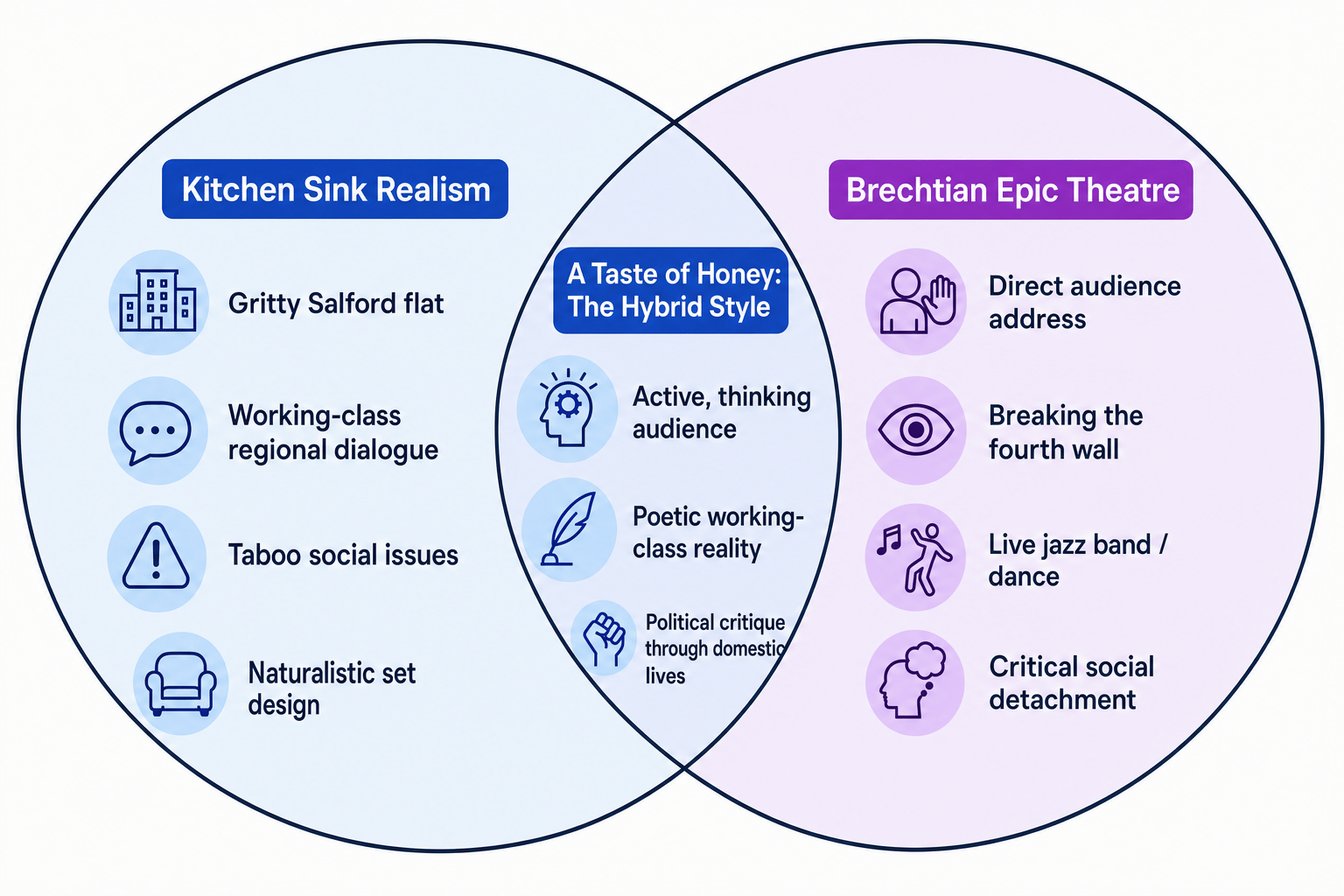
1. Brechtian Distancing (Verfremdungseffekt)
Bertolt Brecht used the term Verfremdungseffekt (frequently translated as the "alienation effect" or "distancing effect") to describe how a playwright can prevent the audience from passively enjoying a play as "escapism."
The purpose of distancing
By reminding the audience that they are watching a constructed theatrical performance, Delaney forces them to look at the characters' struggles with intellectual detachment. Instead of crying for Jo, the audience is encouraged to ask: "Why does society allow young, working-class women to be abandoned like this?"
Delaney achieves this distancing through several specific stage techniques:
- Direct Address (Breaking the Fourth Wall): Characters turn away from each other and speak directly to the audience. When Helen grumbles about her living situation or explains her past, she often delivers these lines straight to the stalls.
- Music and Dance: In the original Joan Littlewood production, a live jazz band sat on or near the stage. Characters would dance or sing when transitioning between scenes. This prevents a dark, depressing scene from becoming a melodrama.
- Sparse Stage Props: The setting is minimal. The stage directions state: "The play is set in a comfortless flat in Salford." There are no unnecessary decorations; the focus remains entirely on the human interactions and the harsh socioeconomic reality.
2. Structural Devices: Cyclical Narrative and Parallels
The architecture of A Taste of Honey is highly deliberate. Structurally, the play is built on mirrors, parallels, and a tight two-act structure that highlights the traps of poverty.
The Cyclical Structure
The play begins and ends with the physical and emotional abandonment of a pregnant mother.
- Act 1, Scene 1: We open with Helen and Jo moving into a dreary, cold flat. Helen is self-absorbed, neglectful, and eventually leaves Jo to marry Peter.
- Act 2, Scene 2: We close with Helen returning to Jo’s flat because Peter has kicked her out. She immediately begins reorganising the flat, insulting Geof, and eventually leaving Jo alone in her hour of need to get a drink.
Confusing plot with structure
Do not simply write: "The story ends how it starts." Instead, frame this as a deliberate structural method: "Delaney uses a cyclical structural framework to highlight the inescapable, generational cycle of poverty and abandonment that traps working-class women."
Structural Parallels and Foil Characters
Delaney pairs her characters to draw sharp contrasts:
| Character A | Character B (The Foil) | The Dramatic Purpose |
|---|---|---|
| Helen (Selfish, cynical maternal figure) | Geof (Selfless, caring, domestic surrogate "mother") | Highlights the failure of biological family structures. Geof provides the maternal care that Helen refuses to give. |
| Peter (Predatory, wealthy, abusive partner) | Jimmie (Romantic, gentle, but fleeting lover) | Demonstrates that the only men who treat Jo with tenderness are those who are also marginalized by society (Jimmie is Black; Geof is gay). |
3. Linguistic Methods: Stichomythia and Vernacular
The way characters speak in A Taste of Honey was revolutionary for 1950s British theatre. Delaney rejected the polished, formal language of standard drama in favor of naturalistic Salford working-class speech.
Stichomythia (Quick-fire Dialogue)
Delaney frequently uses stichomythia to represent the volatile, combative relationship between Helen and Jo.
Stichomythia
A dramatic technique in which alternating lines of dialogue are spoken by two characters in rapid succession. It is often used to signal conflict, tension, or sharp wit.
Look at this exchange from Act 1, Scene 1:
HELEN: You’re not old enough to run your own life.
JO: I am.
HELEN: You’re not.
JO: I am.
HELEN: Well, we’ll see.
This rapid-fire bickering mimics real-life domestic conflict. It shows their deep familiarity with each other, but also their inability to communicate on any meaningful, emotional level.
Regional Vernacular and Colloquialisms
The characters use local slang and phrasing (e.g., "bloody," "shut your mouth," "soft"). This anchors the play firmly in the reality of post-war northern England, asserting that working-class voices are worthy of being heard on a serious theatrical stage.
Worked Example: Analysing a Dramatic Method
When writing about dramatic methods, always connect the method (what Delaney does) to the meaning (what she is trying to say about society/the characters) and the effect on the audience.
Analyzing direct address and Brechtian stagecraft
Walk through this step-by-step breakdown of how to analyze a key dramatic method in the play.
-
Identify the dramatic method and the textual evidence: Locate a specific moment where the playwright breaks naturalistic conventions. In Act 1, Scene 1, Helen looks at the miserable view from the window and comments sarcastically: "Tenement block, cemetery, slaughterhouse. Oh, what a beautiful view!" She delivers this line not to Jo, but directly to the audience.
-
Analyze the linguistic and dramatic features of the quote: Note the harsh tricolon of nouns ("tenement block, cemetery, slaughterhouse"). These are grim symbols of working-class confinement, mortality, and butchery. The subsequent exclamation ("Oh, what a beautiful view!") uses heavy irony to highlight her bitter, cynical humor.
-
Explain the theatrical effect of the direct address (AO2): By speaking directly to the audience, Helen breaks the "fourth wall." This Brechtian distancing technique pulls the audience out of the emotional reality of the scene and forces them to confront the physical environment directly. They become complicit in the dialogue, acting as Helen’s confidants.
-
Connect the analysis to the wider themes and context (AO3): Link this staging choice to Delaney's broader social critique. By forcing the audience to look directly at the reality of post-war urban decay, Delaney demands that middle-class theatergoers acknowledge the bleak physical conditions working-class women were forced to navigate in 1950s Britain.
How to weave in AO2 terminology
Instead of writing "Delaney shows that Helen is mean when she says...", use active verbs and theatrical terms: "Delaney employs stichomythia to construct a highly combative domestic dynamic..." or "The sparse set design physically manifests the characters' socioeconomic deprivation..."
4. Symbolism and Motifs
Props and physical items on stage are never just functional in a well-crafted play; they are visual motifs that carry deep symbolic weight.
The Bulb (Light vs. Dark)
The single, unshaded lightbulb in the flat represents the harsh, unvarnished truth of their lives. Jo constantly complains about it, wanting to cover it or turn it off.
- Symbolism: The light represents reality. Jo's desire to hide or soften the light symbolizes her desire for romance, fantasy, and an escape from her grim surroundings.
The Brass Ring
When Jimmie proposes to Jo, he gives her a toy-like brass ring on a pocket handkerchief. Jo wears it around her neck.
- Symbolism: The ring is cheap, impermanent, and ultimately meaningless in a legal sense, yet it represents Jo's desperate longing for love and commitment. It is a fragile symbol of "a taste of honey"—a fleeting moment of sweetness in an otherwise bitter life.
Watch out for 'device-spotting'
Do not simply list these symbols in your essay. For instance, writing "The ring is a symbol of love" will not get you high marks. You must explain how the prop is used dynamically on stage: "When Jo wears the brass ring on a cord around her neck, it becomes a visual, constant physical reminder to the audience of Jimmie's absence and her desperate attempt to cling to a fleeting romantic fantasy."
In the exam
- Always refer to the audience: Remember, a play is a sensory experience. Use phrases like "The audience witnesses...", "This creates a sense of discomfort for the spectator...", or "Delaney manipulates the audience's sympathy...".
- Discuss the stage directions: Delaney’s stage directions are highly detailed and telling. Analyze them just as closely as you would analyze the spoken dialogue.
- Structure by dramatic concept, not chronologically: Instead of writing your essay from the beginning of Act 1 to the end of Act 2, organize your paragraphs by thematic methods (e.g., one paragraph on cyclical structure, one on Brechtian distancing, one on symbolic props).
Check yourself
- Why did Bertolt Brecht develop the "alienation effect", and how does Shelagh Delaney use it when Jo or Helen speak to the audience?
- How does the cyclical structure of the play reflect the social realities of working-class women in 1950s Salford?
- Contrast the dramatic purpose of Geof as a foil character to Peter. What does this tell us about the play's presentation of masculinity?
