For your AQA GCSE English Literature exam, you need to know a range of short, powerful quotes from Shelagh Delaney's A Taste of Honey. Because the exam is closed-book, you must memorise these quotes and understand how to analyse them in depth.
In these study notes, you will learn how to select, dissect, and integrate key quotes to write high-scoring essays on characters, relationships, and the play's unique 1950s social context.
What you'll learn
- How to select and memorise highly versatile, short quotes.
- The art of "zooming in" on specific words to explore Delaney's language and dramatic methods.
- How to link quotes directly to the themes of maternal neglect, class, and marginalised identities in post-war Britain.
The Power of the "Micro-Quote"
In the exam, you are assessed on your ability to use textual references and analyse the writer's craft. Many students make the mistake of trying to memorise long, complex chunks of dialogue. This often leads to misremembering or panic during the exam.
Instead, you should focus on micro-quotes: brief phrases of two to five words that carry immense thematic weight. Using micro-quotes allows you to embed your evidence seamlessly into your own sentences, which makes your writing flow naturally and demonstrates a sophisticated command of the text.
Micro-quote
A micro-quote is a highly compact textual reference (usually between two and five words) that contains rich figurative language, symbolic weight, or key thematic ideas.
Less is more in a closed-book exam
Favour short, punchy quotes that can be adapted to multiple exam questions. A single short quote like "dirty, uncomfortable and wet" can be used to discuss setting, poverty, Helen’s neglect, or Jo’s hopelessness.
Understanding Shelagh Delaney's Style
Before looking at specific quotes, it is vital to understand the literary and theatrical movement A Taste of Honey belongs to. Delaney wrote this play in 1958 as a direct reaction against the polite, middle-class "drawing-room dramas" that dominated British theatre at the time.
Kitchen Sink Realism
Kitchen Sink Realism is a cultural movement of the late 1950s and 1960s in Britain that focused on the gritty, unvarnished realities of working-class life. These plays featured domestic settings, colloquial dialogue, and characters facing social issues like poverty, unplanned pregnancy, and prejudice.
When analysing Delaney’s quotes, you should look out for:
- Colloquialism: Informal, everyday language that reflects real working-class speech.
- Motifs: Recurring elements, images, or ideas that have symbolic significance (such as the "taste of honey" itself, light/darkness, or music).
- Subtext: The unspoken meaning behind a line of dialogue, which often reveals the characters' hidden vulnerabilities or defensive mechanisms.
Exploring Key Quotes by Theme
Let’s examine some of the most versatile and powerful quotes in the play, categorised by theme.
Theme 1: Maternal Neglect and Cyclical Relationships
The dysfunctional dynamic between Helen and Jo is the emotional spine of the play. Their dialogue is fast, sharp, and combat-like, yet it hides a deep-seated fear of abandonment.
1. "I've always done my best for you." (Helen, Act 1, Scene 1)
- Context: Helen says this early in the play to justify her parenting and her decision to move them into yet another run-down flat.
- Analysis: This quote is rich in irony. Helen's "best" is demonstrably inadequate; she constantly prioritises her own financial security and love life over Jo’s well-being. The defensive tone highlights her self-delusion and her refusal to take accountability for her neglect.
2. "You should have been put in a wicker basket and set adrift on the river." (Helen, Act 1, Scene 1)
- Context: Helen is exasperated by Jo's constant complaints about their living conditions.
- Analysis: This line draws on biblical imagery (alluding to the story of baby Moses). While it is delivered with a dark, comic edge, it reveals the underlying truth that Helen views Jo as a burden. The idea of setting her "adrift" prefigures Helen's literal abandonment of Jo later in the play when she leaves to marry Peter.
Theme 2: Poverty, Escapism, and Hope
The characters in A Taste of Honey live in a bleak, post-industrial landscape (Salford, Greater Manchester). They use fantasy and temporary pleasures to escape their grim realities.
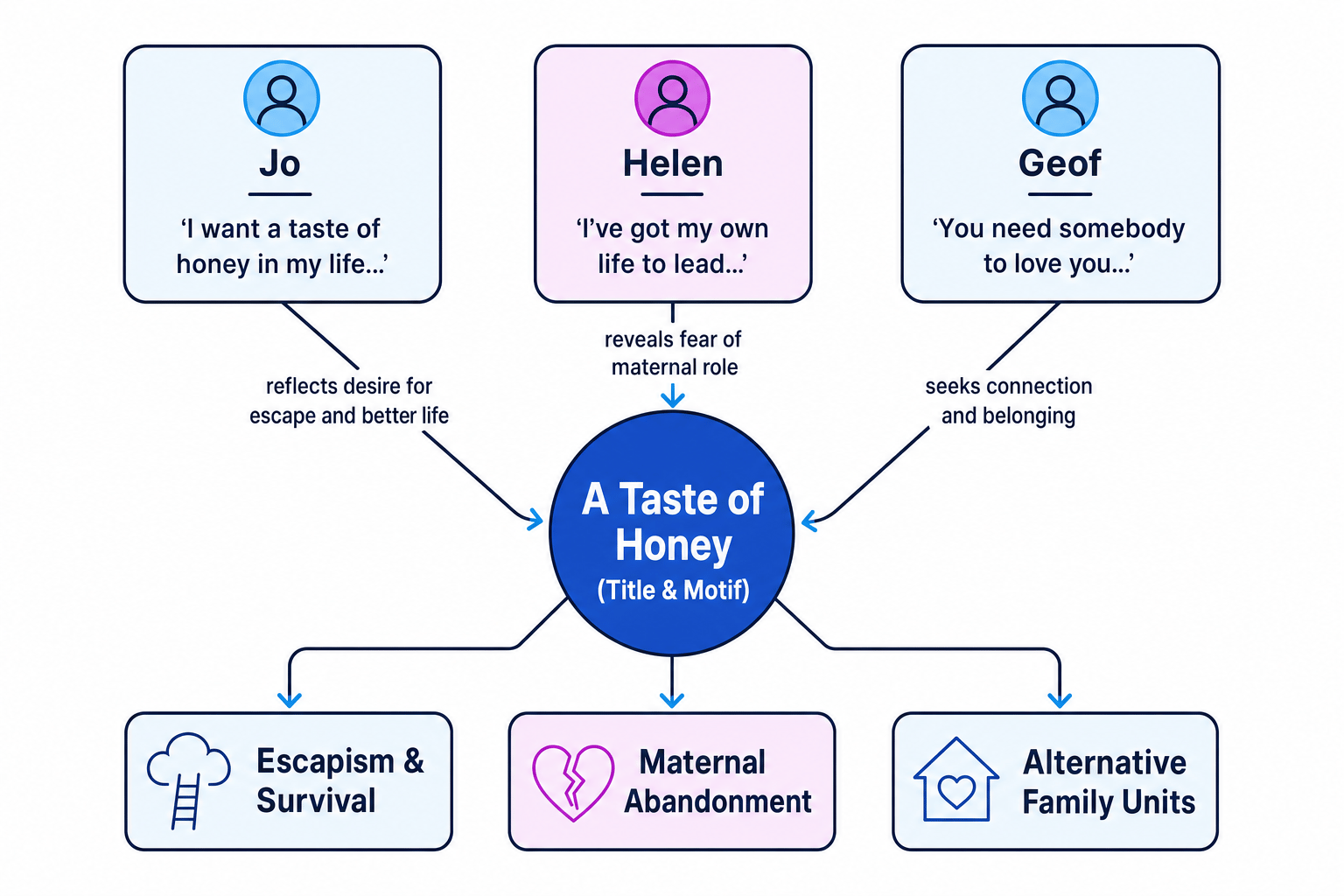
3. "I want a taste of honey in my life, and then I don’t care." (Jo, Act 1, Scene 2)
- Context: Jo says this to the Boy (Jimmie) as she contemplates her future and her desire for excitement and love.
- Analysis: This quote introduces the central metaphor of the play's title. "Honey" represents sweetness, warmth, and luxury—things entirely missing from Jo's bleak, grey existence. The word "taste" is crucial; Jo does not expect a lifetime of happiness, only a brief, sensory experience of joy. The final clause, "and then I don’t care," betrays a tragic, fatalistic attitude typical of youth growing up in poverty.
4. "Tenements, cemeteries and gasworks. It’s quite a view." (Jo, Act 1, Scene 1)
- Context: Jo looks out of the window of their new flat and describes the landscape of Salford.
- Analysis: Jo uses sarcasm and dry irony to cope with her bleak surroundings. The list of three nouns—"tenements" (cramped housing), "cemeteries" (death), and "gasworks" (industrial pollution)—creates a claustrophobic, oppressive atmosphere. It illustrates how the working-class characters are physically and socially hemmed in by industry and mortality.
Theme 3: Marginalised Identities and Unconventional Support
Delaney was revolutionary in her sympathetic portrayal of characters who were heavily marginalised in 1950s Britain: a gay man (Geof) and a black sailor (Jimmie).
5. "You need somebody to love you while you're looking for someone to love." (Geof, Act 2, Scene 1)
- Context: Geof offers this gentle piece of advice to Jo while taking care of her during her pregnancy.
- Analysis: This quote gets to the heart of Geof’s selfless, maternal nature. In a play dominated by transactional or selfish relationships (like Helen and Peter), Geof offers unconditional, platonic love. The parallel structure of "somebody to love you" and "someone to love" highlights the emotional void Jo has suffered due to Helen's neglect.
Misinterpreting Geof and Jo's relationship
Do not describe Geof and Jo’s relationship as a conventional romance. Geof is a gay man (though homosexuality was illegal in the UK in 1958, Delaney makes his sexuality clear through coded language and subtext). Their bond is a domestic partnership built on mutual survival and platonic care, representing an "alternative family unit" that challenges the rigid mid-century nuclear family ideal.
How to Analyse a Quote in an Essay
To achieve high marks for assessment objectives, you must not simply "drop" a quote into your essay and move on. You need to unpack its layers of meaning, evaluate Delaney's dramatic choices, and link these to the social context of the 1950s.
Let's look at a step-by-step example of how to construct a high-level analytical paragraph around one of the play's key quotes.
Analysing Jo's pursuit of happiness
Question: How does Shelagh Delaney present the theme of hope in A Taste of Honey?
- State your point and contextualise the quote: Delaney presents hope not as a grand, achievable future, but as a desperate, fleeting desire for sensory relief from poverty. This is evident when Jo tells Jimmie, "I want a taste of honey in my life, and then I don't care."
- Zoom in on language and dramatic methods: The central metaphor of "honey" acts as a sensory motif of warmth, sweetness, and emotional nourishment, highlighting how starved of affection Jo has been in her chaotic upbringing with Helen. By utilising the noun "taste" rather than a word suggesting permanence, Delaney emphasises that Jo’s expectations are tragically limited; she is starved of comfort to the extent that a transient moment of happiness is worth any future consequence.
- Link to context and Delaney's social message: This fatalistic phrase, "and then I don't care," reflects the bleak social mobility of working-class youth in 1950s Salford. Delaney uses Jo’s desperate plea to show how poverty restricts ambition, forcing young, working-class women to seek immediate, short-term escapism—such as Jo’s impulsive relationship with Jimmie—rather than long-term security.
Integrating Quotes Gracefully
Try to weave your quotes directly into the grammar of your own sentences.
- Instead of: Jo is very unhappy with the flat. She says: "dirty, uncomfortable and wet."
- Write: Jo immediately rejects the flat, condemning it as "dirty, uncomfortable and wet," which mirrors her feelings of domestic entrapment.
Summary of Core Quotes
To help you revise, here is a quick-reference guide to the essential quotes you should memorise, mapped to the characters and themes they connect with:
| Quote | Speaker | Key Themes | Literary / Dramatic Feature |
|---|---|---|---|
| "I have to consider myself. I’ve got my own life to lead." | Helen | Maternal neglect, selfishness, survival | Self-justifying rhetoric, declarative language |
| "I’m not having any plans made for me." | Jo | Rebellion, independence, youth vs. age | Defiant tone, active voice |
| "We don’t ask for much, only a bit of love." | Jo | Emotional deprivation, isolation | Understated, poignant dialogue |
| "He’s only a kid, Jo. He doesn’t know what he’s doing." | Geof | Empathy, maternal instinct, maturity | Gentle, colloquial advice |
| "I will return, like a very slow penny." | The Boy | Escapism, false hope, abandonment | Simile, colloquial idiom, foreshadowing |
In the exam
- Read the extract first, but look at the big picture: You will be given a printed extract from the play, but you must write about the whole play. Use 2–3 quotes from the printed extract, but make sure you bring in 3–4 memorised quotes from other parts of the play to construct a balanced argument.
- Use correct terminology: When analysing your quotes, name Delaney's techniques accurately (e.g., sarcasm, colloquialism, subtext, naturalistic dialogue, dark humour). Never just spot the device—always explain why she used it to affect the audience.
- Anchor your quotes in the 1950s context: Every time you use a quote about poverty, gender, or relationships, briefly explain how it reflects or challenges the social norms of 1950s post-war Britain. This guarantees you pick up marks for showing your understanding of context.
Check yourself
- Why does Jo's use of the word "taste" in the quote "I want a taste of honey in my life" suggest a sense of hopelessness?
- What does Helen's reference to setting Jo "adrift in a wicker basket" reveal about her attitude toward motherhood?
- How does Geof's dialogue differ from Helen's, and what does this show about his role in the play?
