In your GCSE English Literature exam, you will be given an extract from The Merchant of Venice and asked a question that connects the extract to the play as a whole. To secure the highest marks, you need to understand how Shakespeare structures his play and how key scenes function as turning points, thematic battlegrounds, and vehicles for character development.
What you'll learn
- How to analyse the dramatic structure and setting shifts between Venice and Belmont.
- Key structural and linguistic methods used in the Bond, Casket, and Trial scenes.
- How to link specific scenes to context (AO3) and write high-scoring, precise analyses (AO1 and AO2).
The Geography of the Play: Venice vs. Belmont
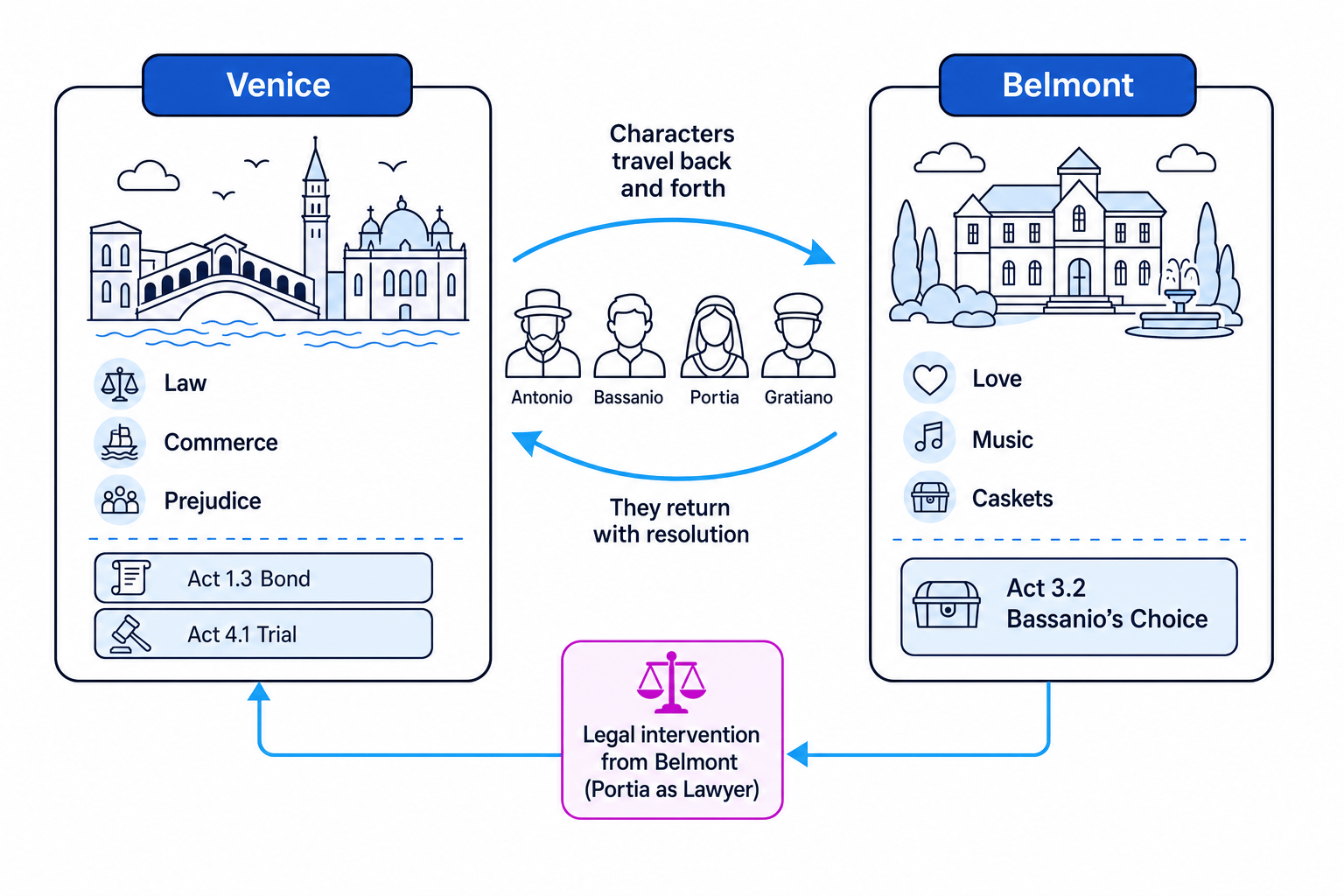
Before diving into individual scenes, you must understand the structural framework of the play. Shakespeare constantly alternates the action between two contrasting worlds.
Dichotomy
A dichotomy is a division or contrast between two things that are represented as being entirely different. In this play, Shakespeare sets up a geographical dichotomy between the chaotic, commercial world of Venice and the romantic, musical world of Belmont.
- Venice is a masculine, public sphere of trade, contracts, law, and deep-seated religious prejudice. It is dominated by financial risk.
- Belmont is a feminine, private sphere of music, romance, caskets, and aristocratic leisure. It is dominated by emotional risk.
Understanding this division is key to analysing any scene, as the physical setting dictates how characters speak, behave, and resolve conflicts.
1. Act 1, Scene 3: The Bond Scene
This scene is the exposition of the play’s primary conflict. Here, Bassanio approaches Shylock for a loan of three thousand ducats, with Antonio acting as the guarantor.
Key Developments
- Shylock’s soliloquy reveals his deep-seated hatred for Antonio, rooted in both religious persecution and financial rivalry: "I hate him for he is a Christian; / But more, for that in low simplicity / He lends out money gratis" (Act 1, Scene 3).
- Antonio’s arrogance is on display; he openly admits he is likely to spit on Shylock and spurn him again.
- The "merry bond" is struck: if Antonio cannot repay the loan in three months, Shylock is entitled to "an equal pound / Of your fair flesh, to be cut off and taken / In what part of your body pleaseth me."
Methods and Analysis
Shakespeare uses prose when Shylock is calculating the money ("Three thousand ducats, well"), representing the cold, practical nature of Venetian commerce. However, when the emotional stakes rise, the characters shift into blank verse (unrhymed iambic pentameter).
When Shylock defends his practice of charging interest (usury), he uses a biblical story about Jacob's sheep. Antonio dismisses this with a famous metaphor:
"The devil can cite Scripture for his purpose."
To an Elizabethan audience, associating Shylock with the devil would reinforce contemporary anti-Semitic prejudices. However, modern audiences often see Antonio’s self-righteousness as hypocritical, highlighting the play's moral ambiguity.
The 'Merry Bond'
The phrase "merry bond" is a brilliant example of oxymoron and foreshadowing. By dressing up a lethal threat as a harmless joke, Shylock exploits Antonio's overconfidence, setting the tragic plot in motion.
2. Act 3, Scene 2: Bassanio's Casket Choice
This scene takes place in Belmont and serves as the romantic peak of the play, contrasting sharply with the dark transactions of Venice.
Key Developments
- Portia desperately wants Bassanio to choose the correct casket (lead) but is bound by her father’s will not to cheat.
- Bassanio rejects the gold and silver caskets, reasoning that outward appearances are deceptive. He chooses the humble lead casket and finds Portia's portrait inside.
- The joy of their union is instantly shattered by a letter from Venice: Antonio’s ships are lost, the bond is forfeit, and Shylock demands his pound of flesh.
Methods and Analysis
Shakespeare employs symbolism through the three metals. Gold represents greed and superficiality; silver represents standard commercial value; lead represents inner worth and the willingness to take risks. Bassanio’s speech mirrors the theme of appearance vs. reality:
"So may the outward shows be least themselves; / The world is still deceived with ornament."
While Bassanio makes his choice, Portia orders music to be played. The song's lyrics contain words that rhyme with "lead" ("bred," "head," "nourished").
Look out for subtle methods!
Did Portia cheat? While she doesn't tell Bassanio which casket to choose, the rhyming cues in her song are highly suspicious. In your essays, you can argue that this shows her pragmatism and intelligence, proving she is not just a passive prize but an active agent.
3. Act 4, Scene 1: The Trial Scene
The climax of the play brings the law of Venice and the wit of Belmont into direct collision.
Key Developments
- Shylock stands in a Venetian court, demanding justice and his pound of flesh. He refuses twice the value of the bond.
- Portia enters disguised as a young male lawyer, Balthazar.
- Portia appeals to Shylock’s mercy. When he refuses, she uses the strict letter of the law against him: he may take the flesh, but if he sheds a single drop of Christian blood, his lands and goods are confiscated by the state.
- Shylock is stripped of his wealth and forced to convert to Christianity.
Methods and Analysis
The dramatic tension is heightened through stichomythia (rapid, alternating single lines of dialogue), which mimics the cut-and-thrust of a courtroom battle.
Portia’s "quality of mercy" speech is a masterpiece of rhetoric, using a simile to argue that mercy is a divine attribute:
"The quality of mercy is not strained; / It droppeth as the gentle rain from heaven / Upon the place beneath."
When Shylock rejects this, Portia uses his own legalistic weapons. She employs hyper-literalism: since the bond specifies "flesh" but not "blood," Shylock is legally trapped.
Misinterpreting the trial's ending
Many students write that the trial represents a triumph of Christian mercy over Jewish cruelty. Avoid this simplistic reading. While Portia talks beautifully about mercy, the punishment meted out to Shylock—forced conversion and the loss of his livelihood—is merciless. Shakespeare leaves the audience feeling deeply unsettled, not triumphant.
Worked Example: Analysing a Key Scene
In the exam, you must show how a specific extract connects to the wider themes of the play. Here is a step-by-step walkthrough of how to write a high-scoring analytical paragraph on Portia’s "mercy" speech in Act 4, Scene 1.
Analysing Portia's Mercy Speech
-
Formulate a clear, thematic thesis point (AO1): Start by explaining why Portia makes this speech and how it relates to the central conflict of the play.
Example: "In Act 4, Scene 1, Shakespeare uses Portia’s rhetoric to contrast the rigid justice of the Venetian legal system with the Christian concept of divine mercy, ultimately exposing the hypocrisy of Venice's ruling class."
-
Select and analyse a specific language method (AO2): Choose a precise quote and zoom in on how the language, imagery, or structure creates meaning.
Example: "Portia uses the natural imagery of 'the gentle rain from heaven' to argue that mercy cannot be 'strained' (forced). The simile of the 'gentle rain' implies that mercy is a natural, life-giving force that flows freely, transcending human law. The soft, sibilant sounds in 'droppeth as the gentle rain' contrast sharply with the harsh, plosive demands for 'justice' and 'forfeit' that dominate Shylock's speech."
-
Integrate historical/cultural context (AO3): Explain how an Elizabethan audience would have reacted to this, and how it reflects the social realities of the time.
Example: "For Shakespeare’s Elizabethan audience, who were deeply familiar with Christian theology, Portia’s appeal would resonate with the Lord's Prayer ('forgive us our trespasses'). However, Shakespeare subverts this Christian ideal. When Portia later demands that Shylock convert to Christianity and surrender his wealth, she denies him the very 'mercy' she so eloquently championed, highlighting the religious double standards of Elizabethan society."
In the exam
- Map the extract to the play's structure: Before writing, identify exactly where your extract sits. Is it the rising action (the Bond), the turning point (the Casket), or the climax (the Trial)? Mention this structural placement in your opening paragraph.
- Track the shift in tone: Look for shifts in language. If characters transition from prose to verse, or if the imagery changes (e.g., from money/business to nature/religion), point this out as a structural method used by Shakespeare.
- Keep quotes short and functional: Do not copy out long three-line blocks of text. Instead, weave single words or short phrases directly into your sentences (e.g., Shylock's desire for a "lodged hate" or his demand for "justice"). This shows a highly controlled, academic writing style (AO4).
Check yourself
- Why does Shakespeare have Bassanio choose the lead casket in Belmont at the exact moment Antonio's fortunes fail in Venice?
- How does the change from prose to blank verse in Act 1, Scene 3 signal a change in the emotional temperature of the conversation?
- In what ways does the Trial Scene (Act 4, Scene 1) mirror and invert the power dynamics established in the Bond Scene (Act 1, Scene 3)?
