In Shelagh Delaney’s groundbreaking 1958 play A Taste of Honey, the action unfolds within a single, drab setting: a "comfortless flat" in Salford. Rather than relying on a complex plot with sensational twists, Delaney uses a series of intimate, character-driven scenes to explore the harsh realities of working-class life, maternal neglect, race, gender, and sexuality in post-war Britain.
To score highly on your GCSE English Literature exam, you must understand how these key scenes function structurally and how they present Delaney’s central themes.
Kitchen Sink Realism
Kitchen sink realism is a British cultural movement of the late 1950s and early 1960s that featured working-class characters living in dreary, realistic domestic settings. It focused on the harsh social issues of the time—such as poverty, abortion, homophobia, and racism—using naturalistic, colloquial language.
What you'll learn
- How to analyse the structural shifts across the play's four most critical scenes.
- How to connect specific character interactions to the social context of 1950s Britain.
- How to identify and evaluate Delaney’s dramatic methods, including Joan Littlewood’s non-naturalistic staging influences.
The Structural Blueprint of the Play
Delaney structures the play in a circular, rhythmic pattern. The play does not offer a traditional Hollywood-style resolution; instead, it leaves characters trapped by their circumstances. Understanding how the domestic setup changes across the acts is key to understanding the play's wider message about systemic poverty and social entrapment.
The Cyclic Structure
A Taste of Honey features a cyclic structure (a plot that ends in a very similar place to where it began). Despite Jo’s attempts to escape her mother's lifestyle and build a new, unconventional family with Geof, Helen's return at the end of Act 2, Scene 2 resets the domestic dynamic, trapping Jo in the same cycle of maternal neglect and poverty that Helen experienced.
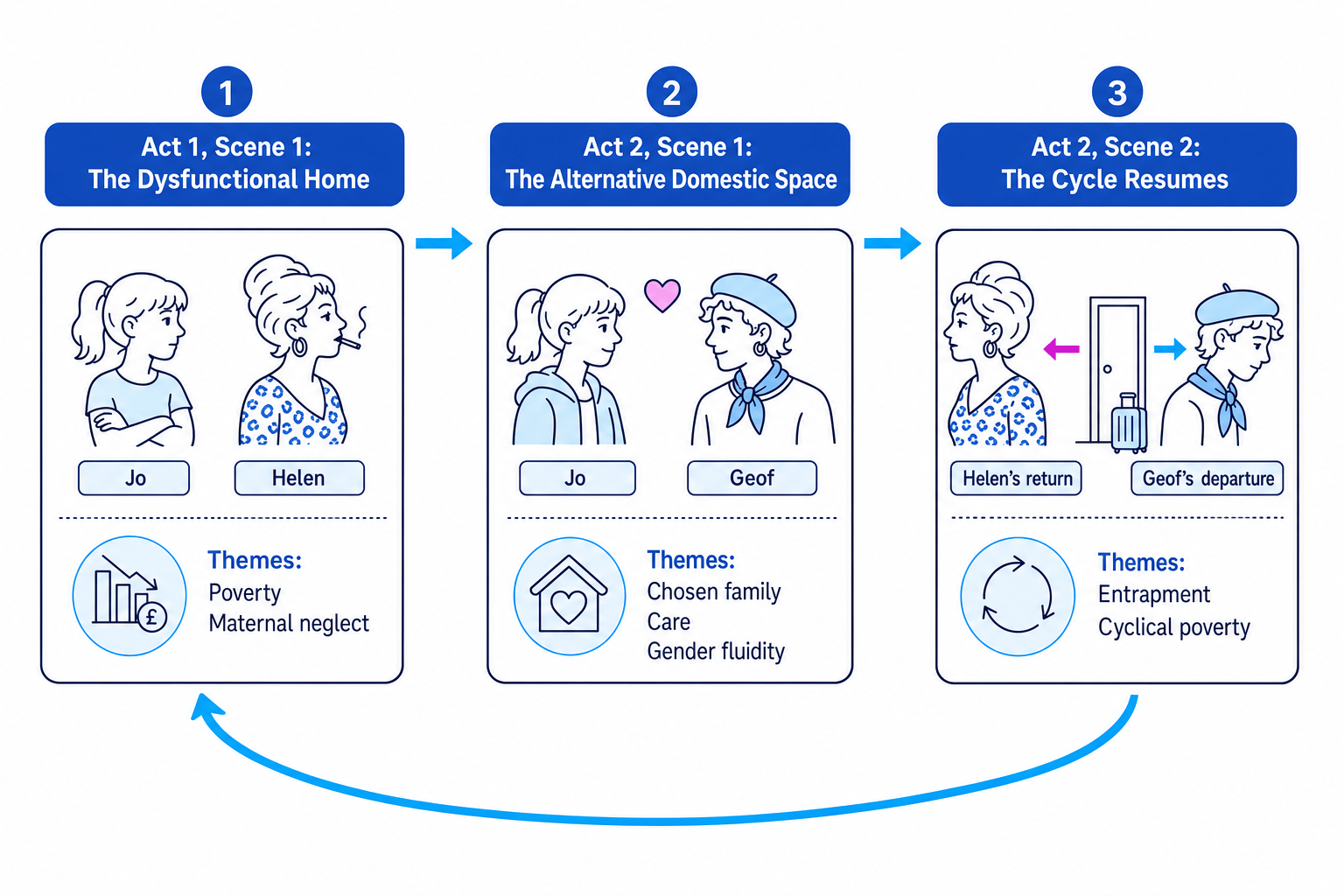
Act 1, Scene 1: The Arrival at the Flat
The opening scene of the play establishes the immediate, physical reality of poverty and the complex, combative relationship between Helen and her teenage daughter, Jo.
Setting the Scene of Displacement
From the moment the curtain rises, we see Helen and Jo entering a "comfortless flat" in Salford. They are carrying cheap suitcases, having fled their previous accommodation to escape unpaid rent. Delaney uses the dirty, neglected flat to symbolise the emotional neglect that characterises Jo’s childhood.
- The dirty window: Helen immediately complains about the state of the room, yet she does nothing to clean it, leaving Jo to wipe the window. This establishes a maternal role-reversal that persists throughout the play.
- The gas ring and the sink: The basic domestic items are shared with other tenants on the landing, highlighting their lack of privacy and low social status.
Jo and Helen’s Dialogue
The dialogue is sharp, fast-paced, and filled with bickering. They behave more like sibling rivals than mother and daughter.
- Helen is self-absorbed, looking in the mirror and searching for her whiskey: "We're keeping out of the rain." She views life through a lens of survival rather than emotional fulfillment.
- Jo is deeply resentful of Helen’s neglect: "You've got no maternal instinct."
Look for the darkness
When Jo says, "I’m not frightened of the darkness outside. It’s the darkness inside houses I don’t like," Delaney is using the setting metaphorically. The "darkness inside" represents the emotional coldness, neglect, and domestic instability of her family life.
Act 1, Scene 2: Jo and Jimmie (The Bid for Escape)
In this scene, Delaney introduces Jimmie, a Black sailor in the Royal Navy. This scene is vital for exploring young love, racial prejudice, and Jo’s desperate bid for independence.
The Naive Romance
Jo’s relationship with Jimmie is romanticised and escapist. Jimmie represents an alternative world far away from Helen’s suffocating influence.
- The Ring: Jimmie gives Jo a cheap brass ring on a ribbon, which she wears around her neck. He promises to return and marry her, a promise the audience suspects is unlikely to be kept.
- The Toy: Delaney uses a toy car that Jimmie gives Jo as a symbol of youth and the childish nature of their dreams.
Contextual Significance: Race in 1950s Britain
In 1958, staging a romance between a white teenage girl and a Black sailor was highly provocative. Society was deeply prejudiced, and interracial relationships were heavily stigmatised.
By presenting Jimmie as kind, poetic, and affectionate—in stark contrast to Helen’s abusive partner, Peter—Delaney challenges the racial prejudices of her contemporary audience.
Misinterpreting Jimmie's departure
Do not write that Jimmie "abandons" Jo maliciously. His departure is a consequence of his employment in the Navy. The tragedy of their relationship lies in its brief, transient nature—it is a fleeting "taste of honey"—rather than a betrayal of affection.
Act 2, Scene 1: Jo and Geof (The Alternative Domesticity)
Act 2 opens several months later. Jimmie has gone, Helen has married Peter and left, and Jo is heavily pregnant and living with Geof, an art student who has been evicted from his lodgings for being homosexual.
Redefining 'Family'
This scene presents the emotional peak of the play. Geof transforms the bleak flat into a warm, clean, functional home. He cleans, cooks, buys a wicker cradle, and brings Jo a rag doll.
- Alternative Gender Roles: Geof assumes a traditional "maternal" caretaking role, while Jo rejects traditional female expectations, refusing to be a housewife or a standard mother: "I don't want to be a mother. I don't want to be a woman."
- A Safe Haven: Geof provides the unconditional love that Helen never could. He tells Jo: "You need somebody to love you while you're looking for someone to love."
Non-naturalism
Non-naturalism refers to theatrical techniques that break the illusion of real life on stage. In A Taste of Honey, this includes characters stepping out of the scene to speak directly to the audience, or the use of a live jazz band on stage to accompany character entrances and exits.
During this scene, Delaney uses non-naturalistic elements—such as Geof and Jo dancing together to jazz music—to emphasise the joy and freedom of their unconventional household, isolated from the judgmental post-war society outside.
Act 2, Scene 2: Helen’s Return and the Cyclic Ending
The final scene of the play brings the inevitable destruction of Jo and Geof’s domestic sanctuary. Helen, having been abandoned by her wealthy, abusive husband Peter, returns to take control of Jo’s flat.
The Disruption of Geof
Helen immediately reasserts her dominance, bullying Geof and insulting his sexuality. She mockingly calls him "Sister Susie" and drives a wedge between him and Jo. Recognizing that he cannot compete with Helen’s aggressive presence, Geof quietly packs his cardboard box and leaves while Jo is asleep.
The Cycle Resumes
When Jo wakes up and discovers Geof has gone, she is devastated. Helen assumes control, but her maternal "care" is instantly exposed as shallow and selfish.
- When Helen discovers that Jo’s baby will be mixed-race (because of Jimmie), her immediate reaction is disgust and anxiety about social embarrassment: "A sister of mine had a black baby... she put it in a basket and drowned it."
- Helen leaves the flat to buy drink, leaving Jo alone on stage as her labor contractions begin.
The play ends with Jo alone, cradling the toy horse Geof left behind, singing the nursery rhyme Geof taught her: "As I was going up Pippin Hill..." The domestic safety Geof built has been entirely dismantled, and Jo is left in the exact same position of isolated, impoverished motherhood that Helen was in years before.
Worked Example: Analysing Alternative Domesticity
Let's walk through how to construct an analytical paragraph examining how Delaney presents the relationship between Jo and Geof in Act 2, Scene 1.
Analysing alternative domesticity
- Point: Delaney presents the relationship between Jo and Geof as a radical, nurturing alternative to traditional, patriarchal family structures of the 1950s.
- Evidence: In Act 2, Scene 1, Geof brings Jo a rag doll to help her prepare for motherhood. When Jo reacts with disgust, saying "The colour's wrong," Geof gently reassures her, saying, "We'll can bathe it and dress it and make it look clean."
- Method: Delaney uses the symbolism of the "rag doll" to represent Jo's upcoming baby and her deep-seated anxieties about motherhood, combined with Geof’s gentle, caring colloquial dialogue which acts as a foil to Helen’s harsh neglect.
- Effect: The physical action of Geof offering the doll highlights his intuitive, maternal care. Jo’s rejection of the doll’s appearance foreshadows her fear of her mixed-race child being rejected by society. Geof’s domestic, practical response ("bathe it and dress it") highlights his willingness to embrace unconventional family roles, providing Jo with the emotional safety net she has never had.
- Context/Theme: Through this domestic interaction, Delaney challenges the strict gender norms of post-war Britain. By showing a gay man and a single, pregnant teenage girl creating a supportive, loving home, Delaney suggests that genuine "family" is built on mutual empathy and choice, rather than biological ties or societal expectations.
In the exam
- Focus on the relationship shifts: If the question asks about a specific character (like Jo or Helen), structure your essay around how their relationships shift across these key scenes. Start with their initial hostility, move to their separation/alternative dynamics, and finish with the cyclic reunion.
- Weave context into your analysis: Never write a separate "context paragraph." Instead, link historical details (such as 1950s attitudes to single mothers, homosexuality, or the rise of the Welfare State) directly to the dialogue or staging choices in the key scenes.
- Remember the stage directions: Delaney’s stage directions are highly detailed. Mentioning how characters move (e.g., Helen constantly looking in the mirror, Geof tidying up, or Jo clutching the toy horse at the end) counts as analyzing structural and dramatic methods (AO2).
Check yourself
- How does the change in the cleanliness and layout of the flat in Act 2, Scene 1 reflect the difference between Helen's parenting and Geof's companionship?
- What does the "brass ring on a ribbon" symbolize in Act 1, Scene 2, and how does its value change by the end of the play?
- Why is Helen’s reaction to the news of the baby’s race in Act 2, Scene 2 structurally and thematically significant for the play’s ending?
