When you sit down to write an essay on Shelagh Delaney’s A Taste of Honey for your GCSE English Literature exam, having a clear, structured plan is your single greatest asset. Because this is a closed-book exam, a solid plan acts as a mental map. It ensures you remain focused on the writer's craft and social context, rather than falling into the trap of simply retelling the story.
This guide will show you how to construct highly effective, thesis-driven essay plans that target the highest grades.
What you'll learn
- How to dissect an exam question and formulate a powerful thesis statement.
- How to organize your thoughts into a logical three-part essay structure.
- How to integrate Shelagh Delaney's dramatic methods and 1950s context into every paragraph.
The Core of GCSE Essay Planning
To score highly on Paper 2, your essay must demonstrate a structured, coherent argument. This means you should never write your essay "on the fly." A great plan bridges the gap between the exam question and a sophisticated, academic response.
Thesis Statement
A thesis statement is a one- or two-sentence summary of your overall argument. It directly answers the prompt and outlines your main line of reasoning, serving as the "anchor" for your entire essay.
Your essay plan needs to account for three key Assessment Objectives (AOs) in a balanced way:
- AO1 (Your Argument): A clear, focused response to the question, supported by precise, remembered quotations.
- AO2 (The Writer's Craft): Analysis of Delaney's use of language, structure, and stagecraft (such as her use of music, colloquialisms, and "Kitchen Sink" theatrical devices).
- AO3 (Context): The relationship between the play and 1950s working-class Manchester (including post-war poverty, changing gender roles, race, and homophobia).
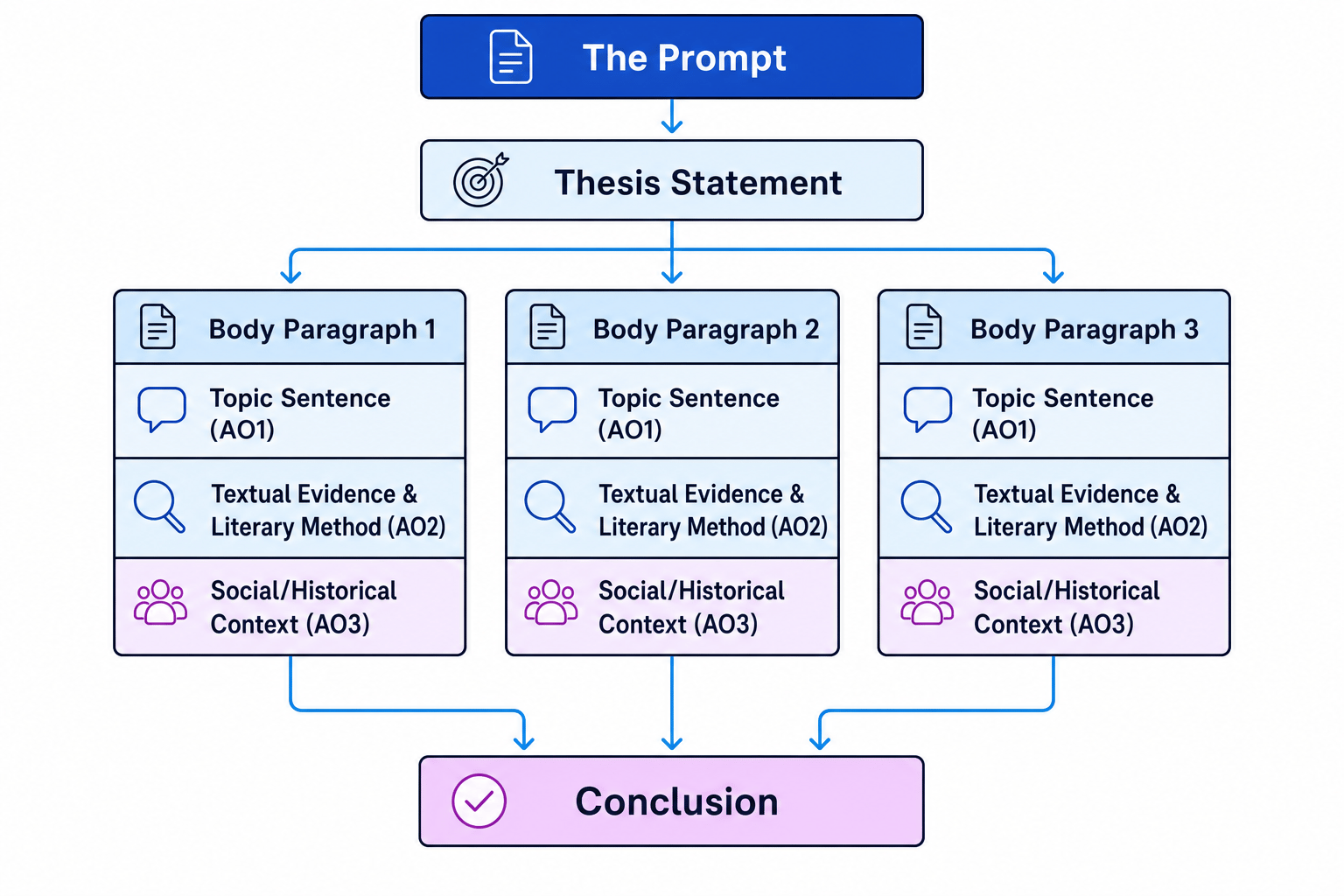
Building a Three-Part Argument
The most successful essays usually follow a three-part structure. Rather than writing a list of disconnected observations, your three main paragraphs should read like a journey, moving chronologically or conceptually through the play to show how a character or theme develops.
Avoid the 'Character Biography' Trap
Never plan an essay that simply lists what a character does in Act 1, Act 2, and Act 3. Instead, structure your plan around how and why Delaney constructs that character to convey a specific social message to her audience.
To do this, we use the "Because, But, Therefore" framework to map out our three body paragraphs:
- Paragraph 1 (The Beginning/Setup): What is the initial state of the character or theme, and because of what social realities does this exist?
- Paragraph 2 (The Complication/Shift): How does the situation change or become challenged, but what obstacles or realities complicate this?
- Paragraph 3 (The Resolution/Message): What is the final state of the character or theme, and therefore what overall message is Delaney conveying to her 1950s audience?
Step-by-Step Essay Planning Technique
Let’s walk through the exact intellectual process of building a high-level essay plan from scratch.
Planning an essay on mother-daughter relationships
Prompt: Explore how Delaney presents the relationship between Helen and Jo in A Taste of Honey.
-
Formulate a thesis statement that answers the "why": Instead of stating that they have a bad relationship, ask yourself why Delaney presents them this way. Write down a thesis statement that targets her authorial intent.
- Draft: Delaney presents the toxic relationship between Helen and Jo as a cyclical product of poverty and emotional neglect, using their conflict to critique the lack of social support for working-class women in 1950s Britain.
-
Establish three distinct, chronological stages of their relationship: Break the play down into three conceptual shifts to form your three main paragraph focus points.
- Point 1: Act 1, Scene 1 — The competitive, codependent, and neglectful dynamics established in their new flat.
- Point 2: Act 2 — Jo's pregnancy and her temporary escape from Helen's influence, contrasted with Helen's abandonment of Jo for Peter.
- Point 3: Act 2, Scene 3 — Helen's return, which disrupts Jo's newly found peace, restoring the cyclical pattern of conflict and codependency.
-
Select high-impact, short quotations (AO1) for each stage: Pick memorable, versatile quotes that allow for deep language or structural analysis.
- Stage 1 Quotes: Jo's "You’re a proper old nuisance" and Helen's "Drink, drink, drink, that's all you're fit for."
- Stage 2 Quotes: Jo's reflective "She makes me feel dirty" and her pride in her independence.
- Stage 3 Quotes: Helen's frantic return and her instant dismissal of Geof, calling him a "little pansy."
-
Identify specific writer's methods (AO2) to analyze: Pinpoint the theatrical or linguistic techniques Delaney uses in these moments.
- Methods for Stage 1: Rapid, stichomythic dialogue (quick, biting exchanges), colloquialisms, and the physical setting of the dingy, shared flat.
- Methods for Stage 2: Contrast and dramatic irony (Helen enjoys relative comfort while Jo is left pregnant and impoverished).
- Methods for Stage 3: Cyclical dramatic structure (the play ends almost exactly how it began, with Helen dominating the space).
-
Weave in the social and historical context (AO3): Align each paragraph with a specific historical reality of post-war Manchester.
- Context 1: The grim reality of working-class housing and the lack of a reliable welfare state safety net for single mothers.
- Context 2: Societal expectations of female domesticity versus the harsh economic reality that forced women like Helen into survivalist pragmatism.
- Context 3: The generational cycle of poverty and the lack of institutional support, which traps working-class women in abusive or neglectful family dynamics.
Analyzing characters as real people
Students often write sentences like: "Jo is angry because Helen is a bad mother." This ignores the writer's craft! Instead, frame your planning around Delaney's choices: "Delaney employs aggressive stichomythic dialogue between Helen and Jo to highlight the emotional friction caused by their forced economic codependency."
Master Essay Plans
Here are two ready-to-use, high-scoring essay plans. Use these to guide your revision and practice your writing.
Plan 1: The Theme of Marginalisation
This essay plan explores how Delaney depicts characters who live on the fringes of 1950s British society (Jo, Geof, and Jimmie).
                      ┌─────────────────────────────────────────┐
                      │                 THESIS                  │
                      │ Delaney uses her marginalized characters│
                      │  to challenge post-war optimism and to  │
                      │  expose the deeply entrenched social    │
                      │     prejudices of 1950s Britain.        │
                      └────────────────────┬────────────────────┘
                                           │
         ┌─────────────────────────────────┼─────────────────────────────────┐
         ▼                                 ▼                                 ▼
┌──────────────────┐              ┌──────────────────┐              ┌──────────────────┐
│   PARAGRAPH 1    │              │   PARAGRAPH 2    │              │   PARAGRAPH 3    │
│  Geof's Gender/  │              │ Jimmie's Race &  │              │ Jo's Cyclical    │
│   Homosexuality  │              │  Social Taboos   │              │   Trappiness     │
└──────────────────┘              └──────────────────┘              └──────────────────┘
Paragraph 1: Geof and Gender Identity
- Focus (AO1): Delaney presents Geof as a gentle, domestic figure who challenges traditional mid-20th-century concepts of masculinity.
- Evidence (AO1): Geof's domestic actions ("He begins to tidy the room") and Helen's homophobic slurs ("miserable little queer," "little pansy").
- Method (AO2): Subversion of gender roles; domestic stage business; derogatory, colloquial language used as a tool of social policing.
- Context (AO3): Homosexuality was illegal in the UK until 1967. Homophobia was socially pervasive, making Geof's sympathetic and central portrayal on stage highly revolutionary.
Paragraph 2: Jimmie, Race, and Imperialism
- Focus (AO1): Jimmie represents both a romantic escape for Jo and a stark reminder of the racial prejudices of the era.
- Evidence (AO1): Jo's fascination with Jimmie's race ("I think you're beautiful") contrasted with Helen's horrified reaction to the pregnancy ("A grey faced baby!").
- Method (AO2): Symbolism (Jimmie's toy ring representing temporary, fragile happiness); contrasting imagery of light and darkness.
- Context (AO3): The post-Windrush era in Britain saw a rise in racial tensions. By portraying a sympathetic interracial romance, Delaney directly confronted her audience's racial biases.
Paragraph 3: The Intersecting Trap
- Focus (AO1): Delaney shows how poverty, youth, and gender intersect to trap Jo in a cycle of marginalisation, despite her attempts to break free.
- Evidence (AO1): Jo's resignation in Act 2: "I'm not frightened of the darkness outside. It's the darkness inside house I don't like."
- Method (AO2): The setting as a physical metaphor for entrapment; the circular structure of the play's ending (Geof's departure and Helen's return).
- Context (AO3): The post-war Welfare State was in its infancy. For young, unmarried, pregnant working-class women, there was virtually no social safety net, making escape from poverty nearly impossible.
The Power of Stage Directions
When planning, don't just look for spoken words. Delaney's stage directions are rich with meaning. For example, notes about Geof tidying the flat, or Jo playing with a sparkler, are fantastic structural and visual methods (AO2) to plan your paragraphs around.
Plan 2: The Presentation of Class and "Kitchen Sink" Realism
This plan explores how Delaney rejects traditional, glamorous theatrical styles to depict the gritty, authentic reality of working-class life.
Kitchen Sink Realism
Kitchen Sink Realism is a British cultural movement of the late 1950s and 1960s that featured working-class protagonists, domestic settings, and addressed social issues like poverty, abortion, and pre-marital sex.
Paragraph 1: The Domestic Setting as a Trap
- Focus (AO1): The physical setting of the flat is planned to immediately convey the claustrophobia and decay of working-class existence.
- Evidence (AO1): Descriptions of the "comfortless flat" and the shared toilet ("We're all uneasy in this room").
- Method (AO2): The use of a single, realistic, bleak set (unwashed windows, lack of heating) to reflect the psychological confinement of its inhabitants.
- Context (AO3): A reaction against the polite, middle-class "well-made plays" of West End theatre (such as those by Terence Rattigan). Delaney brings the actual, unpolished reality of Salford slums to the stage.
Paragraph 2: Colloquial Language and Working-Class Voice
- Focus (AO1): Delaney legitimizes working-class identity by writing in authentic, regional, and colloquial voices rather than standard, received pronunciation.
- Evidence (AO1): Biting, rapid-fire dialogue, insults ("bloody," "daft"), and regional phrasing.
- Method (AO2): Naturalistic dialogue; stichomythia to represent tension; the influence of music hall humor (dark, cynical banter used as a coping mechanism).
- Context (AO3): In 1958, hearing authentic northern, working-class dialects on a London stage was incredibly rare and politically radical. It demanded that the establishment take working-class lives seriously.
Paragraph 3: The Rejection of Easy Resolutions
- Focus (AO1): In keeping with realism, Delaney refuses to provide her audience with a clean, happy ending, emphasizing that poverty is an ongoing cycle.
- Evidence (AO1): Helen's return, Geof's quiet departure, and Jo left alone on stage, breathing heavily as she goes into labor.
- Method (AO2): Open-ended, unresolved dramatic climax; cyclical structure; use of a melancholy jazz motif to underscore the unresolved tension.
- Context (AO3): Challenging the post-war political narrative of "You’ve never had it so good" (a famous slogan by Prime Minister Harold Macmillan). Delaney shows that for the northern working-class, very little had actually improved.
In the exam
- Spend 5 minutes planning: Do not skip this! A 5-minute plan will keep your essay structured, preventing you from drifting off-topic or running out of things to say.
- Draft your thesis statement first: Write your thesis at the top of your planning space. Refer back to it before starting every single paragraph to make sure you are maintaining a single, coherent argument.
- Map your quotes to your methods: Next to every quote you jot down in your plan, write a one-word reminder of the method (e.g., Stichomythia, Symbolism, Stage Direction). If you don't plan your methods, you risk writing a purely AO1-focused essay.
Check yourself
- Can you write a thesis statement for an essay about Peter's role in the play in under two minutes?
- Which three quotes would you select to show how Jo's character changes from the start of the play to the end?
- How does the cyclical structure of the play's ending directly support Delaney's critique of the 1950s welfare system?
