Because your GCSE English Literature exam is closed-book, you do not need to memorise long blocks of text. Instead, your goal is to master a small bank of short, versatile, high-impact quotations. By learning how to "explode" these quotes—analysing their structural, linguistic, and contextual layers—you can adapt them to almost any essay prompt.
What you'll learn
- How to select and memorise highly versatile, short quotes for the closed-book exam.
- How to apply the "Quotation Explosion" technique to analyse language, form, and structure (AO2).
- How to seamlessly link your quotation analysis to Elizabethan and Jacobean contexts (AO3).
The Art of the "Quotation Explosion"
To achieve top marks, you must avoid simply dropping quotes into your essay to prove that a plot event happened. Every quote you use must be analysed for its deeper meaning.
Micro-analysis
Micro-analysis is the practice of zooming in on a specific word, grammatical feature, or literary device within a quotation and explaining how it creates meaning, develops a theme, or reveals a character's subconscious motivations.
Instead of writing, "Shylock is angry, which we see when he says 'Hath not a Jew eyes?'", you should break the quotation down to show how Shakespeare constructs this anger and humanity.
The 'Less is More' Rule
A single, deeply analysed three-word quotation will always score higher than a long, three-line block of text that you simply summarise. Zoom in on nouns, verbs, and structural patterns to show the examiner you are looking at the play as a constructed work of art.
Key Quotes: Theme by Theme
1. Prejudice, Humanity, and Revenge
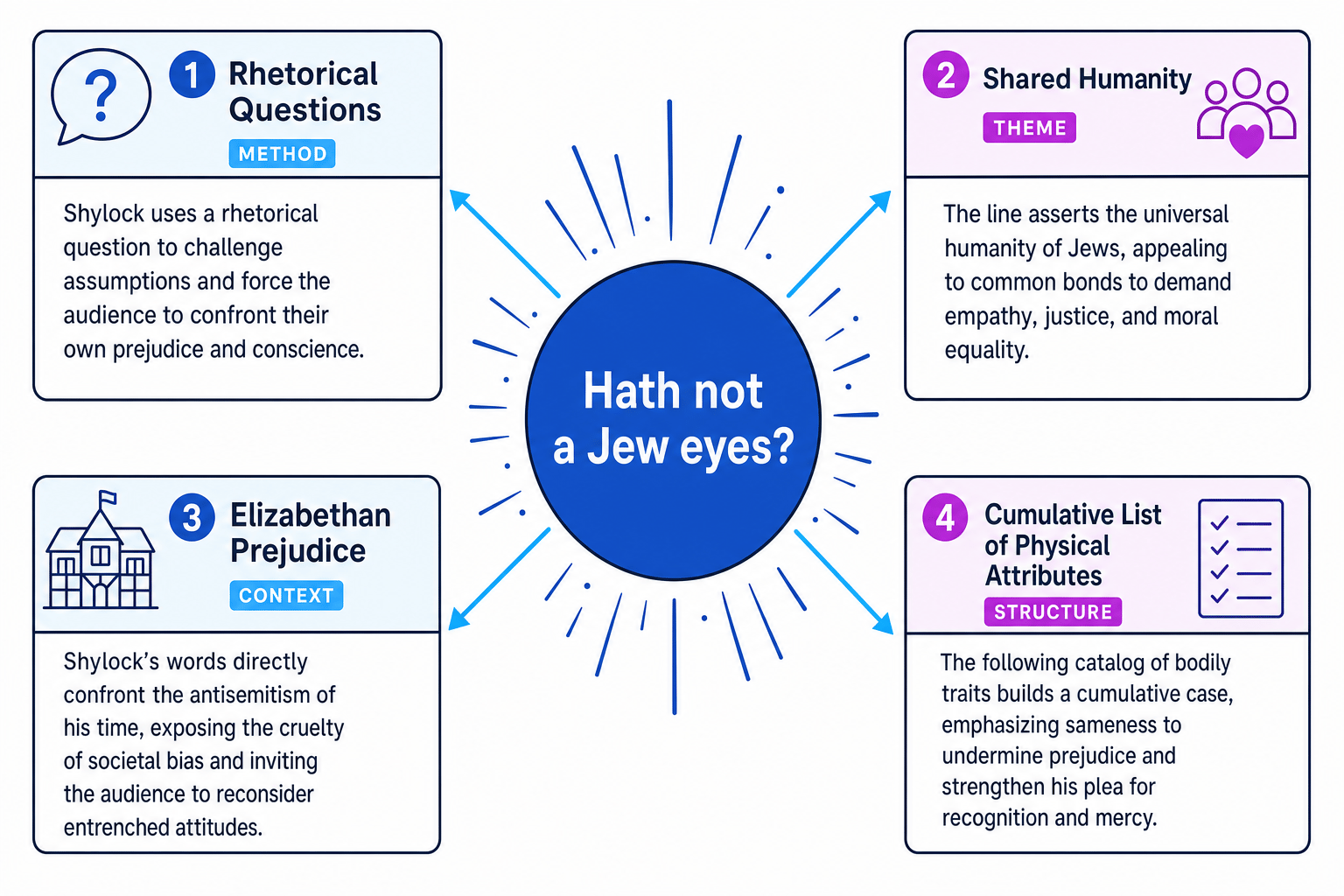
"Hath not a Jew eyes? Hath not a Jew hands, organs, dimensions, senses, affections, passions?" — Shylock (Act 3, Scene 1)
- The Method: Shakespeare utilizes a barrage of rhetorical questions and a cumulative list of physical and emotional attributes.
- The Effect: By focusing on shared human anatomy ("eyes", "hands", "organs") and feelings ("affections", "passions"), Shylock bypasses religious differences to appeal to a universal biological and emotional reality. The relentless pace of the list reflects his rising desperation and anger.
- The Context (AO3): In Elizabethan England, Jewish people had been officially banished since 1290, meaning Shakespeare's audience would have had very little direct contact with Jewish communities. They were largely viewed through antisemitic caricatures. By presenting Shylock with such raw, universal humanity, Shakespeare challenges his contemporary audience's prejudices, even as the character moves toward a villainous path.
The Dual Purpose
Never treat Shylock as a simple villain or a perfect victim. This quote does both: it defends his humanity, but it is also used to justify his impending revenge ("If you prick us, do we not bleed? And if you wrong us, shall we not revenge?").
2. Mercy, Justice, and Power
"The quality of mercy is not strained; / It droppeth as the gentle rain from heaven / Upon the place beneath." — Portia (Act 4, Scene 1)
- The Method: Portia uses a simile ("as the gentle rain") and natural imagery.
- The Effect: The verb "strained" means forced or constrained. Portia argues that mercy must be given freely; it cannot be compelled by law. Comparing mercy to "rain" suggests it is natural, life-giving, and divine. It falls impartially on everyone, just as rain falls on all land.
- The Context (AO3): This speech contrasts the Old Testament concept of strict justice and retaliation (the "law" Shylock demands) with the New Testament Christian doctrine of grace and mercy. Portia is appealing to Shylock, but Shakespeare is also highlighting the religious hypocrisy of the Venetian court, which later forces Shylock to convert to Christianity—an act they view as "merciful," but which strips Shylock of his identity.
Ignoring the Hypocrisy
Many students write about Portia’s "Mercy" speech as if she is a perfect beacon of justice. Do not fall into this trap! In the exam, point out the dramatic irony: Portia delivers this beautiful speech demanding mercy for Antonio, but later shows absolutely zero mercy to Shylock when she uses legal technicalities to strip him of his wealth and faith.
3. Wealth, Deception, and Value
"All that glisters is not gold; / Often have you heard that told." — The Scroll in the Golden Casket (Act 2, Scene 7)
- The Method: Shakespeare uses rhyming couplets, alliteration ("glisters... gold"), and an aphorism (a pithy observation that contains a general truth).
- The Effect: The visual verb "glisters" (glistens) highlights the superficial lure of outward appearances. The contrast between what "glisters" and actual "gold" serves as a moral warning that physical beauty and material wealth often mask corruption or worthlessness.
- The Context (AO3): Venice was a global hub of trade, mercantilism, and immense wealth. Through the casket test, Shakespeare critiques his own society's obsession with surface presentation, wealth, and status. This moral lesson extends to characters like Bassanio, who initially describes Portia as a "lady richly left," showing that his love is tied up with financial ambition.
Worked Example: Deep Quotation Analysis
Let's walk through how to construct a high-scoring analytical paragraph on a highly versatile quote from Act 1, Scene 3, where Shylock outlines his boundaries to Bassanio and Antonio.
Analysing Shylock's boundary quote
Quote: "I will buy with you, sell with you, talk with you, walk with you, and so following; but I will not eat with you, drink with you, nor pray with you."
-
Identify structural patterns and contrast (AO2):
Observe the strict grammatical structure. Shakespeare uses parallelism and syntactic symmetry, dividing the sentence into two distinct halves separated by the coordinating conjunction "but".
-
Analyse specific word choices and semantic shifts (AO2):
Look closely at the verbs. The first half features verbs of commerce and public interaction ("buy", "sell", "talk", "walk"). The second half transitions to verbs of intimate communion and spiritual devotion ("eat", "drink", "pray"). The repetition of "with you" acts as a rhythmic drumbeat, highlighting that while economic transactions are unavoidable, social and spiritual integration is absolutely barred.
-
Connect the textual patterns to characterisation and historical context (AO3):
This linguistic wall mirrors the literal walls of the Venetian Ghetto, where Jewish residents were forced to live locked away at night. Shylock is defining his identity through exclusion. While the Christian characters view Shylock solely as a financial tool, Shylock reasserts his religious integrity by refusing to compromise his kosher dietary laws ("eat", "drink") and his faith ("pray"). This reveals that the prejudice in Venice is not just personal, but deeply institutionalized.
In the exam
- Embed your quotes: Never let a quotation stand alone as its own sentence. Always weave it grammatically into your own writing. Instead of: Shylock hates Antonio. "I hate him for he is a Christian." This shows..., write: Shylock’s prejudice is immediately established when he admits in soliloquy that he hates Antonio "for he is a Christian", exposing how religious divisions poison Venetian society.
- Use the "Zoom-In, Zoom-Out" method: Start by stating your overall point (Zoom-Out). Provide your short quote and identify a technique, such as a metaphor or structural contrast (Zoom-In). Finally, connect that specific word or technique back to Shakespeare’s overall message or the historical context of Elizabethan England (Zoom-Out).
- Track character changes: Choose quotes that show a character's journey. For example, compare Shylock's confident, legalistic language in Act 4, Scene 1 ("I stand here for law") with his defeated final lines ("I am not well. Send the deed after me, / And I will sign it"). Pointing out this linguistic collapse will demonstrate a sophisticated understanding of dramatic structure.
Check yourself
- Can you identify the literary method used in "The quality of mercy is not strained; / It droppeth as the gentle rain..." and explain why it is effective?
- Why is it better to memorise three-word fragments like "stand for law" or "gentle rain" instead of full, four-line speeches?
- How does the scroll's message "All that glisters is not gold" link to Bassanio's initial description of Portia in Act 1, Scene 1?
