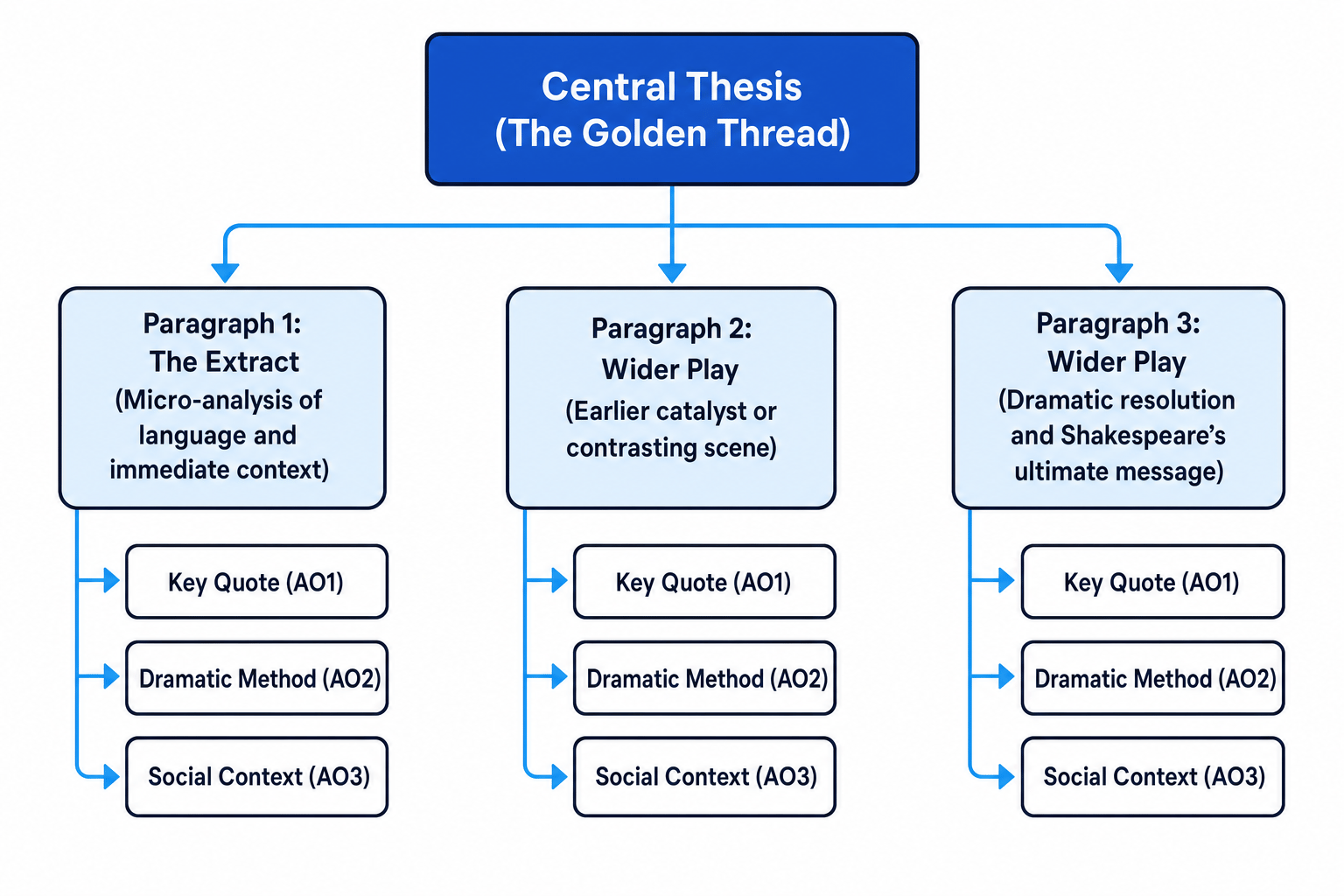
Step-by-Step Essay Planning
Let's put this planning framework into practice. We will walk through the creation of a full essay plan based on a highly common exam focus: Shylock's dual nature as both a victim and a villain.
Imagine your exam paper has provided an extract from Act 3 Scene 1 (Shylock's famous "Hath not a Jew eyes?" speech) and the following prompt:
Starting with this extract, explore how Shakespeare presents Shylock as both a victim and a villain.
The Balance Rule
Never write an essay that argue Shylock is 100% victim or 100% villain. Shakespeare's plays are tragedies and comedies of human complexity. A level 5/6 (top band) essay will always explore the tension between these two opposing presentations.
Here is the step-by-step process to plan a top-tier essay response.
Planning an essay on Shylock as victim and villain
-
Construct a nuanced thesis statement (AO1/AO3): Rather than just agreeing that he is both, establish a cause-and-effect relationship. Why is he a villain? Because of the victimization he has suffered.
Example Thesis: "While Shakespeare conforms to Elizabethan anti-Semitic stereotypes by presenting Shylock as a merciless, vengeful villain, he simultaneously subverts these expectations by illustrating how Shylock's villainy is a direct, tragic product of the systemic Christian prejudice and abuse he suffers in Venice."
-
Deconstruct the extract for Paragraph 1 (AO1/AO2/AO3): Look closely at the provided scene (Act 3 Scene 1). Locate the exact turning point where his plea for shared humanity shifts into a threat of violence.
- Evidence: "Hath not a Jew eyes? [...] If you prick us, do we not bleed?" shifting to "The villainy you teach me I will execute, and it shall go hard but I will better the instruction."
- Method: Rhetorical questions (to establish shared physical and emotional humanity) followed by the cold, declarative verb "execute" and the comparative "better" (showing his descent into vengeful villainy).
- Context: Shakespeare challenges the Elizabethan audience's prejudice by humanizing a Jewish character, yet ultimately satisfies their expectations by having him vow revenge.
-
Select contrasting wider play evidence for Paragraph 2 (AO1/AO2/AO3): Find a scene earlier in the play that establishes why Shylock behaves this way. Act 1 Scene 3 is perfect here, as it shows the daily reality of Venetian prejudice.
- Evidence: "You call me misbeliever, cut-throat dog, / And spit upon my Jewish gaberdine."
- Method: Animalistic imagery ("dog") and degrading verbs ("spit") showing the dehumanization Shylock faces from Antonio—the supposed Christian hero. Note the regular iambic pentameter which gives Shylock a controlled, dignified tone, highlighting his restraint in the face of abuse.
- Context: Usury (charging interest on loans) was a sin for Christians but one of the few professions allowed to Jews in Venice. Antonio's hatred is economic as well as religious.
-
Select resolving wider play evidence for Paragraph 3 (AO1/AO2/AO3): Go to the climax—the trial scene in Act 4 Scene 1. How is Shylock's dual nature resolved? He demands his "pound of flesh" (villainy), but is stripped of his wealth and forced to convert (victimhood).
- Evidence: Shylock insists on his bond: "The pound of flesh which I demand [...] Is dearly bought, 'tis mine and I will have it." Later, Portia's cruel triumph forces him to "presently become a Christian" and leave his wealth to Lorenzo.
- Method: The recurring motif of the legal "bond" and the stark contrast between his demands for absolute justice and the court's forced, merciless "mercy".
- Context: The forced conversion was seen as "saving" Shylock's soul by an Elizabethan audience, but modern audiences view it as the ultimate destruction of his identity, highlighting the shifting reception of the play over time.
-
Review the plan for structural cohesion: Check that every paragraph links back to your original thesis statement (the "golden thread"). Ensure you have at least one clear poetic/dramatic method (AO2) and one contextual link (AO3) noted down for each of the three paragraphs.
Feature Spotting
Do not just write down devices in your plan (e.g., "metaphor" or "rhetorical question") without noting why they are used. A plan that says "Shylock uses rhetorical questions to show he is a victim" is weak. Your plan should say: "Rhetorical questions establish shared physical vulnerability, forcing the Christian characters (and the audience) to acknowledge their shared humanity."
Integrating Context (AO3) into your Plan
GCSE examiners do not want to see "historical facts" dumped into your essay at random. Saying "Elizabethans hated Jews because of Roderigo Lopez" does not get you marks unless it is directly tied to Shakespeare's dramatic choices.
When planning, make sure your AO3 notes explain why Shakespeare wrote the play the way he did or how an audience would react.
Contextualizing Shylock
When referencing Venetian society, remember that Venice was a wealthy, cosmopolitan trading hub. The laws protecting foreign merchants (like Shylock) had to be absolute, otherwise, Venice's international trade reputation would collapse. This is why Antonio and the Duke cannot simply rip up Shylock's contract—which makes Shylock's legal exploitation in Act 4 even more dramatic.
Complete Model Essay Plan
Here is how your final, concise plan should look on your scrap paper before you begin writing your essay. Notice how short and abbreviated it is—you only have 5 minutes to write this in the actual exam!
Prompt: Explore how Shakespeare presents Shylock as both a victim and a villain.
- Thesis: Shylock's villainy is not inherent; it is a direct reaction to the brutal, systemic victimization he suffers in Venice's hypocritical Christian society.
- Para 1: The Extract (Act 3, Scene 1)
- Focus: Shylock's speech: the turning point from victim to villain.
- Evidence: "Hath not a Jew eyes?" / "The villainy you teach me I will execute".
- Method: Rhetorical questions (shared humanity); Verb "execute" (learned behavior).
- Context: Subverts Elizabethan caricature; reveals revenge as a lesson learned from Christians.
- Para 2: The Wider Play - The Past (Act 1, Scene 3)
- Focus: The catalyst—daily abuse from Antonio.
- Evidence: "spit upon my Jewish gaberdine" / "void your rheum upon my beard".
- Method: Degrading, visceral verbs and animalistic slurs ("dog").
- Context: Venetian usury laws; Christians used Jews for finance while abusing them.
- Para 3: The Wider Play - The Climax (Act 4, Scene 1)
- Focus: The trial—vengeance defeated by systemic cruelty.
- Evidence: "I demand the bond" / "presently become a Christian".
- Method: Motif of the legal "bond" vs. the forced "mercy" of conversion.
- Context: Conversion as spiritual death; Elizabethan vs. modern audience interpretations.
- Conclusion: Reiterate thesis. Shakespeare exposes the moral rot of Venice—the "villain" Shylock is ultimately a mirror reflecting Christian hypocrisy.
In the exam
When you turn over your exam paper, use this exact routine to guarantee a focused essay:
- Spend exactly 5 minutes planning. Do not skip this. An unplanned essay almost always drops marks in AO1 (coherence).
- Deconstruct the prompt. Circle the key theme or character name, and underline any instruction keywords (like "how" or "present").
- Draft your Thesis Statement first. Write it out in full at the top of your planning sheet. This keeps your mind focused on the core argument.
- Select 3 clear quotes from the extract and 3 clear quotes from your memory for the wider play. Do not choose long sentences; pick short, 2-to-5-word phrases that are rich in language methods.
- Check off your AOs. Make sure your notes show a balance: Is there a quote? (AO1) Is there a named method? (AO2) Is there a historical or social link? (AO3).
Check yourself
Before moving on to the next topic, ask yourself these questions to see if you have mastered essay planning:
- Can you explain why it is vital to balance the analysis of the extract with references to the wider play?
- What is the difference between a simple plot statement and a sophisticated thesis statement?
- Can you identify three distinct moments in The Merchant of Venice that you could use to contrast with the trial scene (Act 4 Scene 1) in an essay on justice?
