To understand Shelagh Delaney’s 1958 play A Taste of Honey, you have to travel back to the gritty streets of post-war Salford. Written when Delaney was just nineteen years old, the play burst onto the stage at a time when British society was undergoing profound, uneasy changes.
In your GCSE English Literature exam, your understanding of this context is assessed under AO3 (Assessment Objective 3). This does not mean you should simply dump historical facts onto the page. Instead, you must show how Delaney uses the world around her to shape the play’s characters, themes, and dramatic impact.
What you'll learn
- How post-war social changes in 1950s Britain influenced Delaney's portrayal of working-class life
- The revolutionary way the play addresses highly taboo subjects, including race, homosexuality, and single motherhood
- How the "Kitchen Sink Realism" movement and theatrical censorship challenged the elite, traditional British stage
Understanding "Context" (AO3)
Before looking at the historical facts, let's establish what literary context actually is and how to use it.
Context (AO3)
Context is the relationship between a literary text and the historical, social, cultural, and political conditions in which it was written and received. It is not just "history"; it is how the writer reacts to, challenges, or reflects the world they lived in.
Many students treat context like a history essay. They write long paragraphs about the 1950s and then simply add, "and this is shown in the play." Examiners call this context-dumping. To get the highest marks, you must always weave your contextual knowledge directly into your analysis of Delaney's language, structure, and stagecraft.
The Golden Rule of AO3
Never write a sentence of context without linking it back to a specific choice Delaney made—whether that is a character's dialogue, a stage direction, or a structural development.
The Social Landscape of 1950s Salford
The play is set in Salford, an industrial city in Lancashire (now part of Greater Manchester). Let’s break down the major social realities of this time and place.
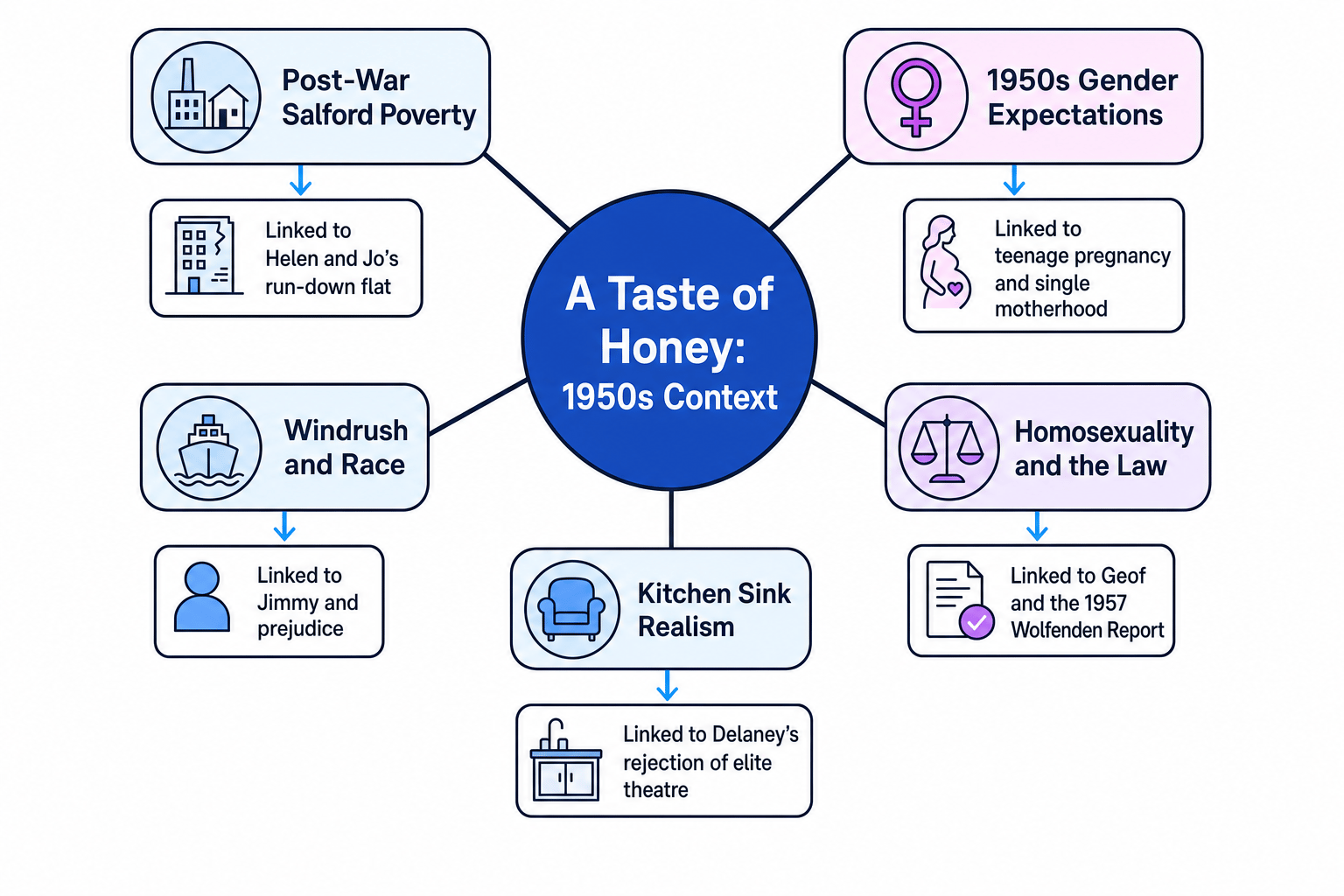
1. Post-War Urban Poverty and the Working Class
In the late 1950s, Britain was still recovering from the physical and economic devastation of the Second World War. Although the post-war Labour government had established the Welfare State (including the NHS in 1948) to eliminate poverty, many industrial northern towns remained desperately poor.
Salford was dominated by heavy industry, factories, and docks. Housing was often substandard, consisting of cramped, damp "back-to-back" Victorian terraces or run-down tenement flats.
Delaney reflects this immediately in the opening scene. Helen and Jo move into a flat that Helen describes as a "comfortless family saloon" with a shared toilet down the hall. By choosing this setting, Delaney forces her middle-class London theatre audiences to look directly at the bleak, unglamorous reality of working-class northern life.
2. Women, Motherhood, and Morality
In the 1950s, women were heavily pressured to conform to traditional domestic roles. Society expected women to marry young, manage a home, and raise children.
- The Nuclear Family: This was the idealized standard. Single mothers were deeply stigmatized.
- Unmarried Pregnancy: Getting pregnant outside of marriage was considered a massive moral scandal. Young women who did so were often sent away to "mother and baby homes" or forced to give up their children for adoption.
Delaney completely subverts these expectations through Helen and Jo:
- Helen is a self-proclaimed "semi-demi-respectable woman" who prioritizes her own survival and sexual desires over her daughter. She refuses to be the sacrificial, nurturing mother demanded by 1950s society.
- Jo becomes pregnant out of wedlock by a black sailor. Her defiance of domestic expectations and her determination to raise the baby outside of a traditional nuclear family were incredibly radical for a 1958 audience.
3. Race and the Windrush Generation
In 1948, the Empire Windrush arrived in Britain, bringing citizens from the Caribbean to help rebuild the post-war economy. This marked the beginning of modern multicultural Britain. However, these immigrants faced widespread, systemic racism, social exclusion, and hostility.
Interracial relationships were highly taboo. By introducing Jimmy, a black sailor in the Royal Navy, Delaney brought these tensions directly onto the stage.
What is revolutionary is not just that Jo has a relationship with a black man, but how Delaney presents it. Jimmy is handsome, tender, and poetic. He treats Jo with a genuine care that she has never experienced from her mother. Delaney does not moralize or lecture; she simply presents their love as natural and sweet, exposing the prejudice of the wider world (embodied by Helen’s horrified reaction later in the play) as cruel and outdated.
4. Homosexuality and the Law
In 1958, male homosexual acts were illegal in England and Wales. Gay men faced police harassment, public exposure, blackmail, and prison sentences. The Wolfenden Report of 1957 had recommended that homosexual acts between consenting adults in private should be decriminalized, but this was not passed into law until the Sexual Offences Act in 1967.
Because of this criminalization, gay characters in British media were almost non-existent. If they did appear, they were usually presented as villainous, tragic, or cartoonish caricatures.
Delaney’s portrayal of Geof was groundbreaking:
- Geof is sensitive, artistic, domestic, and deeply empathetic.
- He becomes Jo’s surrogate family and the most maternal figure in the play, cleaning the flat and preparing for the baby.
- While Helen hurls homophobic insults at him (calling him a "pouf" and telling him "you're half a man"), the play itself treats Geof with immense dignity and sympathy.
Confusing the play's attitude with the characters' attitudes
Students often assume Delaney is being prejudiced because characters like Helen use homophobic or racist language. Remember: Delaney is exposing the prejudice of her society, not endorsing it. Look at how the drama treats Geof and Jimmy. They are the most sympathetic, loving characters in the play, while the prejudiced characters (Helen and Peter) are selfish and destructive.
The Literary Context: Kitchen Sink Realism
To understand why A Taste of Honey caused such a sensation, you must understand what British theatre looked like before 1958.
Kitchen Sink Realism
Kitchen Sink Realism is a cultural movement of the late 1950s and early 1960s in British theatre, art, and literature. It focused on the domestic lives of working-class people living in industrial areas, using gritty realism, regional accents, and candid depictions of taboo social issues.
Prior to this movement, mainstream British theatre was dominated by polite, upper-middle-class dramas set in country drawing rooms (often called "well-made plays"). The characters spoke in Received Pronunciation (Queen's English) and avoided any mention of sex, money, or real-world struggle.
Delaney belonged to a group of young writers known as the "Angry Young Men" (though she was one of the very few women), who rejected these artificial, elite plays.
The Theatre Workshop and Joan Littlewood
Delaney sent her script to Joan Littlewood, the radical director of the Theatre Workshop in Stratford, East London. Littlewood’s mission was to make theatre accessible and relevant to working-class audiences.
Littlewood used experimental, collaborative techniques. She introduced live jazz music, direct address to the audience (breaking the "fourth wall"), and encouraged actors to improvise. This energetic, music-hall-influenced style offset the bleakness of the play's domestic setting, giving A Taste of Honey its unique, bittersweet tone.
Censorship and the Lord Chamberlain
In 1958, all plays in the UK had to be licensed by the Lord Chamberlain, a government official who censored any stage material deemed immoral, politically sensitive, or indecent.
The Lord Chamberlain's office heavily scrutinized A Taste of Honey because of its references to homosexuality and premarital sex. Joan Littlewood and the Theatre Workshop had to use clever phrasing and subtext to slip the play past the censors. For example, Geof’s sexuality is never explicitly named, but it is made perfectly clear through code and behaviour.
The power of subtext
Because of 1950s censorship laws, Delaney had to write Geof’s homosexuality using subtle cues. When analyzing his character, look at how Delaney uses double entendres and euphemisms. For example, when Helen says Geof is "like a sister to" Jo, or when Geof says he has "been kicked out" of his flat, the contemporary audience would immediately understand the subtext.
Worked Example: Integrating Context
Let's look at how to write a high-scoring paragraph that seamlessly weaves contextual knowledge with language and structural analysis.
Analyzing the presentation of Geof and gender roles
Question: How does Delaney present Geof's character in relation to 1950s social expectations?
-
Step 1: Point and Textual Evidence
Start with a clear analytical claim and a precise quotation. Focus on Geof's domestic actions.Delaney presents Geof as a direct challenge to the rigid gender roles of 1950s Britain by portraying him as highly domestic and nurturing. When Jo is struggling during her pregnancy, Geof offers her comfort, stating: "You need somebody to look after you." He actively steps into the caregiving role, preparing the flat, making tea, and even buying a wicker basket to act as a crib.
-
Step 2: Analysis of Method and Language
Analyse the literary or dramatic methods being used, focusing on the effects of these choices.The imperative "need" highlights Geof’s proactive sense of responsibility, while his domestic actions function as a visual motif of maternal care. In a domestic setting traditionally dominated by women, Geof becomes the primary caregiver. Delaney structurally positions Geof as the true "mother" figure in the play, contrasting his gentle attentiveness with Helen’s maternal neglect.
-
Step 3: Integration of Context (AO3)
Explain why Delaney made this choice by linking it directly to the 1950s social climate, censorship, and the play's reception.This subversion of domestic roles was highly radical in 1958, a time when homosexuality was illegal and gay men were heavily stigmatized as social predators or tragic figures. By presenting Geof not as a punchline, but as the play's moral centre and most nurturing presence, Delaney directly challenged the homophobic prejudices of her contemporary audience. Furthermore, because of the strict censorship of the Lord Chamberlain’s office, Delaney could not explicitly declare Geof’s sexuality; instead, she uses his domesticity and the insults thrown by Helen to subtly bypass the censor, forcing the audience to sympathize with a marginalized figure.
In the exam
When answering a question on A Taste of Honey, keep these three strategic tips in mind to maximize your AO3 marks:
- Avoid "history-dumping": Never write a whole paragraph purely about the 1950s. Always start with the text (a quotation and a method), explain its meaning, and then explain how the context helps us understand Delaney's deeper purpose.
- Focus on Delaney's intentions: Use active verbs to describe what Delaney is doing with context. For example: "Delaney challenges...", "Delaney exposes...", "Delaney subverts the 1950s expectation that..."
- Consider the contemporary vs. modern audience: Think about how a 1958 audience would have reacted to seeing a gay man, a black sailor, or an unmarried pregnant teenager on stage compared to how a modern audience reacts today. This demonstrates excellent critical distance.
Check yourself
Before moving on to the characters or themes, make sure you can answer these key contextual questions:
- Why was the setting of a run-down Salford flat so shocking to West End theatre audiences in 1958?
- What was "Kitchen Sink Realism", and how did it differ from traditional British drawing-room dramas?
- How did the legal status of homosexuality in the 1950s affect the way Shelagh Delaney had to write the character of Geof?
- How does the play reflect the historical shift known as the Windrush generation through the character of Jimmy?
