When you study Shakespeare, it is easy to fall into the trap of talking about characters as if they are real people who go home at the end of the scene. To get the highest marks in your GCSE English Literature exam, you must shift your perspective. Shakespeare did not write biographies; he designed dramatic constructs. Every character in The Merchant of Venice is carefully engineered to represent specific ideas, challenge the Elizabethan audience's values, and drive the play's central thematic debates.
In these study notes, we will explore the complex characters of the play, map their relationships, and look at how to write a top-tier analytical response that treats them as literary tools rather than real individuals.
What you'll learn
- How to treat characters as symbolic constructs rather than real people.
- The dual dynamics of Venice and Belmont and how they shape the characters.
- Deep, exam-focused analysis of Shylock, Portia, Antonio, and Bassanio.
- How to analyze character language to meet AQA assessment objectives (AO1, AO2, and AO3).
Characters as Dramatic Constructs
Before looking at individual characters, we must define what a character construct is.
Dramatic Construct
A dramatic construct is a character created by a writer to represent a specific theme, ideology, or social group. Instead of asking "What would Shylock do?", ask: "What idea or social anxiety is Shakespeare exploring through the construct of Shylock?"
By viewing characters as constructs, you naturally hit the criteria for high marks. You will stop summarizing the plot and start analyzing Shakespeare’s choices (AO2) and his exploration of Elizabethan context (AO3).
Mapping the Two Worlds of the Play
The characters in The Merchant of Venice are divided by geography, culture, and values. Shakespeare structures the play around two contrasting locations: Venice (the masculine world of finance, contract law, and religious hostility) and Belmont (the romantic, feminine world of music, wealth, and mercy).
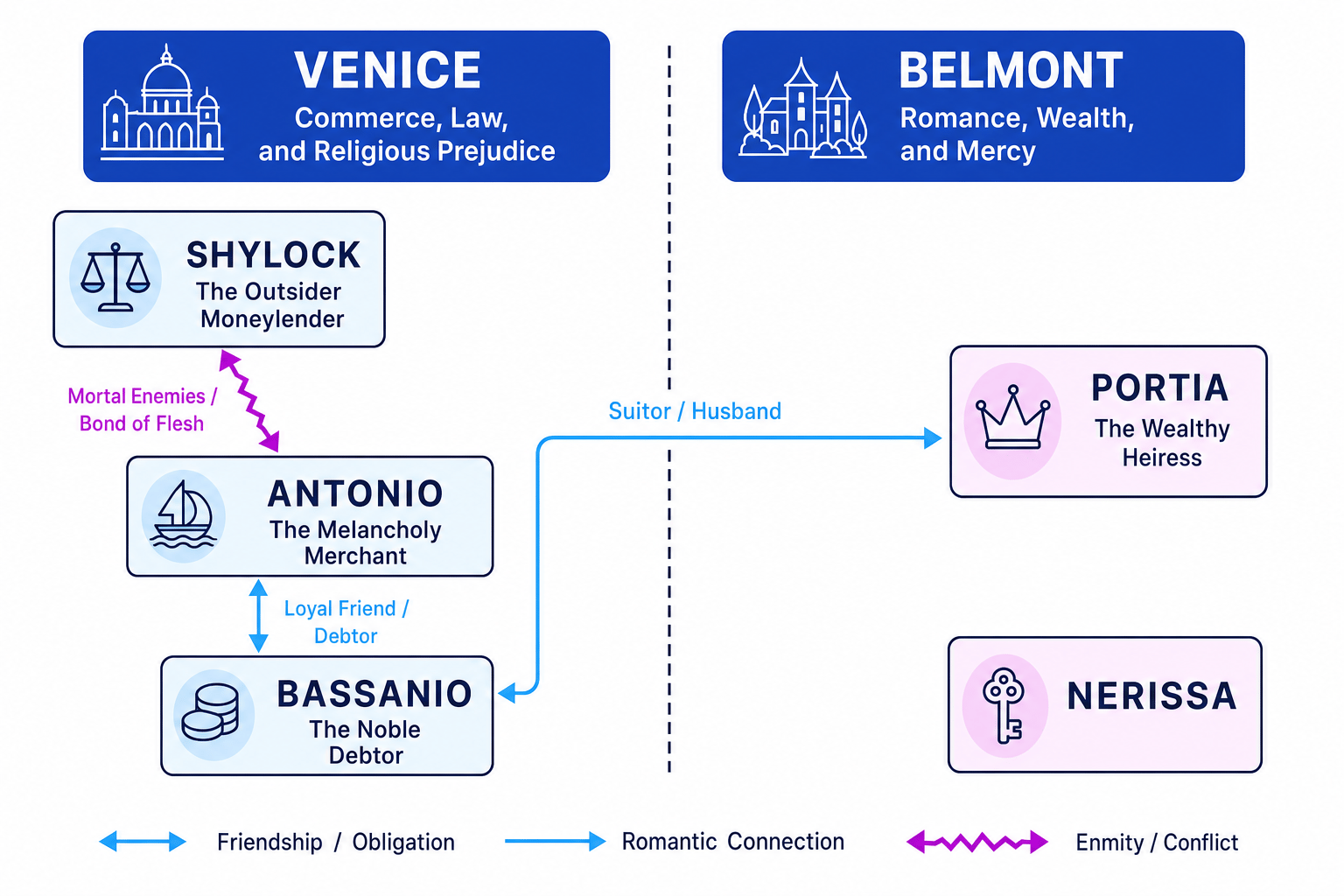
Understanding which "world" a character belongs to—and how they cross between them—is crucial to analyzing their dramatic purpose.
Shylock: Victim or Villain?
Shylock is one of Shakespeare’s most complex and controversial constructs. To an Elizabethan audience, he was a Jewish moneylender—a figure of suspicion and ridicule. To a modern audience, he can appear as a tragic victim of systematic prejudice. A high-scoring essay must explore this tension without oversimplifying him into just one role.
Shylock as the Villain
In many ways, Shylock is constructed to fit the anti-Semitic Elizabethan stereotype of the grasping, merciless usurer (someone who lends money at high interest rates).
- He values his contract over human life, demanding a "pound of flesh" (Act 1, Scene 3) from Antonio.
- When his daughter, Jessica, elopes with a Christian and steals his gold, Solanio reports that Shylock cried in the streets: "My daughter! O my ducats! O my daughter!" (Act 2, Scene 8). Shakespeare deliberately structures this report through a prejudiced Christian character to make Shylock look absurd, equating his love for his child with his love for money.
Shylock as the Victim
Conversely, Shakespeare gives Shylock some of the most humanizing and powerful lines in the play, challenging the audience’s prejudice.
- In Act 3, Scene 1, Shylock delivers his famous monologue: "Hath not a Jew eyes? Hath not a Jew hands, organs, dimensions, senses, affections, passions?"
- Here, Shylock uses a cumulative list of rhetorical questions to argue for shared humanity. He points out that Christian cruelty is the template for his own desire for revenge: "The villainy you teach me I will execute."
The Vicious Cycle of Prejudice
Shylock is a construct who shows how systematic oppression breeds a desire for vengeance. His malice is not innate; it is a mirror image of the Christian hypocrisy and abuse he has suffered at the hands of Venice.
Portia: Intellect, Illusion, and Agency
Portia is the wealthy heiress of Belmont. While she initially appears trapped by the patriarchal will of her dead father (the lottery of the three caskets), she emerges as the most powerful intellect and active force in the play.
The Limits of Gender
In Belmont, Portia’s agency is restricted. She complains to her maid, Nerissa: "I may neither choose whom I would, nor refuse whom I dislike; so is the will of a living daughter curbed by the will of a dead father" (Act 1, Scene 2). The word "curbed" highlights her feeling of imprisonment.
The Power of Disguise
To exercise real agency, Portia must leave Belmont and enter the masculine, legalistic world of Venice. She does this by transforming into Balthasar, a young male doctor of law.
- By adopting a male persona, Portia exposes the limitations of Venetian law and patriarchal authority.
- Her "Quality of Mercy" speech in the courtroom (Act 4, Scene 1) uses religious imagery to appeal to Shylock’s humanity: "It droppeth as the gentle rain from heaven / Upon the place beneath."
- However, when Shylock refuses to show mercy, Portia uses his own legalism against him, insisting on the literal wording of the bond ("no drop of blood"), which ultimately destroys him.
Portia is not a perfect hero
Do not write about Portia as a modern, flawless feminist hero. While she is incredibly smart and saves Antonio, she is also highly prejudiced. She makes racist remarks about her suitor, the Prince of Morocco ("Let all of his complexion choose me so"), and she ruthlessly strips Shylock of his wealth and identity in court.
Antonio: The Melancholy Merchant
Antonio is the titular "Merchant of Venice." He is characterized by unexplained sadness and intense devotion to Bassanio.
- His Melancholy: The play opens with Antonio stating: "In sooth, I know not why I am so sad" (Act 1, Scene 1). This unexplained melancholy has been interpreted by modern scholars as either a symptom of his mercantile anxieties or a sign of unrequited, homoerotic love for Bassanio.
- His Christian Hypocrisy: Antonio is a deeply loyal friend, willing to sign a deadly bond to fund Bassanio's courtship. Yet, he is also a cruel bully to Shylock. Shylock recalls how Antonio "did spit on me on Wednesday last" and called him a "dog" (Act 1, Scene 3). Antonio proudly replies: "I am as like to call thee so again."
Watch out for Christian hypocrisy
Always look for the gap between what the Christian characters preach (mercy, love, charity) and how they actually act toward outsiders like Shylock. Antonio is a prime example of this double standard.
Bassanio: Romantic Hero or Spendthrift?
Bassanio is Antonio’s close friend and Portia’s eventual husband.
- He is often presented as a romantic hero who successfully solves the casket riddle.
- However, Shakespeare also constructs him as an irresponsible spendthrift who views Portia primarily as a financial investment. In Act 1, Scene 1, when asking Antonio for a loan, he describes Portia as "a lady richly left" before mentioning her beauty or virtue. He treats his quest to win her as a gamble to pay off his debts.
Worked Example: Analyzing a Character Construct in a Key Passage
Let's look at how to construct a high-scoring analytical paragraph on Shylock’s character construct.
Suppose you get an exam question asking: "Explore how Shakespeare presents Shylock’s desire for revenge in Act 3, Scene 1."
Here is how you should build your analysis step-by-step.
Analyzing Shylock's desire for revenge
-
Formulate a clear thesis statement (AO1/AO3): State how the character construct represents a wider theme.
Draft: In Act 3, Scene 1, Shakespeare constructs Shylock not as a cartoonish villain, but as a product of Venetian Christian cruelty, suggesting that Shylock's thirst for revenge is a direct result of the systemic prejudice he experiences.
-
Embed a short, precise quotation and identify the writer’s methods (AO2): Focus on syntax, imagery, or form.
Draft: This is evident when Shylock demands: "If a Christian wrong a Jew, what should his sufferance be by Christian example? Why, revenge!" The use of the rhetorical question, followed immediately by the single-word exclamation "revenge!", creates an urgent, declarative tone that justifies his actions.
-
Analyze the linguistic and dramatic effects of the method (AO2): Explain how the language works on the audience.
Draft: By mirroring the noun "example" with the word "revenge," Shylock exposes the hypocrisy of Venetian society. He demonstrates that the "villainy" he plans to execute is not an inherent Jewish trait, but a direct lesson taught to him by his Christian oppressors.
-
Connect the analysis to context and the writer’s overall purpose (AO3): Why did Shakespeare write this?
Draft: To an Elizabethan audience, accustomed to viewing Jewish people as inherently malicious, this monologue would have been deeply provocative. Shakespeare uses Shylock’s speech to challenge contemporary prejudices, forcing the audience to recognize the shared humanity of the marginalized group and the moral failures of the Christian hegemony.
In the exam
- Treat characters as constructs: Always use the writer's name when discussing characters. Instead of "Shylock is angry," write "Shakespeare constructs Shylock's language to convey..."
- Balance your analysis: In any character question, make sure you show how different characters highlight each other's traits (e.g., how Antonio's melancholy contrasts with Bassanio's romantic idealism, or how Portia's mercy in theory contrasts with her ruthlessness in practice).
- Address context (AO3): Remember that the play is set in Venice but was written for an Elizabethan audience. Explain how characters like Shylock and Portia would have challenged or conformed to 16th-century English social anxieties regarding usury, foreigners, religion, and gender.
- Focus on structural shifts: Track how characters change. Shylock begins as a powerful, defiant figure in Act 1 but is reduced to a silent, broken man stripped of his faith and fortune by Act 4. Portia moves from a passive victim of her father's will in Belmont to a powerful arbiter of justice in Venice.
Check yourself
- Why does Shakespeare use the geographical contrast between Venice and Belmont to structure his character groups?
- What are three key quotations that show the complexity of Shylock as both a victim and a villain?
- How does Portia's behavior in the courtroom (Act 4, Scene 1) complicate her presentation as a symbol of Christian mercy?
