When Shelagh Delaney wrote A Taste of Honey in 1958, she wanted to showcase the real, unvarnished lives of working-class people in Salford. Instead of the polished, upper-class characters dominating British theatre at the time, Delaney populated her stage with marginalised individuals navigating poverty, race, sexuality, and fractured family structures.
Understanding these characters means looking past their surface flaws to see how Delaney uses them to critique 1950s British society.
What you'll learn
- How the combative mother-daughter dynamic between Jo and Helen drives the play’s cycle of neglect.
- How Geof and Jimmie act as catalysts for Jo's growth while challenging 1950s prejudices.
- How to analyse characters as dramatic constructs used by Delaney to critique post-war British society.
The Core Relationship Map
At the heart of the play is a web of unconventional, fragile relationships. Unlike traditional dramas of the 1950s, which centered on nuclear middle-class families, Delaney’s characters are bound by survival, loneliness, and fleeting moments of affection.
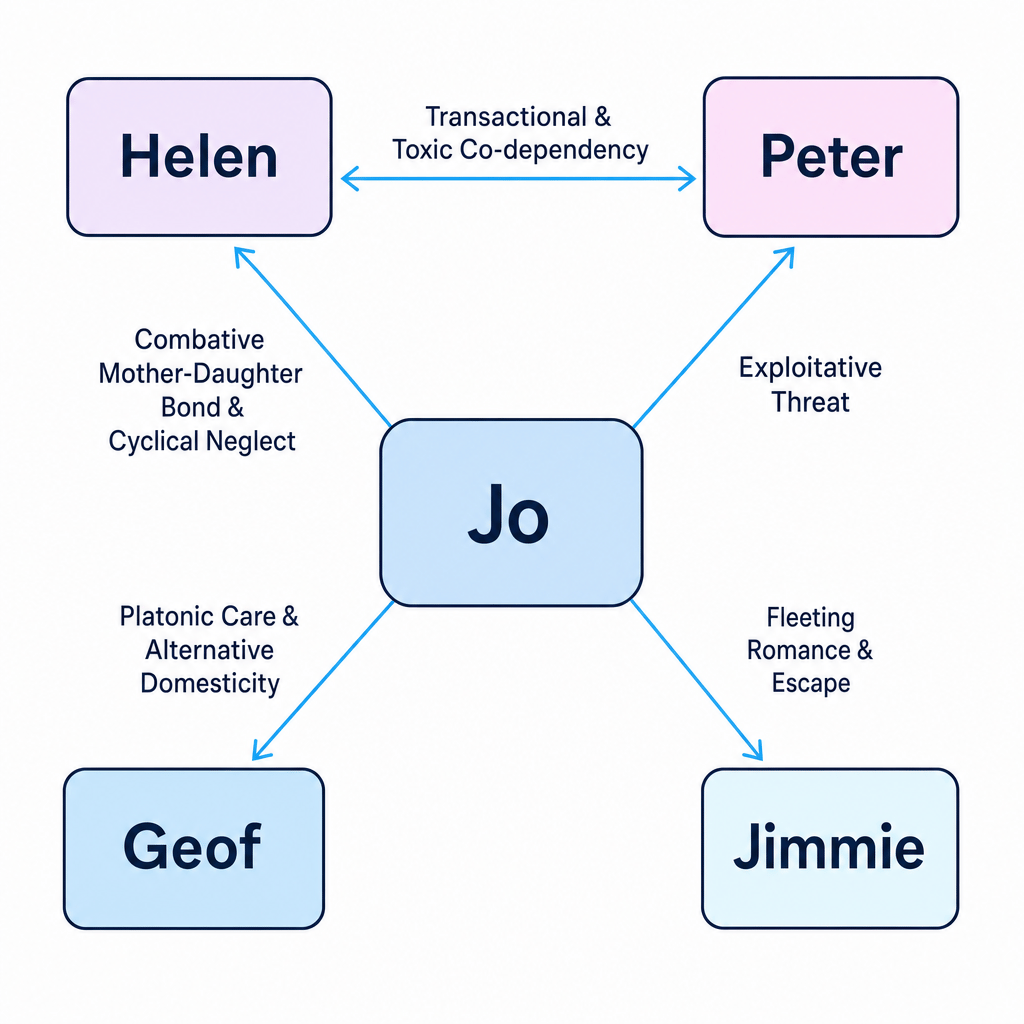
Jo: The Cynical Protagonist
Jo is a teenage girl on the cusp of adulthood. She is creative, sharp-tongued, and deeply vulnerable. Her character arc is defined by her search for security and her determination not to repeat her mother's mistakes—even though she frequently slips into the same patterns of behaviour.
Key Characteristics and Role
- Defiant but Needy: Jo shields herself from her mother’s neglect with sharp sarcasm, yet she constantly seeks reassurance. Her vulnerability is highlighted by her fear of the dark and her sudden retreats into childhood comfort.
- The Creative Escape: Jo's drawing and painting represent her desire for a life beyond the squalor of the Salford flat. However, her art is largely dismissed by Helen, illustrating the suppression of working-class potential.
- The Cycle of Motherhood: When Jo becomes pregnant, she faces the prospect of single motherhood, mirroring Helen’s own past. Delaney uses Jo to explore whether it is possible to break free from generational cycles of poverty and emotional detachment.
Kitchen Sink Drama
A cultural movement in 1950s and 1960s Britain that used social realism to depict the domestic lives of working-class characters living in cramped, rented accommodation, dealing with controversial themes such as abortion, poverty, and homosexuality.
Helen: The Survivalist Mother
Helen is Jo’s mother, a self-proclaimed "semi-demi-monde" who relies on men for financial survival. She is often viewed as a neglectful parent, yet Delaney writes her with a complex layer of pragmatism that prevents her from being a simple villain.
Key Characteristics and Role
- Transactional Survival: Helen views relationships through a purely financial lens. Her marriage to the younger, wealthier Peter is not driven by love, but by a desperate need for material security and an escape from her dingy flat.
- Emotional Neglect: Helen is consistently incapable of providing Jo with emotional warmth. She treats Jo more like a sister or a rival than a daughter, famously telling her, "I should have orf'd with him" when discussing Jo's father.
- Humour as a Shield: Helen uses music-hall style banter and quick-witted cynicism to deflect from her own regrets and aging.
The Cycle of Co-dependency
Despite their constant bickering, insults, and periods of separation, Jo and Helen are bound together. Their co-dependency stems from shared trauma and poverty; they cannot live comfortably together, but they cannot survive entirely apart.
Geof: The Untraditional Carer
Geoffrey is an art student who moves in with Jo after she is abandoned by both Helen and Jimmie. As a young homosexual man in 1950s Britain, Geof is a heavily marginalised figure, yet he represents the play's most nurturing and maternal presence.
Key Characteristics and Role
- Unconditional Support: Geof steps into the domestic role that Helen abandons. He cleans the flat, buys a wicker cradle for Jo’s baby, and offers her genuine, non-demanding physical affection.
- The Maternal Surrogate: Delaney subverts traditional gender roles by making a young, gay male character the primary nurturer. Geof’s domesticity contrasts sharply with Helen’s maternal coldness.
- Vulnerability under the Law: In 1958, homosexual acts were illegal in the UK. Geof’s housing insecurity and gentle, defensive nature reflect the constant threat of societal hostility and police persecution he faces.
Avoid Modern Lenses
When writing about Geof, remember that the word "gay" is never explicitly used in the play, as censorship laws under the Lord Chamberlain were highly restrictive in 1958. Delaney conveys Geof's sexuality through euphemisms and societal reactions, such as Helen calling him a "fairy" or "sister".
Jimmie (The Boy): Fleeting Romance and Escape
Jimmie is a Black sailor in the Royal Navy who proposes to Jo. Though his time on stage is brief, his presence has a profound structural and thematic impact on the play.
Key Characteristics and Role
- A Taste of Honey: Jimmie offers Jo her first genuine experience of romance, symbolized by the "toy ring" he gives her on a ribbon. This brief, sweet interlude is the "taste of honey" that gives the play its title.
- The Catalyst for Social Prejudice: Through Jimmie, Delaney exposes the deep-seated racial prejudices of post-war Britain. Helen's horrified reaction to the news of Jimmie’s race exposes the systemic bigotry of the era.
- The Transience of Escape: Jimmie’s departure back to sea leaves Jo pregnant and alone, demonstrating that romantic escapism cannot easily solve the material realities of working-class life.
Peter: The Threat of Dominant Masculinity
Peter is a wealthy, younger businessman who marries Helen. He represents the predatory, transactional aspects of the patriarchal society that surrounds Jo and Helen.
Key Characteristics and Role
- Aggressive Consumerism: Peter uses his money to control Helen, buying her things while demanding her absolute subservience. He treats women as possessions to be bought, used, and discarded.
- The Disruptive Force: Peter acts as a physical barrier between Jo and Helen. He actively drives a wedge between mother and daughter, ultimately forcing Jo out of Helen’s life to secure Helen for himself.
Viewing characters as real people
Do not write about these characters as if they are your friends or real historical figures. Always refer to them as dramatic constructs. Instead of writing "Helen is a bad mother because she leaves Jo," write "Delaney constructs Helen as a neglectful mother to expose how poverty forces working-class women to prioritise financial survival over maternal duty."
Worked Example: Analysing Character Dynamics
Let's walk through how to construct an analytical paragraph examining the relationship between Jo and Geof in Act 2, Scene 1, focusing on how Delaney subverts traditional domestic roles.
Analysing Jo and Geof's alternative domesticity
- Formulate a clear point linked to Delaney's dramatic purpose: Delaney constructs the relationship between Jo and Geof to challenge the traditional, nuclear family structure of the 1950s, presenting a platonic, queer-aligned partnership as far more nurturing than the heterosexual norm.
- Introduce and embed a precise quotation: This is evident when Geof takes on a maternal role, insisting on caring for the pregnant Jo and declaring, "You need somebody to love you while you're looking for someone to love."
- Analyse the language, form, or structural methods used: The repetition of the verb "love" emphasizes the emotional security Geof provides, contrasting sharply with the transactional relationships modeled by Helen and Peter. By utilizing simple, sincere prose dialogue, Delaney strips away the theatrical melodrama of the era, presenting their domestic intimacy as natural and wholesome.
- Link the analysis to the historical and social context (AO3): By placing a young homosexual man and an unmarried pregnant woman at the center of a domestic household, Delaney directly subverted the 1950s ideal of the nuclear family. At a time when homosexuality was criminalised, presenting Geof as the play's moral and maternal anchor was a radical political statement that exposed the hypocrisy of mainstream societal values.
In the exam
- Focus on the prompt: Whether the question is about one character (like Helen) or a relationship (like Jo and Helen), you must structure your essay around how that character helps convey Delaney's overall message about society.
- Weave context (AO3) into your character analysis: Do not dump historical facts in a separate paragraph. Connect Helen’s choices directly to the lack of welfare and financial options for women in the 1950s, or Geof’s domesticity to the persecution of queer individuals.
- Analyse structural transitions: Look at how characters change across the two acts. Contrast Jo's child-like dependency in Act 1 with her impending motherhood and cynical maturity in Act 2.
Check yourself
- Why does Delaney choose to make Geof—a young, gay man—the most maternal and domestic character in the play?
- How does the "toy ring" given by Jimmie symbolise both hope and the transience of Jo’s escape?
- In what ways does Helen's treatment of Jo reflect her own struggle for survival in a patriarchal, post-war society?
