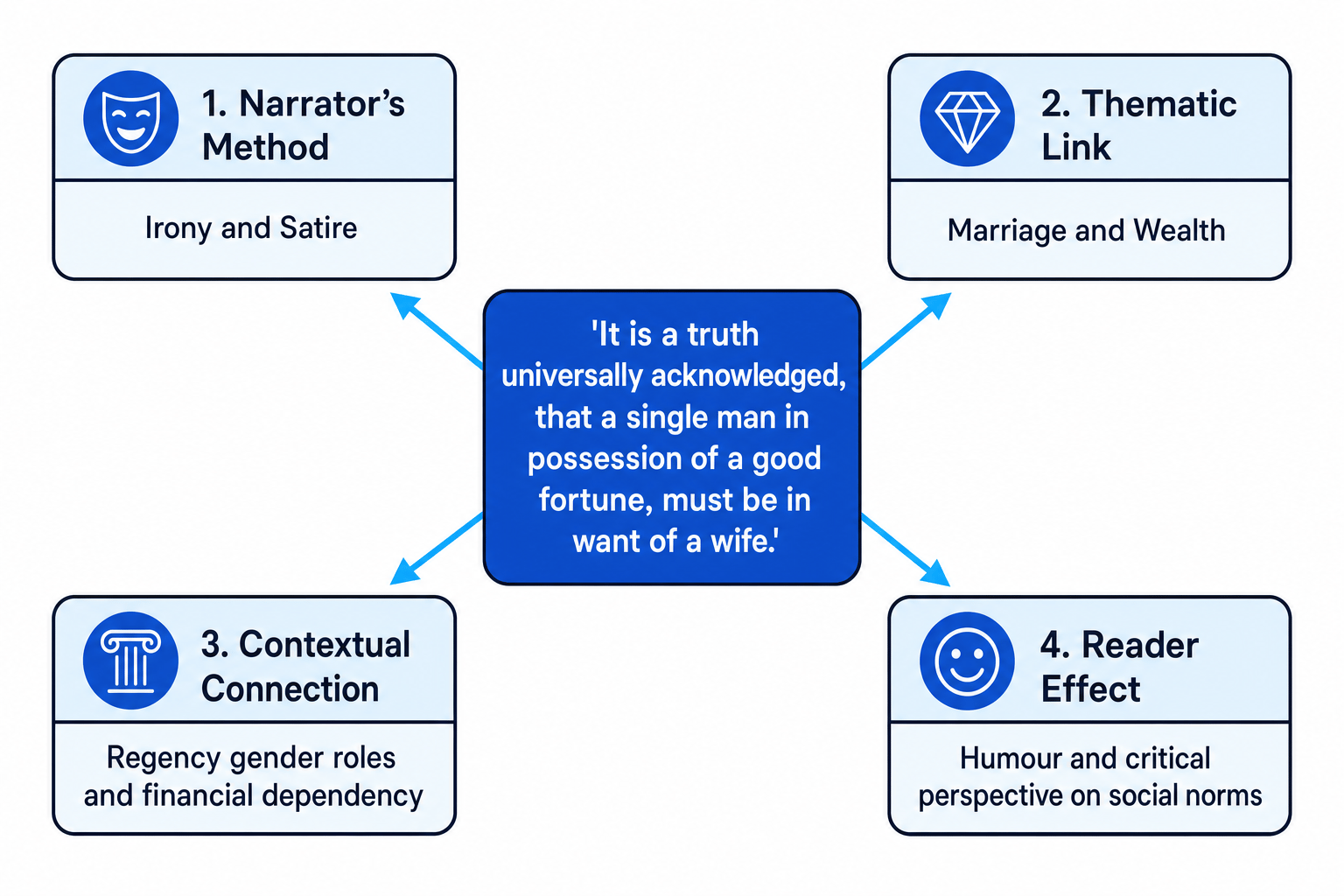
Essential Quotations by Theme
To write a top-grade essay, you should group your quotes by theme. This allows you to fluidly move between different parts of the novel when answering an exam question.
Theme 1: Pride, Class, and Social Snobbery
"She is tolerable; but not handsome enough to tempt me; and I am in no humour at present to give consequence to young ladies who are slighted by other men." (Mr. Darcy, Chapter 3)
- Context: Darcy speaks these words at the Meryton Assembly, establishing his initial role as the novel's antagonist.
- Analysis: The adjective "tolerable" reduces Elizabeth to an object on a scale of physical attractiveness, highlighting Darcy's aristocratic detachment. The verb "tempt" reveals his fear of losing control or compromising his high standards. By refusing to "give consequence" (social status or attention) to those "slighted" by others, Darcy displays his deep class prejudice and intellectual arrogance.
"He is a gentleman; I am a gentleman's daughter; so far we are equal." (Elizabeth Bennet, Chapter 56)
- Context: Elizabeth defends her right to marry Darcy during a fierce confrontation with his aristocratic aunt, Lady Catherine de Bourgh.
- Analysis: This is a crucial moment of female self-assertion. Elizabeth uses parallel syntax ("He is a gentleman; I am a gentleman's daughter") to dismantle Lady Catherine's complex class hierarchy. By asserting they are "equal", Elizabeth rejects the rigid, wealth-based class distinctions of the Regency era, arguing instead for a nobility based on personal character and moral standing.
Integrating Quotes Instantly
Never write: "A quote that shows Elizabeth is independent is, 'He is a gentleman; I am a gentleman's daughter.'" Instead, embed it: Elizabeth boldly confronts Lady Catherine's class snobbery by declaring that because she is a "gentleman’s daughter," she and Darcy are "equal."
Theme 2: Marriage, Practicality, and Love
"I am not romantic, you know. I never was. I ask only a comfortable home..." (Charlotte Lucas, Chapter 22)
- Context: Charlotte explains her sudden engagement to the absurd Mr. Collins to a shocked Elizabeth.
- Analysis: The adjective "romantic" here does not just mean loving; it implies unrealistic or idealistic. By rejecting romanticism, Charlotte acts as a pragmatic foil to Elizabeth's idealism. Her modest desire for a "comfortable home" reflects the harsh socio-economic reality for unmarried Regency women, for whom marriage was the only respectable avenue to financial security and survival.
Judging Charlotte Lucas too harshly
Many students write that Charlotte is greedy or cold. This misses the historical context! In Austen's time, an unmarried woman without an inheritance faced poverty or a life of dependency as a governess or poor relation. Charlotte's choice is a survival strategy, not greed.
"My affections and wishes are unchanged, but one word from you will silence me on this subject for ever." (Mr. Darcy, Chapter 58)
- Context: Darcy proposes to Elizabeth a second time, showing how much he has changed since his first, disastrous proposal.
- Analysis: This statement contrasts sharply with Darcy’s first proposal, which focused on how much he struggled against his better judgment to love her. The passive humility of "one word from you will silence me" demonstrates that Darcy has overcome his pride. He now respects Elizabeth's autonomy and power, showing that true love requires mutual respect and vulnerability.
Unpacking a Quote: Step-by-Step Analysis
Let us walk through how to build a high-scoring analytical paragraph using a micro-quote. We will analyze Darcy's reaction to Elizabeth's eyes, a recurring motif in the novel.
"But no sooner had he made it clear to himself and his friends that she had hardly a good feature in her face, than he began to find it was rendered uncommonly intelligent by the beautiful expression of her dark eyes." (Chapter 6)
Analyzing Darcy's change of perspective
Here is how to analyze this quote step-by-step to build a high-quality analytical paragraph:
-
State the point clearly, linking to the question and character development: Start by identifying how the quotation shows Darcy's transition from prejudice to attraction. Example: Austen uses Darcy’s shifting perception of Elizabeth's physical appearance to signal the breakdown of his cold, aristocratic detachment.
-
Embed the micro-quote naturally into your sentence: Avoid dropping the whole sentence into your essay. Isolate the key words. Example: Although Darcy initially insists that Elizabeth has "hardly a good feature in her face," he is quickly captivated by the "beautiful expression of her dark eyes."
-
Identify the literary method and zoom in on specific language: Identify the contrast and analyze the noun phrase. Example: The stark contrast between his critical assessment of her "features" and his sudden fascination with her "dark eyes" marks a shift from superficial social judgment to genuine, deeper interest. The adjective "dark" acts as a motif throughout the novel, symbolizing Elizabeth’s intellectual depth and moral clarity, which contrast with the shallow, bright glitter of the Bingley sisters.
-
Connect the analysis to the author's intent and context (AO3): Explain why Austen wrote this and how it fits the Regency context. Example: Through this, Austen suggests that true compatibility is rooted in intellectual equality rather than superficial physical attraction or financial suitability, challenging the traditional Regency marriage market which prioritized wealth and status over personal connection.
In the exam
- Prioritize short quotes: Memorize phrases of 2–5 words (e.g., "tolerable," "obstinate, headstrong girl," "comfortable home") rather than full lines. They are easier to remember and look more natural when embedded.
- Track character development through quotes: Choose quotes that show a change in perspective. For example, compare Darcy's early claim that Elizabeth is only "tolerable" with his later confession that she is "one of the handsomest women of my acquaintance."
- Always link language to context: When analyzing quotes about marriage (like Charlotte's or Mrs. Bennet's), always refer to the lack of legal rights and financial security for Regency women (entailment, lack of career options).
Check yourself
- Which quote best demonstrates Elizabeth's refusal to let class differences intimidate her when speaking to Lady Catherine?
- How does the opening sentence of the novel use irony to mock Regency expectations of marriage?
- What does Charlotte Lucas's desire for a "comfortable home" tell us about the social reality for middle-class women in nineteenth-century England?
